Chronicle Editor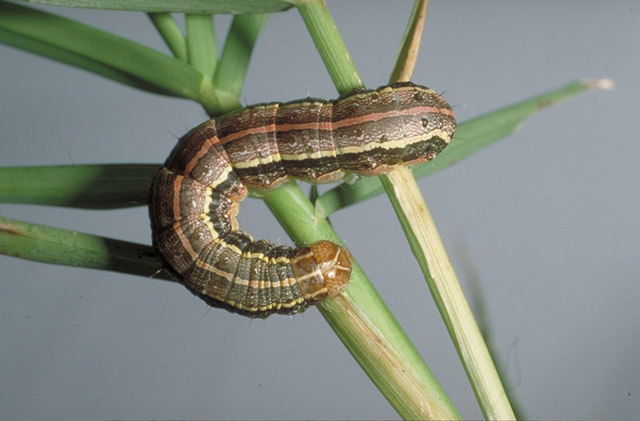
Patrick Chitumba , [email protected]
THE destructive African fall armyworm has spread to Gokwe North and South districts in the Midlands province where it is threatening farmer’s efforts and could cripple prospects of a good harvest.
Earlier armyworm outbreaks were reported in Mashonaland East, Mashonaland West, Mashonaland Central.
The pest presents a major threat to household and national food security, as it mainly attacks maize, sorghum and millet.
The armyworm is the larvae stage of a moth that is common across Southern Africa and is easily identified by the colour of its wings, which are dark brown with black spots, while hind wings are white with dark edges.
The migratory moths travel in multitudes and cover long distances during the night.
Midlands provincial agronomist, Mr Innocent Dzuke, confirmed the outbreak of African armyworm in the two Gokwe districts.
“In the Midlands province two districts have been affected by the African armyworm, which are Gokwe North and South,” he said.
Mr Dzuke said in Gokwe South District four wards have been affected by African armyworm. These are wards 10, 11, 23 and 24.
“Crops affected are maize, sorghum, finger millet and pastures. It is also being found in cotton but attacks grass weeds too,” he said.
Mr Dzuke said under sorghum 2,5ha had been affected, finger millet 0,176ha, pastures 1,32 ha, and maize 15ha.
“The department of migrant pests has issued 30kg of Carbaryl to Wards 10 and 11 for the control of African armyworm. Ward 23 and 24 will also be issued their Carbaryl,” he said.
In Gokwe North District, Mr Dzuke said Wards 3, 4, 28, 36, 10, 12 were the most affected by the armyworm.
“About 700ha are under threat from the African armyworm affecting 450 farmers. Maize, sorghum, grass, millet and rapoko had been affected,” he said.
Mr Dzuke said some farmers are spraying effectively but the outbreak needs chemical assistance.
The Ministry of Lands, Agriculture, Fisheries, Water and Rural Development through the Acting Director for the Migratory Pests Control Department, Mr Shingirayi Nyamutukwa, recently acknowledged receiving reports about the pests from four provinces as of December 25 last year.
The outbreak has come along with the devastation of a lot of crops and grazing pastures.
“As of today, a total of 164,5 hectares have been affected and a total of 54.83 hectares of sorghum, as well as less than one hectare of finger millet have been attacked by fall armyworm,” he said.
“In terms of pastures, we have at least 32 hectares that have been also damaged,” said Mr Nyamutukwa.
He said at least 234 farmers have been assisted with chemicals to support the Government’s efforts in fighting the armyworms.
“We have at least 234 farmers who we have assisted to acquire chemicals to control the armyworm and as the Government we have provided chemicals and we are currently assisting farmers on control,” said Mr Nyamutukwa.
He said the rains subsided, the problem of armyworms is predicted to spread if not monitored and urged farmers to practice religious scouting of their fields and report any signs of the worm to the nearest Agritex office for action to protect the crops since there is no more time for replanting.



 Online Reporter