admin
admin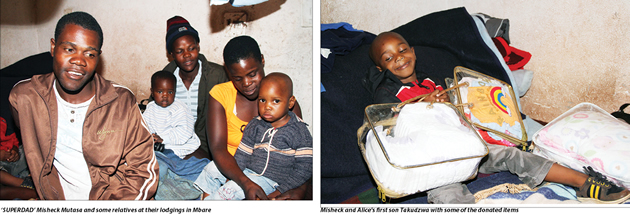
Dudzai Matewu and Stanley Mushava
DOWN Second Avenue in Mbare, a small room, stuffed up and heaving for air, in a house shared by six families, is home to a young couple, Misheck Mutasa (25) and Alice Nendanga (20) and their four-year-old son, Takudzwa.
A few weeks ago, Alice added to their family four more children when she delivered bouncing quadruplets — Sharline, Shanell, Shantel and Sharmaine through normal procedure at Harare Central Hospital.
The news was greeted with joy by the family, their neighbourhood and well-wishers who have unofficially changed the couple’s family name to “Baba naMai Four”, after their four “miracle babies.”
The couple’s immediate challenge, however, is providing for their children, given that Misheck, a vegetable vendor in Mbare, is not a man of significant means, while his wife is unemployed.
Alice is currently in hospital nursing her girls, pending the acquisition of conducive accommodation for the family.
The Herald tracked down the family to their home for a close-up with family members and neighbours.
Present at the “house” were the quadruplets’ two aunts, Maria (30), thankfully resident within close proximity in Magaba, Mbare, and Tracy (28) who travelled all the way from Marange to share the joy and help her in-law.
Also present was Alice’s mother, Rozai Nendanga (46) who had travelled from Buhera to help her daughter nurse her “quads.”
The room was more jam-packed as Aunt Maria had brought along her two babies since she could not leave them in anyone’s custody back home in Marange.
Aunt Tracy had also brought along a baby.
There were, as such, eight people in the small room when we arrived and we raised the number to 11.
Contrary to custom, Misheck is being forced by circumstances to sleep in the same room with his mother-in-law and sisters for lack of alternative accommodation.
Space woes were worsened by donations from well-wishers, which were randomly perched on the wardrobe, the bed, the display cabinet.
So far the couple has received donations worth hundreds of dollars including pampers, clothing, wrappers and cash.
In the room a disused sink is used to shelve dishes.
Babies’ booties were spread on the rim of a bucket to dry besides kitchenware on the sink.
A dysfunctional two-plate stove shared the pushing-tray with pots besides a make-do primus stove borrowed from the landlady.
Despite the humble means, it is clear that love is all over the room.
A plaque with the inscription “We can share everything but not my husband” and pictures of the love-birds is framed on the wall.
Misheck, visibly overjoyed like “Mr Lion” in “Mind in Turmoil,” expressed optimism that he would be able to secure a more gainful job to provide for his family.
“With the arrival of our lovely girls, I am now supposed to find a different means of livelihood so that we can have spacious accommodation and healthy food,” Misheck said.
“Things were already hard, and honestly we had just prepared for one more child when the scan showed that we were getting more than we bargained for.
“However, God’s ways are not our ways and we believe just as he blessed us with our daughters, he will also provide the means for us to give them a good life,” he said.
Misheck teams up with four fellow vendors to buy a ticket for a stall at a market informally known as “Kumakoronyera” in Mbare.
“I usually sell green pepper, peas and onions.
“The market opens from 6am to 11:30am daily.
“Profits fluctuate but on a lucky day, I can get as much as $7,” he said.
Misheck’s sister, Tracy, interjected to explain that things were hard since “Baba Four” had dropped out of school when he was in Grade 6.
“It was tough for us from a young age.
“Our father attended a white-garment sect and did not see the value of educating his children.
“None of us ever went to school up to Grade 7.
“Our father had five wives. Our mother was the second wife and she had six children.
“Life was hard because even though Baba was working in Harare, we never got to spend a cent of the money he made.
“All he ever did with his money, besides spending it by himself in Harare, was to send bus fare for a wife whom he would be favouring at that moment to join him in Harare or to go to a church conference,” Tracy said.
Misheck bemoaned the lack of unity with his brothers, whom he said were not showing up when he needed a filial hand in his situation.
“Maybe it’s poverty.
“We are all struggling. But I was expecting that my brothers would be able to chip in and help me with the situation.
“Only one of my brothers visited my wife in the hospital,” he said.
Mbuya Rozaria said Alice’s situation was peculiar since no one in living memory had achieved such a maternal feat within her range.
“We don’t know of anyone both from my family tree and her father’s who had quadruplets. It’s a first. Only her aunt, Alice Mugumisi, from her father’s side, had twins. Three sets, actually,” she said.
Apparently, 20-year-old Alice “took her namesake’s hand.”
Four-year-old Takudzwa, the first of five siblings, did not manage words but was all smiles. His father explained that he was yet to go to crèche because he does not have a birth certificate.
“His mother did not have a National Identity card up until the birth of the ‘quads.’
“Even then, her uncle had to come from Buhera to act as her guardian since no one from her father’s side could perform the function,” he said.
Alice’s father is late while the whereabouts of her uncles are as known as the whereabouts of flight MH370.
As such, Alice ended up stuck with her maternal uncle’s surname “Nendanga” instead of her paternal surname “Mugumisi.”
As to how many children they were originally intent on having, Misheck said they were never conclusive about the issue.
“We both hinted at two.
“Sometimes I suggested six but Alice would exclaim ‘Six?
“What do we give them?’ I would say it was for the appointed time; if our fortunes changed and we had money enough and to spare,” Misheck said.
Misheck and Alice met and fell head over heels with each other at the house of Misheck’s late aunt.
“I was staying with my mother’s young sister along Sanyanga Road and Alice was her maid.
“Mainini was the one who brought me into the vending business and gave me a ‘start’ in life. Sadly, she passed away in 2007. I started staying with my other aunt but could never bring myself to forget Alice even though we had last seen each other at aunt’s funeral.
“I revived communication with her since I had her new address,” he said.
One thing led to another, with Misheck becoming a less lonely man shortly afterwards.
Landlady Fungisai Matsekere (30), was equally shocked to hear the news of the four babies.
“Five kids in one room?
“It’s going to be hard for the family, going forward.
“I think people should chip in and help Baba Taku, considering that his job is not that gainful for him to afford two rooms at the moment.”
“Baba Taku” said he was limited by his “little education” but would be happy to land a job with the council.
“Anything at the council would do.
“I wouldn’t mind even sweeping.
“I would also love to don the municipal police uniform and chase away street vendors,” he said jokingly.
“We were shocked by the size of the pregnancy and we started to assume that Alice confused ‘her days,’” Tete Maria said.
“We thought the doctor was lying when she went for a scan.
“I could not process it. I said to my wife, ‘It would have been a better lie if the fellow had said twins, not quads,’” Baba Taku interjected.
Tete Maria said her dress-making skills would come in handy as she would make clothes for her nieces.



 Online Reporter