Online Reporter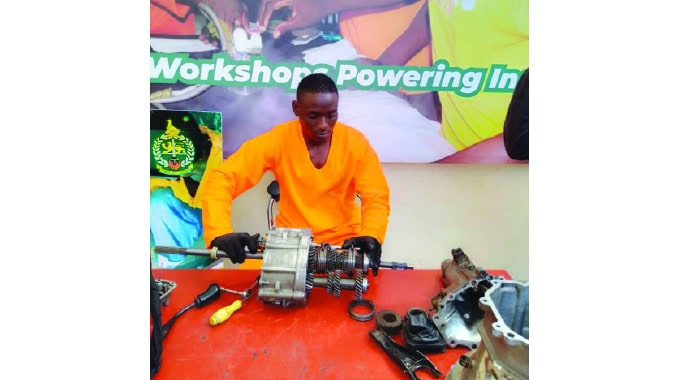
Givemore Muzariri
Serving an eight-year sentence at Khami Prison for attempted murder, committed when he struck another man on the forehead with a beer bottle during a nightclub altercation, Rivaldo Khumalo (24) is grateful to the Zimbabwe Prisons and Correctional Service (ZPCS) for its rehabilitative approach.
Adopted in 2013, this progressive programme has been instrumental in equipping countless inmates with vital life skills and career pathways, fostering their development even while behind bars and preparing them for a productive life on release.
Khumalo was part of the ZPCS team that exhibited a variety of products from prison workshops, including welding, carpentry, and motor mechanics, at the 65th Zimbabwe International Trade Fair in Bulawayo.
“I would like to thank the management of Zimbabwe Prisons and Correctional Service for adopting a transformative approach which emphasised rehabilitation of inmates, intending to turn them into productive citizens when they go back to their communities,” Khumalo stated, his voice filled with sincerity as he reflected on the impact of these initiatives.
He recounted the incident that led to his incarceration at the age of 22, following a nightclub altercation sparked by a misunderstanding over a beer bottle on a pool table.
“While still trying to understand what was going on, the guy started pushing me, insulting me, and quickly, I thought of taking my bottle from the table. While still in shock, he slapped me, so I hit him with the bottle that was in my hand in self-defence.”
The victim sustained severe head injuries.
“When I used this bottle, I never thought it was going to really affect this guy, but from the medical examinations carried out by the doctors, it showed that he had been affected mentally,” he admitted, acknowledging the devastating consequences of his actions.
He was sentenced to ten years, with two years suspended for continuing good behaviour after his release. Upon arrival at Khami, Khumalo initially struggled.
“At first, I thought this was the end of my life, but with time, I discovered that it was actually a good place to correct one’s life.”
This shift in mindset proved crucial. Observing other inmates actively engaged in learning trades and pursuing education inspired him to seek his own path to self-improvement.
Within three months of incarceration, Khumalo chose to channel his energy into something constructive. He enrolled in a motor mechanics class, driven by a long standing interest in vehicles and the practical nature of the trade. The learning environment was unique and highly motivating. He was taught by experienced fellow inmates who had honed their skills over years in the prison workshops. This peer-to-peer mentorship not only provided technical knowledge but also fostered a strong sense of community and shared purpose.
Khumalo completed his theoretical lessons and quickly progressed to hands-on experience, working as an attaché in the prison workshop. There, he had the invaluable opportunity to service various vehicles, sharpening his diagnostic and repair skills across a range of automotive issues.
He has since registered for his Class Three trade test, a significant step towards formal qualification. His ultimate goal is to become a Class One journeyman mechanic, a highly skilled and sought-after certification. He has chosen to specialise in gearboxes.
“Right now, I am working on perfecting my skill in the area of gearboxes because I realised that a lot of mechanics out there don’t really understand the dynamics of gearboxes, so that is going to be my area of specialisation. I know that a lot of people really need that service.”
This strategic focus reflects not only his dedication to his craft but also a sharp entrepreneurial instinct—even from within prison walls.
Khumalo extended heartfelt thanks to his family for their unwavering support throughout his incarceration. Despite the disappointment his actions caused, they have remained a pillar of strength, visiting him and even purchasing essential tools for his upcoming practical trade tests. This tangible support has reinforced his determination to succeed.
“With that support, I am promising them that once I come back home, I am going to be the best in terms of behaviour, considering that a lot of people will be judging me.”
He is acutely aware of the societal scrutiny he will face upon release and is committed to proving his rehabilitation through his conduct and contributions.
Khumalo passionately urged fellow inmates to embrace the rehabilitation opportunities offered by ZPCS. He views these programmes as vital empowerment tools and a crucial “fall back plan” for life after prison.
“I would like to take this opportunity to encourage inmates like me to look for a career they could develop whilst in prison so that it becomes a fall back plan once their jail terms expire.”
He believes that by acquiring skills, inmates can become productive members of society, contributing to national development and helping to break the cycle of crime.
“This is more of an empowerment programme so that we can contribute to the development of our nation, which requires everyone to play a part as we work towards the attainment of Vision 2030.”
Khumalo also made a broader societal appeal, calling for a review of policies that, in his view, unfairly discriminate against ex-convicts. He argued that current regulations by many firms barring individuals with criminal records from employment create significant barriers to reintegration and perpetuate marginalisation.
“Some of the policies that we have as a nation should be reviewed to try and involve everyone in the development of the nation. As we speak, there is a policy that does not allow the employment of people with criminal records.”
He suggested that such policies, possibly inherited from the colonial era, are outdated and need to be re-evaluated.
“If this policy was introduced during the colonial era, it’s high time we do away with it and come up with a policy that promotes unity amongst ourselves as a nation, with the aim of not leaving anyone or any community behind as we move forward.”
Khumalo’s transformation from a young offender to a skilled tradesman and vocal advocate underscores the profound impact of rehabilitation. His story is not only one of personal redemption but also a powerful call for a more inclusive and compassionate society.