

 admin
admin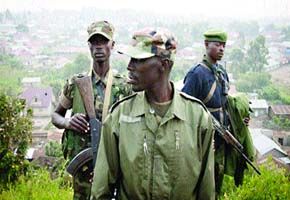
However, high-powered regionally fuelled diplomatic pressure compelled the armed rebels, most of whom are Tutsis, to withdraw from the town, making it possible for DRC national defence forces to re-occupy or to prepare to do so sooner or later.
Earlier, DRC soldiers and those of the United Nations peace-keeping force had packed up their military bags and luggage and left the town without firing a shot as M23 rebels advanced, their AK rifles spitting deadly fire.
The socio-political scenario in the DRC’s eastern area and the Great Lakes region has more or less ethnically polarised into Tutsi versus Bantu situation. The Tutsis are of Nilotic origin. Their ancestors drifted southwards from the Ethiopian highlands in about the 15th and 16th centuries in search of pasture for their herds and eventually settled in Rwanda/Burundi where they defeated the BaHutu, a Bantu people, who had themselves seized the area from the pygmies. Some Tutsis settled in the eastern Congo. Rwanda, Burundi and Uganda, DRC and Tanzania and to a less extent Zambia as well as Malawi and even South Sudan lie in what we may loosely call the Great Lakes if we use that expression in a wider geo-politico sense.
The DRC has been a politico-military boiling cauldron since 30 June 1960 when the country became independent and its former colonial master, Belgium, pulled out. We in Southern Rhodesia (now Zimbabwe) had heard very little about the politics of the vast country until just about that date when such names as Kasavubvu, Tshombe, Joseph Desire Mobutu and, of course, the unforgettable Pan-Africanist Patrice Lumumba began to feature regularly in our print and other media.
Before then, all we knew about the Belgium Congo (as it was then called) was that it produced a lot of diamonds, wild rubber and that somewhere in that country there was a place called Mukambo where fairly cheap second hand clothes were sold by black people in the open air.
Be that as it was the Congo burst into the world’s political scene on attaining its independence with a tragically deafening din. No sooner had it become independent than a man called Moise Tshombe of the Lunda tribe declared his home territory, Katanga, independent of the rest of the new nation. It was most interesting to note that the Luba people had a century or so earlier broken off Lunda from an empire of the Lunda to establish their own kingdom in the western section of Katanga.
Tshombe who was married to a daughter of the senior Lunda chief declared himself the president of the secessionist Katanga, an incredibly mineral-rich area with large Belgian mines.
Some Kasai based political leaders tried to imitate Tshombe’s lead by also declaring their home area independent of the national administration whose prime minister was the indefatigable Lumumba.
It took the global military efforts of the United Nations to put down all those rebellious micro-states. Hundreds of thousands of human lives were lost in the process. Lumumba and two of his cabinet ministers were among those who paid the ultimate price.
Three major factors are the cause of the continuous political turmoil in the DRC, greed fuels a great many of the uprisings in the DRC, a heightened sense of ethnocentrism (tribalism) is the other factor, the third is endemic corruption which is taken advantage of by some western and even oriental fortune-seekers and other unscrupulous moguls to subvert the established state.
The DRC is very rich in natural resources; it is by far the richest country in this regard in the African continent. Greedy leaders see no reason for not seizing rich areas, localities as well as regions for their own personal selves.
The sense of nationhood is wanting in many DRC political organisations. What prevails in most of them is obviously a self-serving urge. Those involved in this identify and group themselves either regionally or ethnically. Leaders of such political parties are ethno-nationalists whose main objective is to establish micro-nations as opposed to macro-nations forcibly created by imperial powers.
The DRC is a very good example of that socio-political historical phenomenon which brought several relatively prosperous states together to form the Belgian Congo. Among those kingdoms were Makoko, Loango and Kongo.
Kongo had actually defeated the other two kingdoms and turned them into tributaries that submitted to the Mani-Kongo, the supreme ruler of the Kongo kingdom.
Loango lay on the northern bank of the river Congo with the ocean washing its western shoreline. To the south of that river were the kingdoms of Kongo whose southern neighbour was the Matamba kingdom one of whose prominent rulers was the feared Queen Nzinga who ruled from 1624 to 1663.
It is interesting to remember that for Queen Nzinga to get onto the Matamba throne she killed her rivals one of whom was her nephew whose heart she ate. She later lightly associated with the Christian faith propagated in the area by Portuguese Roman Catholics.
South of the Matamba kingdom was that of Ndongo, and to the east was that of Kasanje to the east of which was the Lunda kingdom. Bailundu and then Kwanhama kingdoms lay further to the South towards the Kunene river near what later became Angola.
Angola got its name from N’gola, king of Mbundu one of the tribal kingdoms in the region. He was not as militarily powerful as Mani-Kongo (lord of the Kongo), and was soon defeated by the Maniputo (lord of Portugal) but thereafter gave the entire territory his name — Angola.
Meanwhile, further north across the river Congo waves and waves of Nilotic people and Sudan communities pushed Bantu groups southwards.
The Sudanics were mainly those of Mobutu Sese Seko’s Ngbandi, and also the Mbanja and the Ngbaka all of whom had been displaced from the land of black people (the Sudan) by roving slave-hunting Arabs from mostly Oman.
These Sudanic tribes were collectively called Moru-Mangbetu. They settled in the Ouele region.
The Nilotics had come from mostly the source of the Blue Nile on the Ethiopian Highlands. Among them are the Tutsis who comprise the majority of the M23 command and political leadership.
Other Nilotic tribes are the Lugbara and the Alur. These people from the north established kingdoms in the northern and eastern savanna lands of what is now called the DRC.
To their south was the Kuba (Bantu) kingdom, which existed before the recent Zande and Mangbetu principalities.
Mwanta Kazembe’s sprawling empire lay further south, a territory that included the Shaba province, formally called Kangata.
In the central region of this vast equatorial region were many other mini-kingdoms. Some were of the Kasai and were headed by their respective balopwe, an equivalent of king.
This is the brief history of socio-political background covering roughly the period ranging from about the 15th to the 19th centuries when Belgium colonially occupied the land, pushing the Portuguese south wards into Angola.
The continuing revolts and other turbulent anti-state occurrences are obviously caused by social, cultural, political conflicts and contradictions in that administratively unwieldy country whose area is a staggering 1 400 800 square kilometers with the population of nearly 60 million. One of the causes of conflict in the DRC is that nation’s almost incomparable level of corruption.
A visitor to the DRC meets corruption right from the point of entry to the hotel room as he or she has to pay a bribe for every service or friendly gesture shown by the immigration and customers — officials, porters, taxi-drivers, hotel porters, receptionists and any other person involved in receiving him or her.
The national administration is permeated through by corrupt practices whose immediate purpose is the enrichment of those on the receiving end.
During the days when the flamboyant president Mobutu Sese Seko Kuku Ngbedu Waza Banga, people from his home region dominated the country’s administration, and made hay while the sun shone.
Mobutu was then without doubt the richest person in Africa. In the last four months of 1976, he was very strongly rumoured to have outbid a member of the British royalty to buy an old stone-built castle in Switzerland.
Whether or not the rumour was well or ill founded, the man was certainly living on cloud nine. But the overwhelming majority of the DRC people were grovelling under grinding poverty. That situation created massive disaffection and anger, leading to revolt against his administration. It eventually fell and he died as a miserable refugee in an isolated desert villa in Morocco.
However, the revolt continued in some parts of the country. Rebels assumed various name tags, from Mai Mai to the current M23. Military intervention by friendly nations such as Zimbabwe, Angola and Namibia brought only temporary relief to the Kinshasa government.
The question about the DRC is: what can and should be done to solve and or stabilise the situation?
It is a matter of historical record that two types of government have failed in the DRC. One has been a highly centralised administration that obtained under Mobutu; the other was some loose federal system.
The federal type of government was tried in the initial period of the country’s independence. The president was then the ex-seminarian, the taciturn Joseph Kasavubu. It obviously failed.
Presently the DRC seems to be faced with one choice or the other of the following choices: a thoroughly devolved system that will deposit most power in either provinces or component state or a complete breakup of the entire country that is the DRC as we know it today, resulting in the birth of new independent sovereign states similar in historical background to south Sudan. The first suggestion will leave the DRC as created by the Belgian colonialists intact with Kinshasa continuing as the national seat of power. That will be in keeping with the principles and aspirations of micro-nationalists such as Patrice Lumumba, Kwame Nkrumah, Joshua Nkomo, Julius Nyerere, Modibo Keita, Kenneth Kaunda, Sekou Toure and the other pioneer Pan Africanists.
Devolution would provincialise and localise both power and whatever complaints people have with the DRC states it would localise social economic, cultural development rather than nationalise as does the current type of government.
Under a devolved type of government, the Tutsi in the DRC’s eastern region could sort out their fears and frustrations without rebelling against Kinshasa. They could run or mis-run their own issues without using armed forces. The same will prevail elsewhere and the proper and responsible exploitation of natural resources would generate a nationally healthy, competitive spirit.
The second option might be based on the DRC’s historical mini-states. This is generally supported by ethno-nationalists and proponents of micro-states. It would be adopted as a last resort by the communities that feel persecuted, politically disadvantaged, marginalised, neglected, culturally threatened or economically deprived. While tribalism may support the creation of such micro-states, it seems that inter-ethnic hostilities could erupt over such matters as state boundaries and natural resources, turning the whole country if not the region, into a slaughter-house particularly in the DRC.
What happened a couple of months after the country’s attainment of independence was a shocking eye opener. So much human blood flowed in the DRC up to 1964. That should continue to serve as a reminder especially to the African Union to arrest the situation now for tomorrow may be too late.
l Saul Gwakuba Ndlovu is a Bulawayo-based retired journalist. He can contacted either on cell 0734 328136 or through Email [email protected].



 derick.khumalo
 Online Reporter