

 admin
admin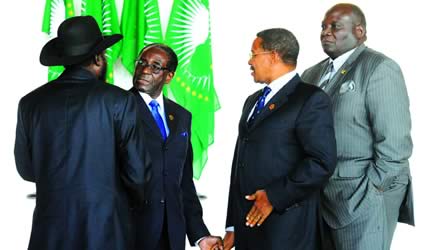
situation in the Great Lakes region, particularly the eastern part of the Democratic Republic of Congo, and political developments in Madagascar.
President Mugabe attended the meeting.
Sources who attended the meeting said no issue related to Zimbabwe was discussed.
Parties in the inclusive Government recently resolved the impasse that had stymied the constitution-making process, paving way for elections scheduled for this year.
Despite this breakthrough several Zimbabwean civil society groups deployed representatives to the Ethiopian capital in a bid to misrepresent the situation and lobby for Zimbabwe’s inclusion on the summit agenda.
The representatives were, however, left with egg on their faces after their calls were ignored.
In an interview with a local daily here yesterday, Crisis in Zimbabwe Coalition programmes manager Nixon Nyikadzi-no said: “We are surprised by the absence of Zimbabwe on the AU agenda.
The Sadc leaders, however, felt that the DRC and Madagascar were more pressing issues for the region.
Sadc Troika members Presi-dent Jakaya Kikwete of Tanzania, Hifikepunye Pohamba of Namibia, Jacob Zuma of South Africa and other regional leaders also attended the meeting.
The Sadc Organ on Politics, Defence and Security Co-operation and the AU’s Peace and Security Council were expected to make presentations on the two regional flashpoints to the African leaders.
The leaders were meeting behind closed doors last night to consider various reports.
Officially opening the summit earlier yesterday morning, African Union Commission chair Dr Nkosazana Dlamini-Zuma said the summit would mainly focus on conflict resolution particularly focusing on situations in Mali, Somalia, DRC, Central African Republic, Darfur, Comoros, Sudan/South Sudan, Madagascar, Western Sahara and the Sahel region.
She said there was need to accelerate the operationalisation of the African Stand-by Force and other mechanisms to enable the union to quickly respond to situations such as the one obtaining in Mali.
Rebel groups recently intensified attacks against the Mali government position before the intervention of French forces.
“We cannot over-emphasise the need for peace and security. Without peace and security, no country or region can expect to achieve prosperity for all its citizens.
“While we are proud of the progress made in expanding and consolidating peace and security on the continent, we also acknowledge that much still needs to be done to resolve ongoing, renewed and new conflict situations in a number of countries,” said Dr Dlamini-Zuma.
Outgoing AU chairperson and Benin President Boni Yayi also stressed the need to quickly establish a continental force to deal with conflict situations.
He deplored the slow reaction of Africa to the Mali crisis as rebels threatened to overrun government held positions before France intervened.
Mr Yayi said African countries, especially regional neighbours under ECOWAS, should have been the first to intervene in Mali before the arrival of the French forces.
United Nations secretary-general Mr Ban Ki-Moon who also spoke during the opening ceremony said the world body was actively working in partnership with the AU to bring greater stability to Africa, especially in the Great Lakes region.
“The UN, AU and others are working together in the Democratic Republic of Congo. On the sidelines of this summit, I hope the regional leaders will endorse a peace and security cooperation framework to address the structural causes of the recurring cycles of violence.
“The UN mission, MONUSCO, is doing everything possible to protect civilians. We are considering establishing a peace enforcement capacity within the mission to address the threat of armed groups in eastern DRC,” said Mr Ban Ki-Moon.
Meanwhile, new Ethiopian Prime Minister Hailemariam Dessalegn was elected the new African Union chair, taking over from Mr Yayi whose one-year tenure ended yesterday.
Mr Dessalegn was recently elected prime minister following the death last year of Mr Meles Zenawi.
In his acceptance speech, Mr Dessalegn said he was committed to working in consultation and coordination with member states, the AU Commission and other organs to advance the objectives of the union.
He said as Africa celebrated 50 years of unity, the continent should special tribute to the generations of Pan-Africanists and founding fathers of the Organisation of African Unity who strived to promote solidarity, cohesion and cooperation.
Mr Dessalegn said in spite of the global economic crisis, Africa had managed to register robust economic growth in the past ten years making it a new pole of global growth.



 Online Reporter