admin
admin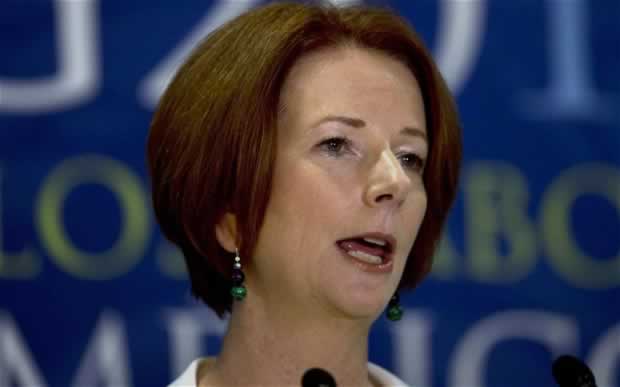
Patrick O’Connor
THE Australian Labour Party was thrown out of office in last Saturday’s national election, having suffered its lowest vote in 110 years, following an election in which none of the fundamental issues confronting millions of ordinary working people — the drive to war, the deepening assault on jobs and living standards and escalating attacks on democratic rights — was raised, let alone addressed.
The vote was not a reflection of overwhelming support for the Liberal-National Coalition, which was returned to office, but the outcome of widespread anger and disgust felt by broad layers of the population after six years of Labour government.
The only explanation offered by the Australian media and political establishment for Labour’s defeat was that it resulted from personality clashes and bitter internecine feuding between the two party leaders, Kevin Rudd and Julia Gillard. In fact, the inner-party struggles were themselves bound up with the intense pressures generated by rising geo-political tensions and the impact of the most severe world economic crisis since the 1930s.
In the immediate wake of the 2008-09 global financial crisis, the Australian economy had been relatively shielded from the economic consequences by continuing demand, particularly from China, for its mineral exports. But the basic dilemma confronting the Australian ruling class — between its economic reliance on China, on the one hand, and its strategic dependence on the US, on the other — only intensified as the Obama administration initiated its aggressive “pivot to Asia” against Beijing.
As the mining boom unravels, big business is now demanding a wholesale restructuring of the Australian economy at the direct expense of the working class.
It is these fundamental contradictions that have fuelled the unprecedented political turmoil of the past six years. In November 2007, the former conservative Howard government lost office after suffering the second largest electoral rout in the post-World War II period. Labour won office with a 6,1 percent positive “swing”, while a sitting prime minister lost his own seat for the first time since 1929.
Just over two and a half years later, in June 2010, the new Labour Prime Minister, Kevin Rudd, was ousted in an overnight inner-party coup orchestrated by Labour and union factional leaders closely aligned with the US embassy.
This was the only time a Labour leader had ever been ousted in his first term. Rudd had alienated Washington by making proposals to ease US-China tensions and was closely associated with Labour’s stimulus spending measures, initiated in the aftermath of the collapse of Lehman Bros in order to bail out the banks and big business.
However, popular hostility to the anti-democratic ousting of Rudd resulted in near-defeat for his replacement, Rudd’s former deputy, Julia Gillard.
The August 2010 election resulted in the first hung parliament in 70 years, with neither of the major parties able to secure a majority.
Gillard formed a highly unstable minority government with the backing of the Greens and rural independents and proceeded to implement the agenda demanded by her backers.
Unconditionally embracing the Obama administration’s “pivot” to Asia, Gillard agreed to station US Marines in Darwin and open up other Australian bases to the American military.
She also junked Rudd’s stimulus measures and imposed a budget schedule of permanent cuts. But her involvement in the 2010 coup continued to plague Gillard and, as her government’s right-wing policies generated deep anger in the working class, her popularity sank to record lows.
Facing the prospect of the Labour Party being reduced to a tiny parliamentary rump, Gillard’s colleagues decided to remove her from office, just weeks before the September 2013 federal election, and replace her with Rudd, whose political comeback was without parallel in Australia or anywhere else in the world.
Rudd’s return was primarily aimed at preventing an electoral debacle by capitalising on his status as the victim of the 2010 coup.
In his concession speech on Saturday, the former prime minister declared that “despite the prophets of doom I am proud we preserved the Labour Party as a viable fighting force for the future.”
Nothing could be further from the truth.
None of the issues underlying the Labour Party’s political crisis has been resolved. It is not a matter of parliamentary numbers, but of the collapse of Labour’s former programme of national economic regulation and limited social reform, under the impact of the globalisation of production over the past three decades.
Like its social democratic counterparts around the world, the Labour Party has been transformed into a political instrument of the corporate and financial elite for boosting corporate profits and ensuring the “competiveness” of Australian capitalism.
The result has been unprecedented social polarisation, with the working class suffering declining wages, structural unemployment, and acute financial insecurity.
This process began under the Hawke-Keating Labour governments of 1983-1996 and accelerated under the 2007-2013 Rudd-Gillard governments. The result is a Labour Party despised within the working class, regarded as no different from the Liberal-National coalition. — wsws.


 Online Reporter