

 admin
admin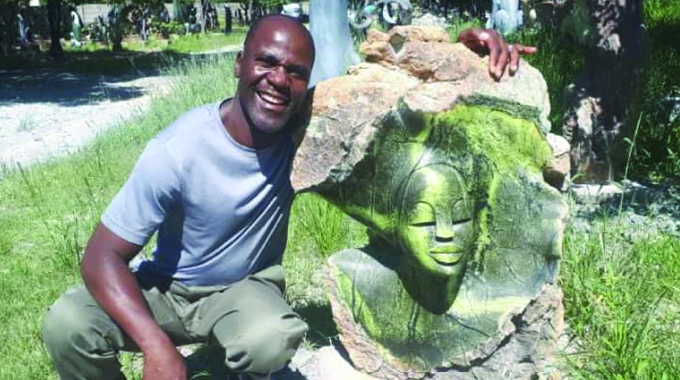
Kundai Marunya Arts Correspondent
Award-winning sculptor, Shelton Mubayi, has urged relative arts authorities and bodies to give space and erect works of local artists in public spaces and buildings around the country.
This he said will increase the appreciation of visual art by locals, thus creating interest in its uptake on the local market.
Of the visual artwork produced daily at different art centres and galleries, a large number is shipped overseas, mostly to Europe and the United States where it has great market value being sold for thousands of dollars.
Locals, except for a few affluent individuals and art institutions, rarely collect art.
Mubayi said having art beautify public spaces will increase its uptake.
“I for one have created several life size sculptures that are suitable to be erected in public spaces not only for their beauty but for the different messages they carry,” he said.
Some of Mubayi’s artwork is themed around creation, gender balance, Covid-19, wildlife and cultural preservation.
“It would be great if our works can be erected in front of national buildings like the recently constructed parliament building in Mount Hampden,” he said. “It’s done everywhere else in the world and we can surely do it locally.
“Imagine creating a sculpture park with works of all the greats on display, or having sculptures on permanent collection in parks like Harare Gardens and Africa Unity Square.”
Public sculptures are common around the world, many of which identify as landmark features of different cities, thus New York identifies the Statue of Liberty, while Wall Street identifies with the Liberty Bull.
The popular public sculptures have grown to become tourist attraction sites earning millions in revenue.
Though credited with producing some of the greatest sculptors to walk on earth, Zimbabwe has a limited number of sculptures in public spaces with the popular ones being the statue of Joshua Nkomo in Bulawayo and the recently erected statue of Mbuya Nehanda in Harare.
Mubayi said the Government policy should include promoting local consumption of visual art.
“We need the support of the art authorities and other custodians of public spaces to increase the visibility of sculpture,” he said. “There is a need for a policy framework that promotes visual art.
“Relative art bodies and stakeholders should hold open calls for public art thus the selection opens to all based on talent and merit.”
Mubayi, son of first generation sculptor Sylvester, sells a number of his works to art lovers in different countries.
“It’s a good feeling having your art on display in different countries but the best feeling comes when one is appreciated at home,” he said.
Female sculptor Charity Mutasa reiterated Mubayi’s sentiments.
She goes further to point out the lack of sculptures by female artists in the public space.
“Most, if not all sculptures in the local public space were done by male artists,” she said. “Males are given priority even in producing work that talks about women issues, in an area a number of women have proved to be equally good.”
Mutasa said the authorities should also engage female sculptors to strike a gender balance in public spaces.
“Opportunities to beautify our public spaces should be given equally without bias on gender, race or ethnicity,” she said.


 Online Reporter