Nqobile Bhebhe [email protected]
Zimbabwe’s banking sector expanded lending by more than 40 percent over the year to June, with agriculture, manufacturing, commerce and distribution emerging as the biggest beneficiaries as financial institutions stepped up support for productive economic activity.
According to Reserve Bank of Zimbabwe (RBZ) Governor Dr John Mushayavanhu’s Mid-Term Monetary Policy Statement Review presented on Thursday, aggregate banking sector loans and advances rose to ZiG94.61 billion as at June 30, 2026, from ZiG67.51 billion a year earlier.
This represents an increase of about 40.1 percent showing a significant expansion in credit to the economy over the period.
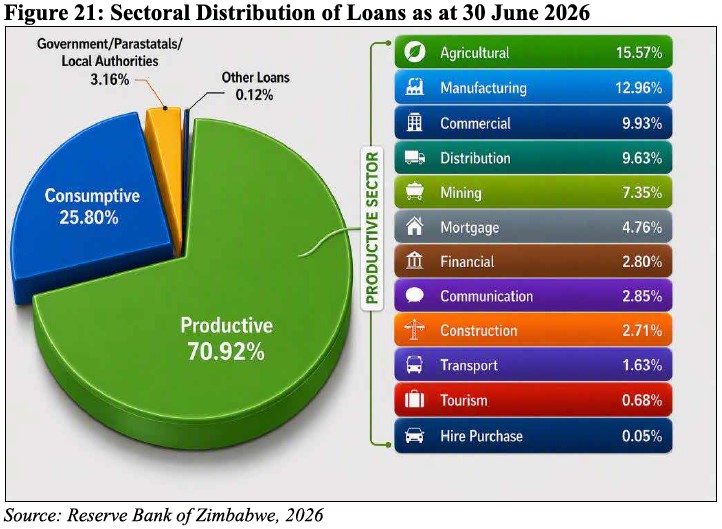
The bulk of the banking sector’s loan book was channelled towards productive activities, with 70.92 percent of total loans classified as productive lending.
The figures point to an increasing role for banks in financing sectors with the potential to drive output, investment, employment and exports, although the dominance of foreign-currency lending remains a defining feature of the credit market.
“Foreign currency-denominated loans dominated the sector’s lending portfolio, accounting for 90.2 percent of the banking sector aggregate loans,” Dr Mushayavanhu said in the statement.
Based on the June loan book, productive-sector lending amounted to roughly ZiG67 billion, while about 25.8 percent was classified as consumptive lending.
The RBZ said lending to productive sectors was predominantly concentrated in agriculture, manufacturing, commercial and distribution activities.
“The banking sector continued to play a pivotal role in supporting productive economic activity, with 70.9 percent of total loans directed towards productive sectors of the economy as at 30 June 2026,” Dr Mushayavanhu said.
Agriculture accounted for the largest share of productive-sector lending at 15.57 percent, followed by manufacturing at 12.96 percent, commercial activities at 9.93 percent and distribution at 9.63 percent.
Mining accounted for 7.35 percent, while mortgages constituted 4.76 percent of total lending. Other sectors included financial services, communication, construction, transport and tourism.
At the current loan book, the agricultural allocation translates to approximately ZiG14.7 billion, while manufacturing received about ZiG12.3 billion. Commercial and distribution activities accounted for roughly ZiG9.4 billion and ZiG9.1 billion respectively.
The pattern is significant for Zimbabwe’s broader economic growth strategy, particularly as Government seeks to expand domestic production, strengthen value chains and reduce reliance on imports.
Agriculture’s position as the largest recipient of bank credit also comes at a time when the sector remains central to food security, agro-processing and rural economic development.
However, the structure of the loan book also indicates the extent to which foreign currency remains entrenched in formal-sector lending.
With 90.2 percent of bank loans denominated in foreign currency, only a relatively small portion of the banking sector’s lending portfolio is being extended in local currency.