Online Reporter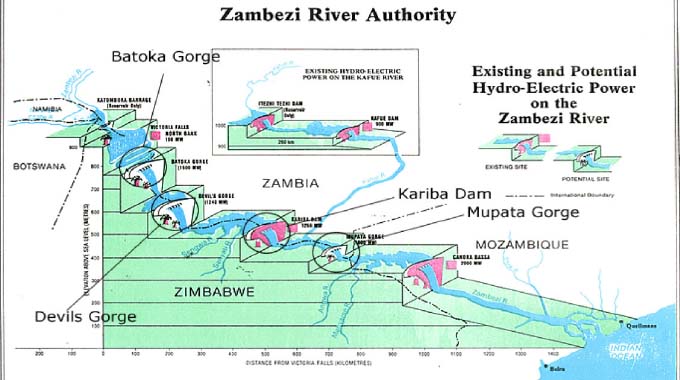
Rutendo Mapfumo
THE long-awaited Batoka Gorge Hydro-Electric Scheme (BGHES) has officially been deemed not to pose a threat to the World Heritage status of Victoria Falls, removing a significant obstacle that has delayed the project for over five years.
This resolution follows a high-level Expert Meeting on World Heritage and Sustainable Development in Africa, recently held in Livingstone, Zambia. The gathering brought together environmental and cultural heritage specialists from 15 African countries to assess the compatibility of large-scale infrastructure with heritage preservation across the continent.
In a significant outcome for regional energy development, the experts unanimously concluded that the BGHES, located 47km downstream of Victoria Falls, does not compromise the Outstanding Universal Value (OUV) of the iconic waterfall — a key requirement for retaining its UNESCO World Heritage designation.
Director of International Conservation Affairs at the Zimbabwe Parks and Wildlife Management Authority (ZimParks) Professor Patience Gandiwa welcomed the verdict, describing it as a milestone for African-led decision-making.
“We do not want anyone or any multilateral process to stand in the way of our aspirations as state parties,” she said.
She noted that one of the primary reasons for the over five-year delay was the apprehension voiced by external experts, who had suggested the project could compromise the site. However, following site visits and thorough evaluations, African experts collectively agreed there were no grounds to halt the initiative.
“Often, African voices are absent, not because experts lack opinions, but because they may not be informed or confident in expressing support. That is why we brought them here to see for themselves,” said Prof Gandiwa.
The Batoka Gorge project, a joint venture between Zimbabwe and Zambia, has come under scrutiny due to environmental and cultural concerns, particularly those raised by Unesco and other international conservation bodies. The main fears centred on how dam construction, tourism disruption, and ecosystem changes might degrade the integrity of one of the world’s most spectacular waterfalls.
However, field visits and updated environmental and social impact assessments presented at the Livingstone meeting reportedly demonstrated that the dam’s location downstream from the falls will ensure minimal impact on both the visual and ecological integrity of the site.
Once operational, the BGHES is expected to generate 2 400 megawatts of electricity, to be equally shared between Zimbabwe and Zambia. Construction is scheduled to commence in 2028 and continue through to 2034, offering a much-needed boost to both countries’ energy supplies, which have suffered from rolling power cuts and ageing infrastructure.
The scheme also aligns with the Southern African Power Pool’s vision of enhancing cross-border energy trade and regional grid stability.
Victoria Falls was designated a Unesco World Heritage Site in 1989. Straddling the border between Zimbabwe and Zambia, the falls are one of the largest and most spectacular in the world. As a critical natural and cultural heritage site, any major development in or around the area requires thorough evaluation to ensure its Outstanding Universal
Value is not compromised.
New Ziana