

 admin
admin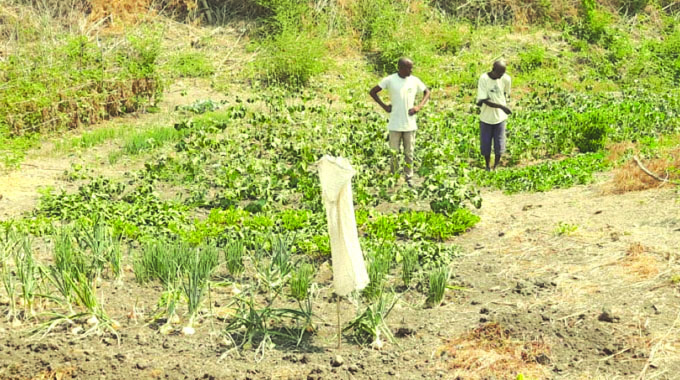
Walter Nyamukondiwa in BINGA
For years John Mudenda, like his forefathers gone before him, has been a nomad, foraging the banks of the Mighty Zambezi River for survival.
To him, it is the ancient rhythm of life to survive that pushes him.
The temporary pole and grass-thatched elevated structures, he calls home, is fortified by thorny branches to keep away wild animals and attests to the transient nature of his stay.
As a sentry post, the one storey structure has your typical wooden stairs, leading into the bedroom where he sleeps with his wife.
The ingazi, is used as a storehouse for the little grain they produce and other crops or as safe house.
The children live in their rural home, about 100kms away in Siabuwa where they attend school.
To him, nothing in permanent but the quest for a thriving garden, nourished by rich soils on the river bank and the moisture it guarantees.
From it comes the food and means to look after his family.
As he steps out of the ingazi, he overlooks the verdant and thriving variety of crops that he has diligently tendered.
It is scorching outside and the ingazi captures the breeze from the nearby Zambezi River.
Don’t they say the higher you go the cooler it becomes.
From okra, tomatoes, onions, maize and vegetables among others, Mr Mudenda has managed to maintain a greenbelt in the midst of wilting or drying vegetation, succumbing to the dry summer season.
The produce from the land is sold or exchanged for maize which cannot be grown successfully in the dry arid part of Binga District.
His enterprise is located about 6km from Binga Centre, towards Rest Camp, near Katuya Fishing Camp.
The gardens are interspaced with fishing camps and harbours from where fishing boats dock or are launched.
“I go home at least once a week to be with the children and see how they are doing while also bringing them food and other necessities,” said Mr Mudenda.
“If I cannot go, then the mother goes to the village. We cannot do any form of meaningful agriculture at home because of the dry conditions.” This is the typical life of most people who have survived on the Zambezi River and its several tributaries for generations. They have rural homes but derive sustainance from the river. They travel kilometres to draw from the Mighty Zambezi.
When nourished, they go home.
Of late, Mr Mudenda is a worried man! He has had to shift his garden and shelter regularly as the heavens have been thrifty in recent years.
Rainfall patterns have changed!
The river catchment has shrunk with the banks ever shifting inwards.
Large tracts of land which used to be submerged in water are now restored typical savannah grassland.
The river has tracked back at least 1,3km and the Mulonga (River) master farmers have had to shift their gardens with increased regularity.
Mr Mudenda’s current garden is about 500m from where his last one used to be.
Several abandoned gardens can be seen on the grasslands with their fortifications still intact.
“We have seen water levels going down over the years and it has become worrying because we don’t know how bad it will get from here,” said Mr Mudenda.
“I don’t have much of a choice but to move my garden closer to where the water is. If it moves, we move also so that we can sustain our crops.” To the master farmers of Mulonga (the river), past and present, such fancy words as streambank cultivation do not mean much.
The banks provide better nutrients and water for all year round farming.
“We have had several run ins with officers from the Environmental Management Agency (EMA) but that has not deterred us.
“I have been doing it for 40 years now. Farming on the river banks was a practice passed down to me by my ancestors, who survived on that since time immemorial,” he said.
The Environmental Management Act (Chapter 20:27), read with part IV of Statutory Instrument 7, 2007 on Environmental Impact Assessment and Ecosystems Protection Regulation prohibits degradation of rivers and bank cultivation.
Contravention of the statutory requirement attracts a fine not exceeding level 10.
Streambank cultivation causes soil erosion which in turn leads to siltation, which triggers loss of storage capacity for water bodies.
Most of the water is lost through run off and evaporation.
All farming activities should be done at least 30 metres away from the highest flood level of any wetland and water body, be it a dam, lake, river, stream or weir.
Part of Mr Mudenda’s crop is just 3 metres away from the river, which makes it easier for him to water the garden and maintain moisture levels idea for his crop.
With the dry arid condition pervading Binga district and other areas, communities have called for the introduction of irrigation schemes to wean them from the stream. Mrs Litembani Kufeni said the Tonga community needs pumps and pipes to draw water from the river.
“We need to look after our families and the River has been the lifeline for us and our ancestors. We know no other way of survival than the Zambezi River and its tributaries,” she said.
“To avoid degrading the environment as authorities say, we need to have pumps and pipes of communal irrigation schemes to move away from the river.”
These are the vagaries of climate change which has had devastating effect on the ability of communities to get predictable livelihoods from the environment.
From longer dry spells to less than average rainfall, communities have had to rethink their way of life.
Binga averages annual rainfall of less than 600mm with 117 days of rainfall. Temperatures are about 3 percent higher than the national average.
At community level, the natural reaction has been to follow the water.
“We last had better rains during the 2018/19 summer season where water levels were much higher,” said Mr Mudenda.
“As a result my garden was up there, near those trees (pointing at a distance about 500 metres away from the current location). The water levels were higher.”
Irrigation development has emerged as a panacea for communities around the Zambezi River, providing a key to boost their adaptive capacity while preserving the environment. It is a time honoured practice, passed from generation to generation, that has sustained the Tonga community but changing climatic conditions have demanded for reevaluation of traditional knowledge systems to be integrated into modern contexts and changed conditions.
Mr Mudenda looks up to the heavens for a lasting solution that ensures he fends for his family, the best way he knows how.



 Online Reporter