shloboe boe
Raymond Jaravaza, [email protected]
FROM a ground-breaking innovation that safeguards miners against dangerous gases in mine shafts, to maximising limited spaces for food production and a product that will revolutionise refuse collection and disposal industry, colleges and universities went all out to showcase various exhibitions at the Zimbabwe International Trade Fair (ZITF).
In line with the country’s industrialisation and modernisation drive, colleges, universities and polytechnics continue to play a leading role in technological advancements through the establishment of innovation hubs.
Some of the innovation hubs are being turned into factories, thereby ensuring that ideas are turned into innovations that are ultimately put to good practical use in everyday life.
Chronicle took the time to tour various stands at the ongoing ZITF where young innovators, current and former students at universities, colleges and polytechnics, were showcasing innovations that offer solutions to challenges in the mining, agricultural and environmental sectors, among others.
At the National University of Science and Technology (Nust) stand, a Computer Science student, Tafadzwa Dexter Sigauke, was showing exhibitors a device that will change the face of artisanal and small scale mining, and safety miners.
Having realised that small scale miners plunge into mine shafts immediately after blasting, without prior knowledge of the dangers beneath the surface, he developed a device that checks for the presence of harmful gases in the deep shafts.
“The device is known as an Ypoterra Drone and when deployed in a mine shaft, records the temperature in the shafts and the presence of harmful gases that are emitted during the blasting of explosives by the miners,” he said.
“Instead of exposing themselves to very high temperatures and dangerous gases, the Ypoterra Drone records vital information and it sends to a cell phone in real time, to make informed decisions before going back into a mine shaft,” said Sigauke.
The device can go down depths of more than 300 metres vertically and in the case of tunnels that run horizontally, a drone is deployed to record the vital information.
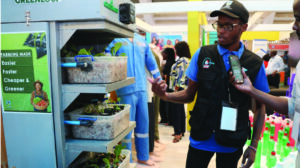
“The drone captures pictures that will tell the miners the areas that were affected during blasting,” he added.
The young innovator said he was inspired to come up with the innovation to tackle challenges faced by artisanal and small scale miners, who do not have technologically advanced tools that can assist them in their day to day operations in search of precious minerals.
Nust Chemical Engineering student, Tanatswa Mapfumo was showcasing an innovation called “Greenloop” that aims to maximise on food production in limited spaces such as high rise residential buildings, ensuring people can still grow vegetables and do fish farming.
The innovation is a single built unit that allows for vegetable and fish farming to be done simultaneously, using the same source of water.
“This project came about after we realised that the country was facing food insecurity in some areas, so we wanted to come up with a concept that allows people to produce food even in small spaces such as residential flats, where there is no land to plant vegetables or do fish farming,” he said.
“In normal farming, a lot of water is used as well as huge pieces of land, so our design saves both water and land and allows people to even grow vegetables in closed spaces like a house. The innovation works in two ways where the waste from the fish nourishes the vegetables and the nutrients from vegetables feed the fish,” said Mapfumo.
“Schools, hospitals and other public institutions, who do not have a lot of land can use our innovation to plant vegetables and keep fish in the same design.
“Our plants go up to 50 percent faster than regular farming methods. The design uses full spectrum lights, which work in the same way as natural light and a farmer can control how long the spectrum lights stay focused on the plants for maximum vegetable production.”
The innovation does not use chemicals or fertilisers, but uses less water and very small spaces of land, thereby, it is good for the environment, added Mapfumo.
On the environmental sector, a Midlands State University (MSU) student already has her eyes set on changing the refuse collection and disposal industry before graduating, with a product that slows down the rate of decomposition of waste.
Known as the AGN Pure, Wendy Murambi described the product as “a waste drier and neutraliser” that can be used by municipalities, rural district councils and big business with lots of waste.
“Our product can be sprayed on the inside surfaces of dust bins in order to prolong the time that waste will decompose and that way, waste management is made easier for companies and households,” he said.
“We have the product in varying containers that are affordable to big businesses, municipalities and homes,” said Murambi.
Several other universities, colleges and polytechnics exhibited various innovations at the annual event.
Through the Education 5.0 model that the Second Republic, through the Ministry of Higher and Tertiary Education, Innovation, Science and Technology Development adopted, is paying dividends as evidenced by the number of innovations at ZITF.
The nation is poised to enjoy the fruits of the Government’s deliberate policies to promote a results-based education system with educational institutions of higher learning taking heed of the Government’s call to leapfrog the country’s development through science and technology.


 Online Reporter