Online Reporter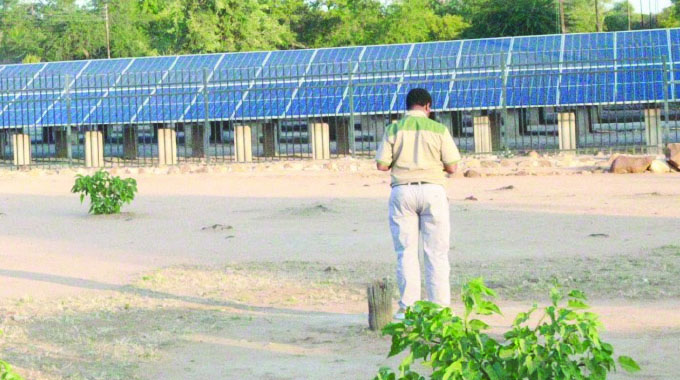
Thupeyo Muleya, thupeyo,[email protected]
FARMERS in Beitbridge District are increasingly adopting sustainable and cost-effective solar-powered irrigation systems, a shift that is transforming agricultural production and strengthening household food security.
As more farmers transition to renewable energy solutions, solar-powered irrigation is emerging as a practical tool for enhancing productivity, cutting costs and building climate resilience in Beitbridge District.
The farmers are now cultivating high-value crops such as chilli, okra and cabbage, supported by Government initiatives implemented in partnership with development agencies, including the Food and Agriculture Organisation (FAO).
Under the Enhanced Resilience for Vulnerable Households in Zimbabwe (ERVHIZ) project, irrigation schemes are being revived and solar-powered systems installed to improve climate resilience among rural communities.
Jalukange Irrigation Scheme has been fully rehabilitated, benefitting 141 families, while Tshikwalakwala Irrigation Scheme has been mechanised with solar plants generating 129 kilowatts of power.
The ERVHIZ project seeks to strengthen rural households’ resilience to climate change by promoting efficient water use technologies such as drip irrigation — a micro-irrigation system that allows water to drip slowly to plant roots, conserving both water and nutrients.
The initiative is expected to enhance food security, improve livelihoods and reduce farmers’ vulnerability to erratic rainfall patterns.
In the past, most farmers relied on electricity from the national grid or diesel-powered pumps, using canals, sprinklers or flood irrigation systems. However, rising fuel costs and power shortages often disrupted production cycles.
Mr Enock Kwinika, a farmer from Ha-Goda area in Ward 15, who recently transitioned to solar-powered irrigation, said the system had significantly improved reliability.
“The solar-powered irrigation has made a huge difference. Many farmers now have reliable water supplies enabling an all year-round crop production. Solar systems bring many benefits to farmers in Beitbridge,” he said.
“Unlike diesel pumps, solar energy is easy to use and affordable. Beitbridge has abundant sunlight, which makes solar energy ideal.”
Ms Remaketsi Mbedzi from Malala village in Ward 6 said the introduction of solar-powered irrigation had encouraged more women to venture into crop production.
“Setting up a solar-powered irrigation system is not as capital-intensive as buying large diesel pumps or connecting to the electricity grid,” she said.
Beitbridge District health and plant inspector Mr Levy Gama said solar energy had environmental advantages as it produces zero emissions and depends on sunshine which is there all year round in the district.
“This is a major advantage for farmers here. Servicing solar-powered pumps is relatively cheaper compared to diesel pumps, ” he said.
Agribusiness expert Mr Orpheus Ndlovu noted that while solar systems are cost-effective, farmers should maintain alternative power sources during winter.
“Fuel costs for diesel pumps can be beyond the reach of many farmers, making solar energy the best option. However, solar systems can be affected by cloud cover during winter, so having a diesel backup or grid connection minimises the risk of crop failure at critical stages,”said Mr Ndlovu.
At Bubane Ranch in Ward 3, cattle farmer, Mr Eric Mawelewele said solar pumps had significantly reduced operational costs and improved livestock management.
“We can now water our animals whenever needed, unlike before when we rationed due to fuel constraints. Since we installed the solar system, costs of cattle ranching have gone down,” he said.
Another farmer from Ward 13, Mr Vhidzwani Mabule, said solar systems have less expenses after installation.
“There is no need to buy electricity tokens, diesel, oil or filters. The same solar panels can power water pumps and, during idle periods, charge batteries for electric fencing thereby improving farm security,” he said.