admin
admin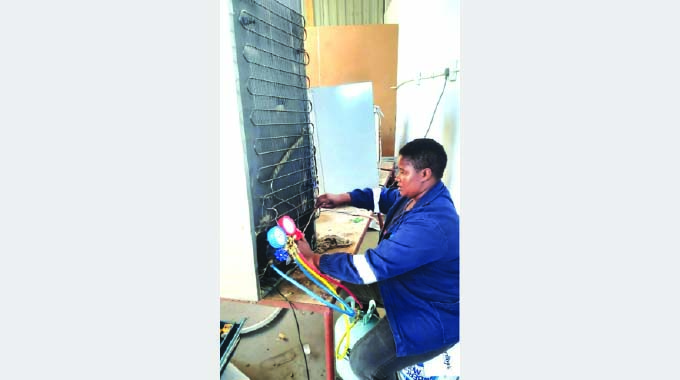
Thupeyo Muleya-Beitbridge Bureau
As more women move into previously male-dominated sectors, success stories are being recorded periodically.
The testimonies are now becoming ordinary stories that are not striking headlines as was the case during the past years.
This is one such story of women in Beitbridge who are venturing into electrical engineering.
Literally and figuratively supercharged, they are making a name for themselves and not turning back.
In the last decade, it would appear like moving mountains for women to try their hand at the usual male- dominated sectors.
The Government, among other things, has been promoting gender mainstreaming with the support from several partners to achieve equality between women and men.
Also as world leaders seek to create a global village, both men and women are now participating in national and economic development matters.
At the turn of the millennium, most towns started growing rapidly in terms of property and infrastructure development.
This saw men taking up most of the jobs, including electrical engineering, but in Beitbridge where there is a massive infrastructure development revolution, women are rolling up their sleeves to take up opportunities.
“It has always been my dream to be unique and to work among men as a lady to boost my self-esteem rather than being stigmatised,” said Miss Diana Dube (19) who has become a renowned electrical engineer in the border town.
“Wearing a work suit made me realise that there is nothing that a man can do that a woman cannot do. So, I decided to train in electrical engineering. My special area is mainly in electrical power engineering and I have done house wiring both in towns and rural areas.”
The youthful engineer said she learned the ropes from an artisan who was used to handling maintenance works at a local hotel.
Some of the works included fixing geysers and light installations.
Miss Dube said choosing such a career was one of her many ways to contribute to eradicating gender-based inequalities.
“Electrical power engineering is a difficult career by its nature,” she said. “One is always confronted by many obstacles, but as someone who is determined to achieve a dream, I take the challenges head-on.
“When I started training, my father thought I would quit, but I am here to stay. This is a very rewarding profession because one can earn a living even if he or she is not formally employed.”
Miss Dube was critical of other female youths who fail to build self-confidence and chase their dreams against all odds that are favouring men.
Mrs Raina Mukwena-Ngwenya (29) is another trailblazer who has made a name in Beitbridge as a mechanical engineer majoring in refrigeration and air conditioning jobs.
She is credited with installing a number of air conditioners, cold rooms, and display fridges, and repairing and servicing them for many businesses and individual households.
“I can also troubleshoot and repair air conditioners for automobiles,” she said. “When I started working as a technician during my industrial training l felt intimidated.
“One had so much fear and no confidence that I would at some point be able to fix something like a refrigerator, cold rooms, or walking chillers and bottle coolers. You will realise that as women, we tend to underestimate and suppress our capabilities to do jobs that are deemed to be masculine in the African context.”
Mrs Mukwena-Ngwenya said women should not allow gender to be a barrier to their success and that they needed to grab every opportunity that came their way.
“There are people out there who gave up on their dreams even without trying to pass the first hurdle due to family background, or lack of proper career guidance,” added Mrs Mukwena Ngwenya.
At the moment, she is upgrading her qualifications as a refrigeration and air conditioning technician.
In the next five years, the electrician said she was looking at having joined bigger corporates and eventually establish her own entity.
Mrs Mukwena-Ngwenya said she had grown a thick skin and was not destructed by people who were always on a fault-finding mission on anything being done by a woman.
“After high school, I enrolled for a course in banking and finance and later switched to mechanical engineering after being exposed to their practical lessons,” she said.
“Since then, I have never looked back. The more I do this kind of job, the more I get confident as an individual and this is a life skill that comes with high returns.”
A career development worker, Mrs Pretty Dube, who is one of the female movers and shakers in Beitbridge said there had been an appreciation in some families that boys and girls can be equal to any task, hence allowing them to venture into professions previously dominated by men.
“As the world opens up through social media, girls are being exposed to these possibilities too and we are seeing women pilots, engineers among other once male dominated professions, being recognised on social media,” said Mrs Dube.
“Women should know that they may face discrimination as some men may resist them due to gender stereotypes. Thus women should work hard and prove their mettle in everything.”
Mrs Dube said women in leadership should promote and empower fellow women so they can rise to higher positions even in male dominated sectors.
She said it was important that the plight of women be considered when drafting policies and programmes for development.
Mrs Dube advised people to move away from the traditionally set stereotypes that confined women’s primary social roles to being housewives and mothers, while men play the role of breadwinners.
“With strong and visible support structures for women in male-dominated professions, success is guaranteed,” she said.
“Let us have those women who have broken into these former male-only careers as role models, sharing their experiences and dispelling any myths and misconceptions about other women’s experiences,” said Mrs Dube.
Women, she advised need to be strategic, and confident and for this, there is need for mentorship and networking.
Women’s Action Group (WAG) programmes manager, Mrs Fiona Tinarwo said their work was bearing fruits on the ground with more women shaking off the societal stereotypes.
This, she said, also spoke to the empowerment where women are now being able to take up positions in key institutions or organisations.
“We have been talking a lot about many women who are involved in unpaid care work,” said Mrs Tinarwo. “The fact that we are having more young women taking up engineering profession is pleasing. This means the women take up positions where they are paid for services.
“The engineering sector has always been dominated by men, and we need to change that narrative as a society.
“Let us allow both men and women to choose career paths freely and not because of what society wants, but because that is their career of choice.”
Mrs Tinarwo urged more women to enrol in technical courses at colleges and universities so that they reduce the gender disparities between them and men when it comes to handling challenging and rewarding professions.



 Online Reporter