admin
admin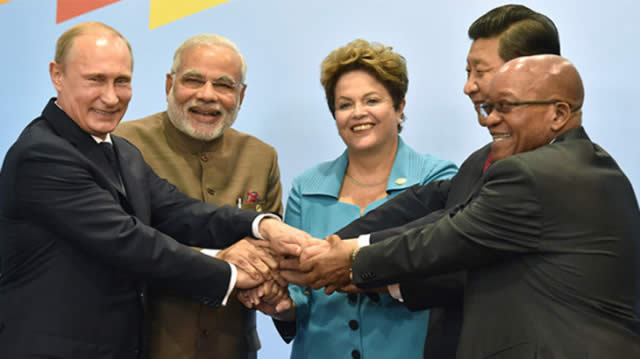
Linda Tsarwe
South Africa is arguably one of the most powerful economies in Africa. Although the country has its own economic problems, it is obviously in a much better state relative to its African peers. Its economy is the second largest economy in Africa and is the stronghold in the southern part of the continent.
One of its major achievements was the inclusion into the BRIC being a four member union – comprising Brazil, Russia, India and China – to then form the BRICS after South Africa had joined in 2010.
Although South Africa is a small fish in a big pond in terms of the size of its economy relative to the members, it stands to benefit relatively more. Synergies with such big economies that are growing faster than the rest of the world cannot be little. As at December 2013, Brazil’s GDP was an estimated US$2,2 trillion.
Growth rate for the first quarter of 2014 was 1,9 percent. The country has a population of over 200 million and an annual GDP per capita amounting to just above US$10 000. Inflation rate has been contained at 6,52 percent as at June 30 2014 while their unemployment rate is at 4,9 percent as at April 2014. Brazil has over the years been a major player in agriculture and automobile industries, currently being the world largest producer of coffee and sugar, and the fourth largest carmaker in the world.
Both its huge population and investment into capital has leveraged the country to be one of the well acknowledged developing nations in the world.
Of course, many have observed the huge social disparities in Brazil, but these are not a new phenomenon especially in developing countries and are bound to narrow with time as the country becomes more developed.
Russia is the third largest economy in the BRICS boasting of a GDP of US$2,1 trillion as at December 2013. Growth in the first quarter was, however, down 0,3 percent relative to 2013 but was still up on an annual basis as at June 2014 at 1,9 percent.
However, 2014 is turning out to be a year of disaster for Russia, mainly due to the conflict in Crimea between Ukraine and itself. This has caused a rift in relationships with the Western countries as well as the European nations who have imposed sanctions on the country.
As a result, Russian state owned enterprises have been shut from the European capital markets. Ironically, Europe is depended on Russia for gas, as it is has the largest gas reserve in the world. Furthermore, it is has the world’s eighth largest oil reserve. Interestingly, oil, natural gas and timber account for more than 80 percent of Russian exports abroad but only contribute 5,7 percent to the country’s GDP.
This gives Russia a stronger standing due to its low dependency on energy exports and economic sanctions might not have that big an impact on their economy. With disregard to its politics and nemesis, Russia is arguably a key player in world economics. Moreover, it even has a more solid role to play in the BRICS.
While there has been a lot of negative news about Russia, India is emerging to be one underdog that is more than just a cricket playing nation. Visibility of their production is increasing especially in African countries, including Zimbabwe.
The local pharmaceutical sector has constantly been crying out to Government over increased inflows of Indian pharmaceuticals in the country, which is driving them out of business. Furthermore, India has tapped into the technological space and gaining acceptance in that area all over the world.
In our local case, Star Africa mentioned in their year ended March 2014 results that they acquired machinery from India to upgrade their sugar plant. In addition India is strong in agriculture being the second largest producer of sugar in the world and a major producer of rice.
As at December 2013, their GDP was estimated at US$1,9 trillion and recorded growth of 2,1 percent in the first quarter of 2014 compared to a growth rate of 1,1 percent attained the same quarter 2013. Population in the country is very high at US$1,2 billion which, however, leads to a much lower annual GDP per capita of only US$1,2 million.
Clearly the standard of living is low, but the movement towards improving it is aggressive. The country is poised for growth and has the second largest workforce in the world and the zeal to achieve it.
The same culture is somewhat exhibited by the Chinese. China has technically taken over the world in terms of production and is now an integral part of global economics. It is the largest economy among the BRICS with an estimated GDP size of US$9,2 trillion as December 2013.
Growth in the first quarter of 2014 was 2 percent compared with 2013 and annual growth was sitting at 7,5 percent as at June 2014. It is currently the second largest economy in the world after the United States and third when ranked with the Euro Area combined.
The country has a trade surplus due to its level of exports, its inflation rate is low at 2,3 percent as at June 2014 while foreign direct investment average US$373 billion monthly.
The Chinese have developed an ability to service all market segments from very low end to high end. They have set a footprint all over the world, and a ‘Chinatown’ can almost be found anywhere else in the world. The level of production and efficiency is a skill South Africa and the rest of the continent can emulate.
All these four fast emerging economies are of significant value to South Africa. With a GDP level of about US$350,6 billion as at December 2013, South Africa constitute 17 percent of Brazil and Russia’s economy each, 18 percent of India’s and just 3percent that of China’s.
Its inflation rate was 6,6 percent as at 30 June 2014. Many have always seen South Africa as the volatile state, prone to labour strikes which have a huge bearing on the performance of the economy. In the first quarter of 2014, the economy contracted 0,6 percent mainly due to the strikes in the mining sector.
This showed how much the economy is reliant on a booming mining sector and so does the rand, which took a huge knock during the same period as well. Following a poor quarter performance, both Moody’s and S&P downgraded the country’s credit rating to just above junk.
However, its inclusion in the BRICS can be regarded as a creation of a safe buffer for its economy. Recently, the union launched a development bank which will be capitalised to the tune of $100billion, although the initial subscribed capital will be US$50billion.
Essentially, the bank is intended to rival the traditional international banks such as the IMF and World Bank and would be targeted towards countries that have difficulty in accessing funds from the IMF and World Bank. Member countries also stand to benefit, if they require funding for development work.
South Africa, in particular, has the opportunity to advance its economy even further through more development work which can curb the unemployment rate that seems to be getting out of control at around 25 percent.
Also, just by having a voting right in an international bank, gives any country an economic leverage over others that do not. Creation of this bank, though still small relative to the traditional ones of such a nature, could be the beginning of creating one powerful institution in the world and South Africa can only but smile to be part of it.
Although the South African economy is far from perfect, it is formidable when compared to many African economies. Zimbabwe could take some lessons from their neighbour by integrating with other countries. Various news reports are claiming that most of these unions and foreign countries are not willing to fund development of the country.
The size of our economy is just a drop in the ocean compared to the powerhouses of the BRICS and if we can do our housekeeping as a country, some of the BRICS money could find its way into the country. We could also make ourselves eligible for accessing funding through their established development bank.
With time, the economy can qualify to be part of other emerging economic unions which is highly beneficial especially for emerging economies. In addition, the country will be putting itself in the spotlight and setting itself up for more foreign investment inflows.
Already, the country has created a comfortable base by adopting a stable currency. What is now required is to set appropriate policies that will attract investment and get the production running.
Foreign currency reserves then gradually builds up and the country can be able to pay off its foreign debt which will be viewed as a sign of goodwill.
Integration into other economic unions as well as the world monetary system would then almost be automatic and more economic development can only be expected.
For feedback and comments email – [email protected]


 Online Reporter