Chronicle Editor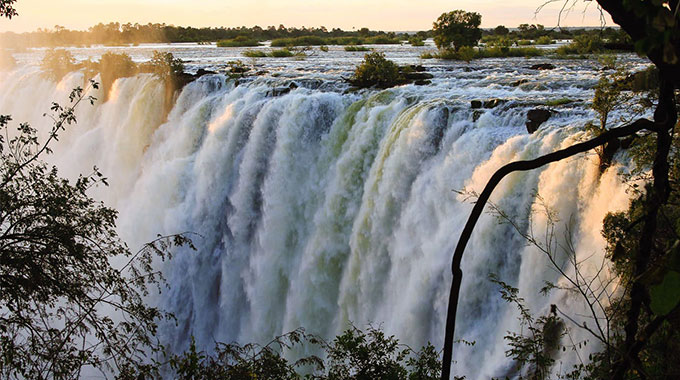
Leonard Ncube, Victoria Falls Reporter
THE Mighty Victoria Falls has received record water flows this year, according to the Zambezi River Authority (ZRA).
However, this best moment is slowly wasting away without the usual local and international tourists due to global lockdown measures as a result of the outbreak of Covid-19.
The river flow, which ZRA said beat a 10-year record, saw the Victoria Falls, one of the world’s top wonders, thundering albeit with no tourists to witness it. The Victoria Falls National Park, where the Rainforest and Falls are located are closed, as like the rest of the world, as Zimbabwe is in lockdown to curb the spread of the coronavirus pandemic. The showers, better known as “The Smoke that Thunders” that characterise the Rainforest have no one to soak this year, and sadly will soon be gone as the season progresses.
According to ZRA, the flows at Victoria Falls rose from 349 cubic metres per second (m3/s) at the start of January to a peak of 4 289m3/s on May 3. The last time such high flows were attained at Victoria Falls was a decade ago during the 2009/10 rainfall season. The second upswing in flows at Victoria Falls started mid-April, four weeks after the double peak at Chavuma.
The flow in Victoria Falls reached over 4 300m3/s although levels have started going down, with 3 355 m3/s recorded on May 27, according ZRA.
“Last year on the same date, the recorded flow at Victoria Falls was 1 117 m3/s. Therefore, this year’s flow recorded on 27th May 2020 at Victoria Falls represents an increase of 200 percent compared to last year’s flow on the same date, and 57 percent higher than the long-term average river flow for Victoria Falls,” said ZRA chief executive officer, Engineer Munyaradzi Munodawafa in a statement.
Victoria Falls is one of the top attractions in Zimbabwe, with a strong value chain economy in the resort town.
Concerning hydro power generation at Kariba Dam, he said the authority will maintain the water allocation for power generation despite the dam receiving significant inflows during the 2019/2020 rainy season.
Eng Munodawafa said the authority will continue monitoring the hydrological situation in the Kariba catchment and water levels at Kariba Dam. He said as of May 27, the recorded lake level was 480,77m, signifying 37,6 percent live storage or 24,40 billion cubic metres (BCM) of stored usable water, with the lake being 5,27m above the minimum operating level (MOL) of 475,50m.
The water level had receded to worrying levels during the first quarter of 2020 just like the one recorded during the 1995/1996 drought period due to delayed onset of the 2019/2020 rainfall season, which only commenced in January 2020 instead of October 2019, Eng Munodawafa said. The water level later rose by 3,13 metres between March 27 and May 27 following increased rainfall activity in the upper Kariba catchment, raising hopes for power generation both in Zimbabwe and Zambia.
“The lake levels should have been by then no less than 8m above the MOL but was only just over 5 metres above the MOL by 27 May 2020. Balancing between the increase in lake inflows with the need to ensure a steady buildup of the reservoir storage for purposes of power generation, and the uncertainty regards the rainfall performance under the upcoming 2020/2021 rainfall season, ZRA has predominantly maintained the water allocation made to the two power utilities at Kariba for the year 2020 (23 BCM of water shared equally between Zesco Limited and Zimbabwe Power Company) to ensure continued availability of water for power generation at Kariba for the remaining months of the year 2020 and beyond,” said Eng Munodawafa.
He said between January and 27 May 2020, a total of 11,45 billion cubic metres were utilised for power generation, representing 34 percent of the gross inflows over the same period.
ZRA is a bi-national organisation jointly owned by the governments of Zambia and Zimbabwe, with a mandate to manage the Kariba Dam and develop additional water storage infrastructure along the shared portion of the Zambezi river.
It monitors and records daily river flow data from its 14 gauging stations located within the Kariba catchment area such as Chavuma and Victoria Falls in upper Zambezi.
“The Zambezi River flows rose from 236 m3/s in January to a peak of 5 006m3/s on 25 February 2020 before water levels subsided until 17 March when it started rising again from the recorded dip of 2838 m3/s on 17 March,” Eng Munodawafa said.
“This second increase, which is characteristic of Chavuma gauging station, continued up to 6 April when the river flows reached a second peak of 5 825m3/s before gradually receding to the 776 m3/s flow recorded on 27 May 2020.
“The flow recorded on the same date last year (27th May 2019) was 239m3/s. The recorded flow at Chavuma on 27 May was 225 percent higher compared to the same date last year. The river flow at Chavuma continued to trend above the long-term average flow for Chavuma gauging station of 482 m3/s by 61 percent,” said Eng Munodawafa.
He said river flows at Chavuma are now in recession as expected during this time of the year. — @ncubeleon



 Online Reporter