Online Reporter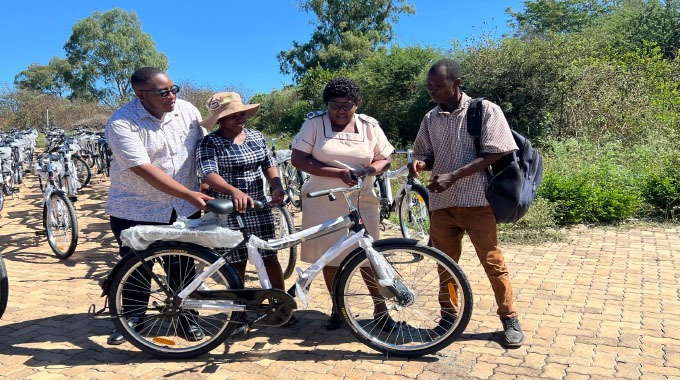
Sukulwenkosi Dube-Matutu [email protected]
MORE than 200 village health workers in Gwanda District have received bicycles in a major boost to frontline healthcare delivery as the Government intensifies efforts to improve access to medical services in remote communities.
The initiative, implemented under the National Development Strategy 2, is part of broader efforts to achieve universal health coverage, with a strong focus on maternal health and strengthening community-based healthcare systems.
The bicycles, distributed at Phakama Clinic through a partnership between the Ministry of Health and Child Care and Buffalo Bicycles Zimbabwe, are expected to significantly enhance mobility for health workers who often travel long distances to serve scattered rural populations.
Village health workers, who received the bicycles at Phakama Clinic on Monday welcomed the development saying it would transform their operations.
“I have to travel 20 kilometres to reach the health facility where I’m stationed. Our village is vast and moving around on foot has been a major challenge,” said Mr Nkululeko Nyoni from Matekenya area.
He noted that some patients rely on health workers to collect medication on their behalf due to distance constraints.
“I’m happy because I can now serve my community better. The bicycle will help me cover more ground, especially when delivering critical health information,” said Mr Nyoni.
Ms Bokang Sebatha, a village health worker from Tshanyaugwe village, said the lack of transport has often delayed urgent responses.
“Our work requires quick response, especially during immunisation programmes where we must ensure full coverage. Without transport, it becomes difficult,” she said.
Community health nurse Ms Thamsanqa Mangwangwa said the district has 350 village health workers, each responsible for about 100 households.
“As a district, we have 350 village health workers and today, 200 will be receiving bicycles, which is a major boost. VHWs are very critical in health delivery as they are a go-between health institutions and the community. They carry crucial information from the clinics to communities and vice versa and they also treat minor ailments,” she said.
Ms Mangwangwa added that the bicycles would strengthen disease surveillance and follow-up care for conditions such as TB, HIV and other chronic illnesses.
“They also carry out surveillance for diseases like diarrhoea, measles, among others and report to health officials. They do follow-ups on all clients, be it TB, HIV, chronic patients and many more. They also refer patients from the community to health facilities, which ensures early diagnosis,” she said.
Ms Mangwangwa appealed to Buffalo Bicycles Zimbabwe to go a step further and provide more bicycles to cater for the remaining village health workers.
Buffalo Bicycles Zimbabwe project manager Mr Ayifani Moyo said the initiative complements Government efforts to strengthen healthcare delivery at grassroots level.
“I want to express my sincere gratitude to Gwanda RDC for allowing us to proffer mobility solutions where it matters most in the district, starting with the health sector. We acknowledge the partnership between Buffalo Bicycles Zimbabwe and the Ministry of Health and Child Care,” he said.
Mr Moyo said their collaboration between the Government and his organisation reflects a shared commitment to improving health outcomes, strengthening frontline service delivery, and ensuring that health workers are equipped with practical tools.
He said improved mobility will enhance service delivery in key programmes, including anti-retroviral therapy distribution in a province heavily affected by HIV and Aids.
“The Ministry of Health works tirelessly to plan, co-ordinate and deliver health services across our communities. However, real success depends on the strength of our partnerships and the support we provide to the people on the front lines,” said Mr Moyo.
Matabeleland South is one of the provinces burdened by the HIV/Aids pandemic hence the bicycles will come in handy in the anti-retroviral therapy distribution programme.
Village health workers play a critical role in Zimbabwe’s healthcare system, particularly in rural areas where they provide community-based services such as health education, disease monitoring and basic treatment.
Their work is central to reaching the “last mile” in healthcare delivery, ensuring early intervention, improved maternal health and better overall health outcomes.—@DubeMatutu