Chronicle Editor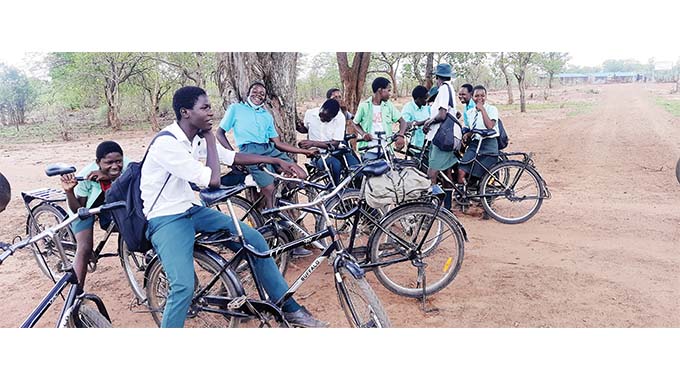
Leonard Ncube, Victoria Falls Reporter
PHILLIP Shoko (19) from Jembwe is a Form Four pupil at Vulindlela Secondary School and he used to miss lessons due to the long distance he had to walk to and from school.
However, that is now a thing of the past, thanks to a bicycle scheme being rolled out by a local organisation.
Greenline Africa Trust (GAT) introduced a bicycle programme in Victoria Falls rural schools in 2017 and more than 2 000 learners have benefitted to date.
GAT partnered World Bicycle Relief for the programme and also works with relevant line ministries such as Primary and Secondary Education, Health and Child Care, Public Service, Labour and Social Welfare among others. Priority is given to girls because they are more vulnerable than boys said he no longer misses lessons.
“I am no longer late at school and no longer miss lessons,” Phillip said in an interview.
Another pupil, Dorcas Mpala (17) who stays seven kilometres away and is in Form Two at the same school said she received her bicycle last year.
“I didn’t know how to ride and the mechanic Mr Ntini taught me and others. I used to wake up at 5am and start walking to school around 5.30am but now I leave home at 6.30am and I am always early. I am so grateful to have received this bicycle as it has helped me not to miss lessons,” she said.
Thandiwe Ncube (14) from BH127 said: “Sometimes we knock off late especially when there are events at school and walking home at that time is not safe. So, the bicycles are helping us get home early and stay safe from animals.”
Authorities have reported that distance from school and poverty are some of the major causes of school drop-outs in most parts of Matabeleland North, Hwange included, where schools are far apart.
This has also been identified as one of the causes for teenage pregnancies and early child marriages in Hwange District as girls are sometimes targeted by “male predators” along the way.
In Hwange, Lupane and Binga districts children also face the risk of being attacked by wild animals due to proximity to game parks.
Some schools have recorded zero pass rate, especially at Grade Seven examinations.
GAT programmes coordinator Ms Edith January said the bicycle programme targets learners aged 10 years and above who live more than three kilometres away from their school.
She said the programme initially focused on school children alone but was expanded to include voluntary community service providers such as health and environment personnel, water pump minders and dip tank attendants in 2019.
They also should be staying three kilometres away from the areas they serve.
Traditional leaders have also benefitted.
Schools whose learners have benefitted are Bethesda, BH36, Chidobe, Chikandakubi, Chimbombo, Chisuma, Jabula, Jabulani, Lesedi, Mbizha, Milonga, Mizpah, Monde, Ndimakule, Neluswi, Sikumbi and Simakade primary as well as Batoka, Chidobe, Chisuma, Jabulani, Mashake, Ndlovu, Nejambezi, Sizinda and Vulindlela, secondary schools.
“The programme aims at improving mobility and promoting service delivery at community level, and also for children to have easy access and mobility to school so that they don’t drop out because of distance,” said Ms January.
Ms January said when a child is given a bicycle, he or she takes responsibility for its safety but it becomes the property of the school.
The bicycle is returned to the school during school holidays for safe keeping.
It is not shared and while at home, no other family member is allowed to ride it.
Each community has a committee put in place to monitor usage of bicycles which are easily identifiable as those given to school children are labeled differently from those allocated to service providers.
The recipient is responsible for the repairs of the bicycle and making a police report in the event that it gets stolen.
However, the committees to help take care of the bicycles and beneficiaries contribute money which is used to pay a designated mechanic to fix those that have faults, thereby providing employment and source of income.
Ms January said a child who has custody of the bicycle for more than three years automatically gets it permanently.
“A child should safely keep the bicycle for at least three years. If one is given at Form One or Form Two and finishes Form Four with it and has been performing well at school, he or she graduates with the bicycle. Those who return them to school would have spent less than the agreed period.
“In the event of misuse, the committees confiscate the bicycle for a certain period or give it to someone else if the recipient is a repeat offender,” she said.
Ms January said preliminary reports had shown an improvement in school attendance and service delivery.
“We are looking at school attendance and improving pass rate. There used to be school drop-outs especially in schools where children walk for 12km to school and reports show that there is an improvement in punctuality and attendance. We are now working on measuring impact in terms of pass rate,” she said.
“We expect service providers to improve service delivery as this has removed the distance barrier. We have also started Income, Savings and Lending Schemes for small entrepreneurs who bake scorns and use the bicycles as they move around to sell.”
Hwange District Schools Inspector Mr Walter Moyo said the bicycles have had a significant impact in helping learners’ welfare.
“The provision of these bicycles has had a great impact considering that our schools are sparsely spaced.
The programme has helped mostly the girl child and kids can now get to school and back home early and be able to do other chores as well as do their homework.
So children’s welfare has improved but when it comes to results there are several factors involved in the learning process,” he said.–@ncubeleon



 Online Reporter