Online Reporter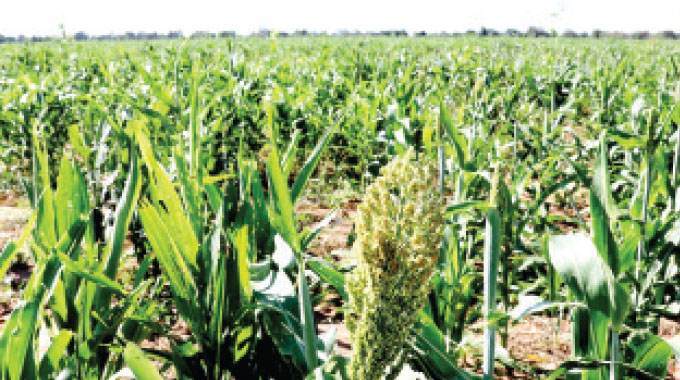
Zimpapers Writer
FARMERS at Bhulaayo Kraal Irrigation Scheme in Binga District have planted 50 hectares of maize under a centre-pivot irrigation system and are anticipating a bumper harvest as Government efforts to strengthen food security and rural industrialisation gain momentum.
The Bhulaayo Kraal project, a flagship initiative aimed at empowering local communities through commercial-scale agriculture, had for years suffered delays and underutilisation of critical infrastructure, including centre-pivot irrigation systems and storage facilities.
However, its revival and rehabilitation under the Agricultural and Rural Development Authority (Arda) have begun to yield positive results, significantly enhancing agricultural productivity in the semi-arid district.
The Government is remodelling the vast 15 000-hectare Bhulaayo Kraal Irrigation Scheme, with 250 hectares so far cleared and tilled as part of phased development.
In an interview, Binga District Development Co-ordinator, Mr Land Kabome, said the current cropping season had seen encouraging progress at both Bhulaayo Kraal and surrounding irrigation schemes.
“Following the onset of the rainy season, we have planted 50 hectares of maize using one centre pivot at Bhulaayo Kraal Irrigation Scheme. Our thrust is to boost food security in the district,” said Mr Kabome.
He said farmers at the nearby Saba Valley Irrigation Scheme, which covers 20 hectares, had planted 15 hectares of maize and five hectares under legumes, with crops showing good potential.
“The crops at Saba Valley are doing very well. In addition, we also have several nutrition gardens dotted across Binga District, which are contributing to household food security and improved nutrition,” said Mr Kabome.
The irrigation drive forms part of broader Government efforts to accelerate socio-economic development in Binga, one of the country’s historically marginalised districts.
Meanwhile, the Government has also kick-started preparations for two new irrigation schemes near Lake Gwayi-Shangani, with a master plan and Environmental and Social Impact Assessment underway for 200 hectares of land.
The development follows a 2022 Cabinet decision granting Binga District rights to draw water from Lake Gwayi-Shangani, as part of a strategy to transform the semi-arid region into a food-secure area by harnessing its abundant water resources.
Lake Gwayi-Shangani, the country’s third-largest inland water body after Lake Mutirikwi and Tugwi-Mukosi, is a flagship project under the National Matabeleland Zambezi Water Project and is expected to be a game changer in addressing perennial water shortages in Matabeleland.
Of the 69-kilometre lake pushback stretch, 52 kilometres fall within Binga District, with the remaining 17 kilometres in Hwange District.
First mooted in 1912, the project is now nearing completion under the Second Republic and will be linked to Bulawayo via a 245-kilometre pipeline, permanently easing the city’s water challenges while unlocking vast agricultural and industrial potential across the region.



 derick.khumalo