Online Reporter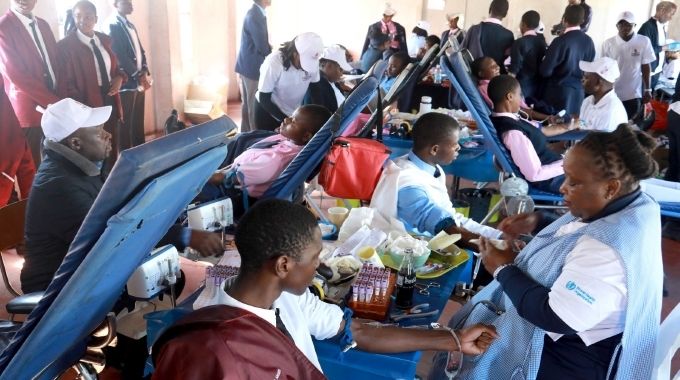
Robin Muchetu [email protected]
A remarkable show of generosity by young Zimbabweans has boosted the country’s blood reserves, with 714 units of blood collected during World Blood Donor Day commemorations last Friday, surpassing the target of 600 units and providing a critical lifeline for patients in need of emergency care across the country.
The collection, achieved at the Zimbabwe Prisons and Correctional Service (ZPCS) Ntabazinduna Training School, comes as Zimbabwe requires an average of 415 units of blood every day to meet the needs of hospitals nationwide.
The donations are expected to strengthen national blood stocks and support patients involved in road traffic accidents, women experiencing complications during childbirth, surgical patients and others whose survival depends on timely blood transfusions.
The achievement was largely driven by schoolchildren from 11 schools across Matabeleland North Province, once again demonstrating the crucial role young people play in sustaining Zimbabwe’s blood donation programme.
According to the National Blood Services Zimbabwe (NBSZ) chief executive officer, Ms Lucy Marowa, the blood bank requires a five-day supply of blood to be safe with 415 units required daily.
“So, we have, as a nation, determined that the country needs about 415 units of blood per day, but is split according to the different blood groups. We know how much blood group O, A and B that we need in the various quantities because we don’t need the same of each blood group,” she said.
“We normally need more of the blood group O than we do of the A and of the B. So, depending on these ratios, we need about 415 units per day,” said Ms Marowa.
“For us to say, we are happy as a country when we say we need five-day supply, we are saying we need just over 2 000 units of blood, but most of that will be blood group O followed by blood Group A and blood Group B in the required ratio.
“So, that’s when we say we have enough blood in the country. For us to be extremely happy we need five days minimum, so when we have seven days, we have excess, you are multiplying that 415 units that you need per day just by the number of days, that is the science behind for us to service all the hospitals in the country adequately each day,” she explained.
On Friday 11 schools were invited to donate blood at the World Blood Donor Day commemorations with the NBSZ highlighting that youths form the core and consistent donors who must be encouraged to continue donating even in their adulthood.
“Traditionally, the national blood programme has been driven by the youth and taking a look at the history of NBSZ it shows that over 70 percent of the blood has been coming from the youth over the years and this really had been a cause for concern for us,” said Ms Marowa.
“We have done a lot of effort to skew this towards the adults, and if you look at the statistics of 2025, this has now changed with 55 percent of the collections coming from the youth and 45 percent now coming from the adults. However, it’s very important to keep the youths engaged.
“We see that after school, they become lost to follow-up as they become busy with life, everything takes over, and they become lost, but once the habit is being inculcated, it’s easy for them to take it into adulthood and also pass it on to their own children and it becomes something that becomes a norm,” she added.
“We always want to make sure that the blood bank keeps on getting better by the day. So, we believe that in the next two weeks or so, we will be achieving this supply, which is in excess of what we normally need, but we are happy with an excess rather than a comfortable position. So, this is where we are, four days at the moment, but aiming to get to seven days so that we really are in a very comfortable position.”
Chief Medical Officer for United Bulawayo Hospitals, Dr William Busumani, who was the guest of honour at the celebrations said the blood donations from school children form the bulk of all donations they receive.
“These young people are still free from a lot of diseases so they are a critical source of blood for the health system and it is critical that we rope them in from an early age.
We can never overemphasise the importance of blood. When a patient comes to a hospital, and they are bleeding, coming from a road traffic accident or has complications during childbirth, they need blood; there is no substitute. So, it is vital that we support the NBSZ in donating blood that saves lives,” added Dr Busumani.
The ZPCS said the relationship between them and NBSZ has been ongoing, built on mutual respect and shared commitment to serving the community. Inmates also donate blood during blood drives.-@NyembeziMu