


 malvernmugadzikwa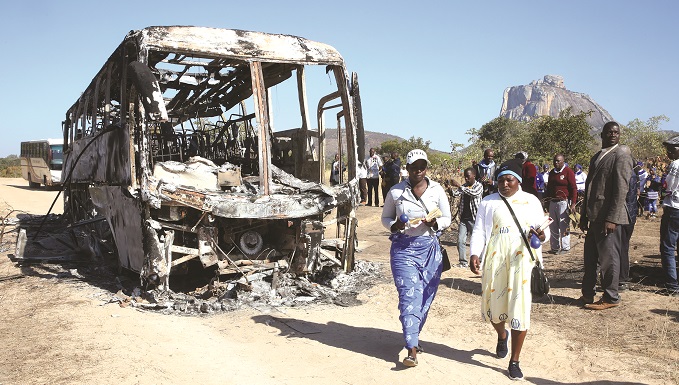
Fatima Bulla-Musakwa
ROAD traffic accidents increased by 8 percent during the first eight months of 2024 compared to the same period in 2023, according to the Traffic Safety Council of Zimbabwe (TSCZ).
This tragic trend has resulted in numerous families mourning their loved ones, including breadwinners, while some victims have suffered life-altering injuries.
Last year was marked by a significant number of severe road traffic accidents.
At least 39 461 road traffic accidents were recorded from January to September 2024, compared to 36 628 over the same period the previous year. During that period, 1 532 people were killed compared to 1 373 the previous year, leaving 7 438 and 6 789 injured, respectively.
With 20 072 accidents recorded in Harare, the capital had the highest number, followed by Bulawayo (3 310) and Mashonaland West (2 593).
The frequency of accidents has left many searching for answers to what can be done to deal with these tragic occurrences.
Efforts to improve road safety
The Government, through the Ministry of Transport and Infrastructural Development, stepped up its road construction efforts last year to ensure better connectivity and smooth travel. Roads within various parts of Harare got a facelift.
For instance, roads leading to the new Parliament building in Mt Hampden were rehabilitated, so were many others within the greater Harare metropolis.
Many major highways were either completely redone or had some parts rehabilitated.
Coupled with that, the TSCZ conducted road safety awareness campaigns across the country. They included the Festive Season Road Safety Awareness Campaign that was launched late last year.
Last month, the First Lady, Dr Auxillia Mnangagwa, held a 5km walkathon to the Marondera tollgate to promote road safety ahead of the festive season and also mark World Day of Remembrance for Road Traffic Victims.
Also, in September, Zimpapers launched the Zimpapers Safe Driving Campaign to draw attention to the issue of frequent fatal accidents, as road carnage statistics continued to grab the headlines.
Attitude change
Despite the awareness campaigns and rehabilitation of roads, accidents, mainly caused by human error, continue to occur on widened roads and at junctions controlled by traffic lights.
In October, a commuter omnibus driver ignored a traffic light and turned right into the lane of an oncoming fuel tanker at the Kuwadzana turn-off, resulting in the loss of seven lives, while scores of other people were injured.
There were more reckless acts that occurred around the country, including overloading and drink driving.
The culture of going through a red traffic light has gradually developed into a norm for some drivers, who put their lives and those of others at risk.
There are also other drivers, especially of public transport vehicles, who have developed the habit of changing lanes without indicating their intentions to other road users behind them. The creation of imaginary lanes by impatient drivers is also another manifestation of improper conduct on the roads. This is done to beat traffic congestion, normally at peak periods of the day, especially in Harare.
This, however, results in even worse congestion.
Statistics show that 4 270 hit-and-run accidents were reported between January and September 2024, compared to 3 782 in the same period the previous year, which tells a story about bad road attitudes. This is a 13 percent increase.
Throughout last year, national police spokesperson Commissioner Paul Nyathi consistently called for self-introspection on the part of drivers.
“People are behaving as if there is no tomorrow, as if the world is ending today,” he said. “As Zimbabweans, we must engage in self-reflection. What kind of driving culture do we want for our country?”
Loss of family members
While arguments on road traffic accidents focused mainly on the injuries and fatalities that occurred, many forgot the grieving survivors and families, who had to deal with the tragic experiences. A disturbing trend that characterised last year’s accidents was the loss of numerous members of the same family at once. For instance, on October 2, a Hwedza family lost seven members — three siblings, two in-laws, a niece and a grandchild.
The family spokesperson, Mr Archibald Marerwa, highlighted how they had struggled to cope with grief and bills since the occurrence.
“We do need financial assistance following that tragedy that affected us as a family. Some children and spouses were left without a breadwinner,” he said. “As a family, we support each other, but there is a point where assistance is needed. If we talk of grief, it’s something that we cannot be able to explain at the moment.”
Also, in September, five girls aged between 10 and 14, all from the same family at the Bindura Rural District Council compound, died after being hit by a vehicle that veered off the Harare-Mukumbura road, on the outskirts of Bindura town.
In June, an unroadworthy bus ferrying Anglican Church pilgrims returning from the Bernard Mizeki shrine in Marondera caught fire, burning eight passengers, including a six-month-old baby.
Ten other passengers were injured. All these are real people behind the statistics.
Way forward
Collective efforts are required by all stakeholders in the transport sector, including drivers, to improve safety on the roads.
Recently, TSCZ media and corporate communications officer Mrs Lucy Kuwandira Mapfumo pointed out that overloading is one of the leading causes of road crashes.
“Overloading vehicles increases the risk of road crashes in several ways, which include increased stopping distance, tyre blowouts, brake failure and decreased stability,” she said.
“As Traffic Safety Council of Zimbabwe, we urge motorists to avoid mixing goods and passengers and generally to avoid overloading their vehicles to preserve lives.”
Specialist psychologist Dr Lovemore Makoni called for attention to grieving families, saying counselling was necessary.
“There is a lot of work that needs to be done with such families, to do what we call grief coaching so that they can be helped to be aware of what they are going through and also help them think differently and in a way that is productive,” he said.
Observing road rules and regulations is the ultimate solution.
Comm Nyathi did not mince his words when he emphasised the need to take action, as law-enforcement agents, to nip the problem in the bud.
“If that means revoking licences, so be it. If it means sending people to jail, then that must happen. Only then will people understand that driving is a collective responsibility; it is not just about getting behind the wheel.
“People need to change their attitudes and cultivate a proper driving culture,” said Comm Nyathi.



 Online Reporter