admin
admin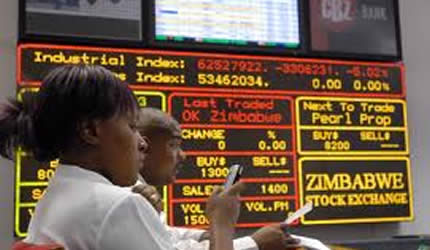
expected to hold national polls in July this year, ending the inclusive Government formed by the country’s three main political parties four years ago.
Since the beginning of the year, heavyweight counters have been dominating trades and some analysts believe the upward trend could be maintained until June.
“The ZSE will perform strongly in 2013 ahead of the forthcoming elections in June/July 2013,” said Invictus Securities in its 2013 Zimbabwe Equity Strategy Outlook Report. “We expect ‘a flight to safety’ as investors rotate into blue chip stocks ahead of elections.
“However, we believe that post-elections investors will look for value amongst the mid-tier stocks.
“We expect the market to reach US$5,1 billion implying upside of 30 percent.”
A senior stockbroker said the market would remain solid before and after polls, but that would “hugely” depend on the prevailing political environment.
“The blue chips will remain solid before the elections with foreigners being the main buyers,” said the broker. “But obviously that hugely depends on the environment. If there is no politically motivated violence or if the current calmness continues prevailing, even second-tier shares are likely to be solid after the elections.
“I don’t think it matters which side (political party) is elected but we hope any Government that will be voted into power will be committed to come up with policies that will promote growth and improve the country’s investment climate.”
The ZSE industrial index has risen 24 percent since December 31, 2012, to 188,86 points while the mining index has jumped 4,65 percent to 68,15 points. Despite the strong rally, the stock market remains depressed. While the economy has recovered over the last three years, market activity has remained subdued.
Despite the marginal increase in turnover in 2012, from US$447,5 million to US$448,2 million, volumes declined significantly from 4,4 billion to 3,5 billion shares.
The same trend is observable since 2010, where volumes have declined steadily, while turnover has remained relatively stable at circa US$400 million.
Foreign participation has improved steadily from 35,4 percent in 2009 to over 47,2 percent of total value traded, in 2012. The trend may continue in 2013 as sentiment towards Zimbabwe improves and foreign investors take positions.
There some significant improvements in corporate profitability since 2012, but share prices have remained largely static for most ZSE listed entities leading to a significant compression in valuations, especially in second-tier companies.
“We expect these companies to be rewarded for their strong performance in 2013 as sentiment towards Zimbabwe improves and multiples expand,” said Invictus.
“It is interesting to note that lack of correlation between the ZSE and most global markets. We estimate this correlation to be close to zero if not negative.”
While the ZSE has significantly lagged behind its regional peers due primarily to negative perception of Zimbabwe among investors, the increase in foreign participation in recent years is very positive and we expect this trend to continue post elections.
“The forthcoming elections present a good opportunity to demonstrate that the country is maturing as a democracy and is rapidly becoming a more attractive investment destination for investors,” it said. “Corporate activity is likely to increase, especially in the banking sector as banks seek desperately to comply with the new capital requirements. Furthermore, we expect a number of listed companies to raise expansion capital as the economy recovers.
“We encourage investors to take positions ahead of elections and strongly believe that Zimbabwe is poised for a strong recovery in 2014. Regardless of the outcome of elections we firmly believe that the new government will adopt a more investor friendly approach in order to raise much needed capital for expansion and job creation.”



 Online Reporter