Online Reporter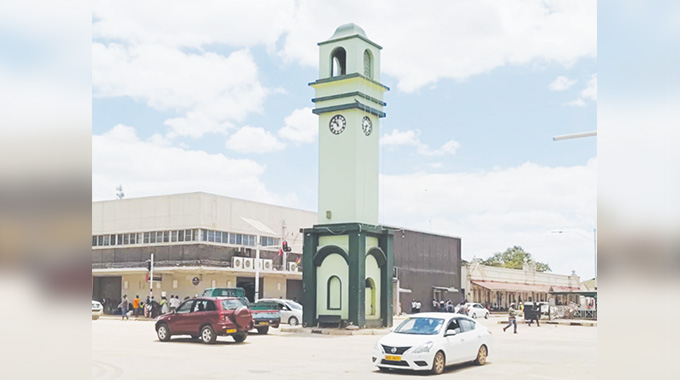
Patrick Chitumba, [email protected]
FOR more than eight decades, the Boggie Clock Tower has stood sentinel over Gweru’s central business district — defying time, stirring curiosity and anchoring the city’s identity.
Silent or sounding, loved or feared, the iconic tower continues to loom large — a timeless reminder that some structures are more than brick and mortar. They are memory, mystery and meaning, etched into the skyline.
Erected in 1937, the 60-foot structure rises at the busy intersection of Main Street and Robert Mugabe Way, its weathered elegance a silent witness to the city’s changing fortunes. To some, it is a relic of colonial architecture; to others, a site wrapped in myth, ritual and urban legend. But to Gweru, the Boggie Tower is simply irreplaceable.

Tourists routinely pause to snap photographs beside the iconic landmark, while the Zimbabwe Tourism Authority (ZTA) has repeatedly featured it in marketing material promoting the Midlands capital. Yet beyond its postcard appeal lies a deeper story — one of love, politics, engineering prowess and enduring symbolism.
The tower was commissioned by Jeannie Boggie, widow of Major William James Boggie, a former Midlands Member of Parliament in the then Rhodesian legislature. Major Boggie is remembered for introducing the original legislation that led to the establishment of Hwange Game Reserve, now one of Africa’s largest wildlife sanctuaries and a major foreign currency earner for Zimbabwe.
In honour of her late husband, Jeannie spared no expense. The clock mechanism was imported from London, complete with Westminster chimes that once rang across the town. Legend has it that during construction, Jeannie insisted on an underground toilet being built near the tower so she would not have to use public facilities while overseeing the project.
As years passed, however, not everyone appreciated the clock’s punctual enthusiasm. Guests at the nearby Midlands Hotel, formerly the Horseshoe Hotel, complained that the chimes — ringing 11 times at 11PM and 12 times at midnight — disrupted their sleep. Eventually, the local authority silenced the chimes.
Today, both the Boggie Tower clock and the once-proud clock at Gweru City Council offices stand frozen in time, their mechanisms no longer working. Yet their silence has done little to diminish their stature.
Recently, the tower reclaimed headlines after a daredevil climber scaled its heights, prompting a dramatic rescue by the Gweru Fire Brigade, which safely brought the thrill-seeker down. The incident left onlookers stunned and once again drew attention to the tower’s magnetic pull.
At Independence, the monument faced an uncertain future. City leaders objected to inscriptions linked to the colonial era and briefly considered demolishing it. Instead, the wording was amended — and the tower endured.
In an interview, Gweru City Council spokesperson Ms Vimbai Chingwaramusee said the city identifies itself with the Boggie Tower.
“It is a symbol of the city’s rich history and cultural identity. The 60-foot-tall tower was erected in 1937 by Jeannie Boggie, the widow of Major William James Boggie, in memory of her late husband, Major Boggie,” she said.
“It is a symbol of the city’s history and cultural identity. For years, people simply looked up to check the time as they walked through the CBD. It remains a key landmark and point of reference.”
Ms Chingwaramusee said efforts to repair the clock have been hampered by the scarcity of imported parts.
“It is unfortunate that the clock is no longer working, just like the one at Town House. We are still exploring ways of restoring it,” she said.
Mr Obvious Gonamombe, acting chairperson of the Gweru Residents Trust, said the tower’s stillness reflects a broader neglect of the city’s heritage.
“These monuments once defined the city. Now they stand watching over us in silence. One wonders if they will ever tick again,” he said.
Beyond the Boggie Tower, Gweru boasts several other heritage landmarks that tell the city’s story. Mtapa Hall, where Zanu held its first congress in 1964, is now a designated national monument undergoing renovations.
The Zimbabwe Military Museum, established in 1974, chronicles the country’s armed forces history through uniforms, weapons, vehicles and aircraft. The former Gwelo Stock Exchange reflects the city’s past as a thriving commercial hub.
Ms Chingwaramusee said these landmarks weave a narrative of Gweru’s identity.
“These landmarks that include Boggie Clock Tower, Mtapa Hall, the Zimbabwe Military Museum, and the Gwelo Stock Exchange — weave a narrative of Gweru’s history, cultural identity and resilience,” she said.
National Museums and Monuments of Zimbabwe (NMMZ) Central Region acting director Mr Clapperton Gutu confirmed that the Boggie Tower is officially recognised as a historical monument.
“Boggie Tower remains one of the most important heritage sites in the City of Progress,” he said.