Online Reporter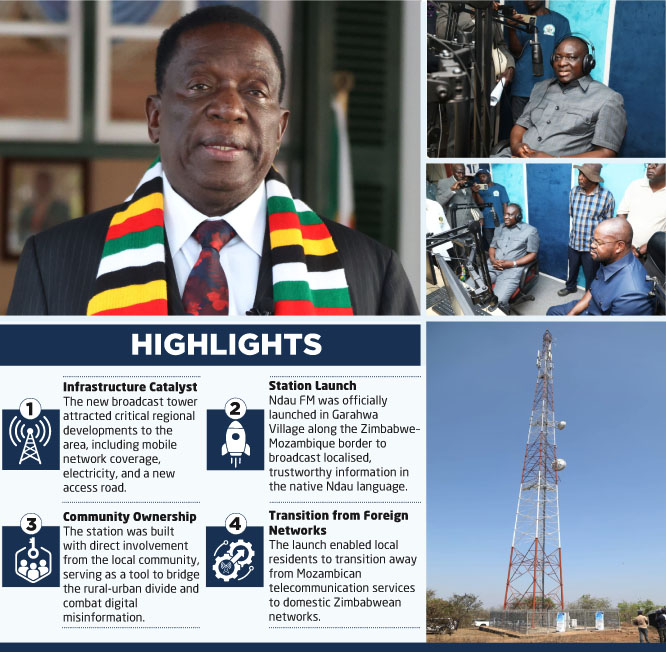
Ray Bande
Senior Reporter
RESIDENTS in the border area of Chipinge South Constituency and surrounding districts have transitioned away from Mozambican telecommunications services following the official launch of Ndau FM in Garahwa Village yesterday (Thursday).
Information, Publicity and Broadcasting Services Minister, Dr Zhemu Soda officially launched the Ndau FM community radio station in Garahwa, along Zimbabwe’s border with Mozambique.
The launch coincided with local commemorations for the International Day for Universal Access to Information.
Addressing the gathering, Dr Soda highlighted the regional significance of the project.
“For many years, communities in this area relied on telecommunications services from our neighbours in Mozambique. The launch of Ndau FM is, therefore, a huge step forward. It brings information services closer to you and strengthens your access to information. This achievement is a clear sign of the Government’s commitment to Vision 2030 – to build an empowered and connected society where no community is left behind,” said Dr Soda, adding that the establishment of Ndau FM yielded additional benefits for local communities, including access to domestic mobile networks.
“The story of Ndau FM is a perfect example of our national mantra: ‘Nyika inovakwa nevene vayo.’ This station is not something that was just given to you. It is something you have built with your own hands. It is a station that the community owns and can use to drive its own development. This is what happens when a community takes ownership of its future. You become active partners in building our nation,” said Dr Soda.
He added that erecting the broadcast tower spurred broader development in the district at large.
“When we installed the transmission tower for Ndau FM, something extraordinary happened. That infrastructure became a foundation for other development enablers. The mobile network operators (MNOs) – under the able leadership of my colleague, the Honourable Minister Tatenda Mavetera – were able to ride on that infrastructure. They brought mobile connectivity to this community, using the tower that was built for this radio station. But that is not all. The tower and the presence of the radio station also attracted other essential services. A road was developed. Electricity came. What started as a simple radio station has
become a magnet for the kind of development that communities need to thrive,” said Dr Soda.
Dr Soda said mobile network operators using the transmission tower demonstrates how community radio can drive infrastructure growth.
“This is what it means when we say community radio is a catalyst for development. It is not just about broadcasting. It is about bringing services and development enablers to the people. It is about creating the conditions for communities to grow and prosper. The mobile network operators who are now here, riding on the infrastructure that was built for this radio station, are a testament to the power of community radio to transform lives. Under the leadership of Honourable Mavetera, the Ministry of Information and Communication Technology and Courier Services is ensuring that the benefits of digital connectivity reach every corner of Zimbabwe. This partnership between community radio and mobile network operators is a shining example of what we can achieve when we work together,” said Dr Soda.
The global observance for the International Day for Universal Access to Information takes place annually on September 28.
“The International Day for Universal Access to Information, which was proclaimed by UNESCO in 2015 and later recognised by the United Nations in 2019, is a reminder of a simple, but powerful truth – information is not a luxury. It is a right. It is your right. It is a right that is protected in our own Constitution. It is a day for all of us — Government, communities, the media, and every stakeholder — to ask ourselves: is information reaching everyone? Is it timely? Is it relevant? And most importantly, can people understand it?” said Dr Soda.
This year’s commemorations are being held under the theme: ‘Upholding Information Integrity in the Digital Age’.
“In a world where news travels faster than ever, and where artificial intelligence can create and spread information in seconds, this theme is a powerful reminder. It reminds us that we must not only have access to information, but we must be able to trust it. But let me be clear: access to information is not a privilege. It is a fundamental human right. Without information, how can our people fully participate in building their communities and their country? And without information in a language people understand, can we truly say they have access? The answer is no,” said Dr Soda, citing community broadcasting as an essential tool to narrow the rural-urban divide.
“That is why the Government, through Statutory Instrument 39 of 2020, deliberately opened the airwaves for community radio stations. We recognised that communities need their own platforms — where they can speak, listen, and be heard. Community radio is one of our most important tools in bridging the gap between our cities and our rural
areas. We want the benefits of the information society to reach every corner of Zimbabwe, no matter where you live or what language you speak. This is what it means when we say we will leave no one and no place behind. This community radio station is not just a platform for information. It is a catalyst for development,” he said.
Dr Soda emphasised that Ndau FM will provide localised, credible news to combat misinformation.
“We are living in an age where information is more powerful than ever. It is the age of AI, where fake news and manipulated information can spread across the world in seconds. This makes the role of a trusted community station like Ndau FM absolutely vital. Ndau FM can be a bridge between you and credible information. It can ensure that you get news that is accurate, timely, and relevant, presented in the language you understand. In this digital age, universal access must go hand-in-hand with information integrity. You must not only have access to information; you must have access to information you can trust — information that helps you make the best decisions for your family and your community.”
Addressing the community’s role in building the station, Dr Soda added: “What makes today so meaningful is that this station was not just built for the community. It was built with the community. It is a radio station by the people, with the people, and for the people. This station was established to share social, economic, cultural, and environmental information in the Ndau language, for the benefit and development of Ndau-speaking communities.
“This is where the principle of universal access to information becomes real. It becomes real when a farmer in Garahwa hears agricultural advice in a language he understands. It becomes real when a child learns something new in their mother tongue. And it becomes real when a community receives a timely warning about a cyclone, flood, or disease outbreak in a language they understand. That information can be the difference between life and death,” he said.
Minister of State for Manicaland Provincial Affairs and Devolution, Advocate Misheck Mugadza commended the national leadership for expanding provincial broadcasting access.
“The people of Manicaland will remain grateful to President Mnangagwa’s able leadership for creating an enabling environment that has resulted in more radio stations opening in the province. The provision of mobile networks through the establishment of Ndau FM is clear testimony of the Second Republic’s determination in its development agenda,” he said in a speech read on his behalf by a director in his office, Mr Joseph Mashingaidze.
Chipinge Rural District Council chief executive officer, Mr Blessing Mavhosha pledged ongoing local authority support for the station.
“As a local authority, we are proud to have been associated with the formation and establishment of Ndau FM, when we provided space for the construction of the station. We will continue finding ways of supporting Ndau FM so that it fulfills its mandate, which is important to us as we seek to develop our largely remote area,” said Mr Mavhosha.
Representatives from the United Nations Development Programme (UNDP) and UNESCO commended the Garahwa community, for its resilience and collaboration during the setup phase.
Officials from the Ministry of Information, Publicity and Broadcasting Services, Broadcasting Authority of Zimbabwe, Transmedia, Zimpapers, Zimbabwe Broadcasting Corporation (ZBC), and Zimbabwe Association of Community Radio Stations (ZACRAS) attended the launch