dyton mupawaenda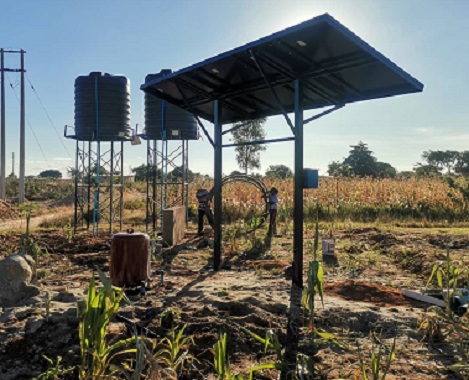
Patrick Chitumba–Midlands Bureau Chief
A LOCAL non-governmental organisation, 4-H Zimbabwe Foundation, has launched an ambitious project that will see over 5 000 villagers benefiting from four solar-powered boreholes in the Chiwundura area outside Gweru.
The foundation launched a project titled, “Enhancing livelihoods through water – women-food nexus interventions”, that will be implemented in eight wards in Chiwundura.
Under the project, over 10 000 trees are expected to be planted while 40 extension officers will be equipped with tablets in order for them to work on smart agriculture programmes with villagers to ensure food security and nutrition.
The launch was held at Vungu Rural District Council and was graced by Vungu Constituency legislator and Ministry of Health and Child Care Deputy Minister Sleiman Kwidini, Chief Chiwundura and Government officials.
4-H Zimbabwe Foundation executive director Mr John Muchenje said according to the 2022 census, Chiwundura had a population of 65 818 people with women comprising 50,7 percent of that population while men numbered 49,7 percent.
He said the area is predominantly a communal farming area with small land sizes of less than three hectares per household.
“The area, like many others in Zimbabwe, has not been spared of disasters such as recurring droughts, decreasing rainfall, heatwaves, low crop yields, water and food insecurity. There has been a shift of gender roles as women now walk long distances to fetch water and, in some cases, men have taken that role,” said Mr Muchenje.
4-H Zimbabwe seeks to address water scarcity, women’s vulnerability and food insecurity emanating from the impact of climate change in Chiwundura.
“With support from the International Climate Initiative (IKI), 4-H Zimbabwe aims at enhancing local based adaptation anchored on improving water security and food production for households in Chiwundura District between March 2024 to May 2025. The project is targeting women and youth as the primary beneficiaries since they are more vulnerable to climate change effects. In total, the project will target 5 964 men and women as direct beneficiaries.”
Mr Muchenje said 4-H Zimbabwe will strategically cooperate with expert and policy-based partners such as the Ministry of Lands, Agriculture, Water, Fisheries and Rural Development (MoLAWFRD) and the Ministry of Environment, Climate and Wildlife as well as local community leaders that will assist in climate risk analysis policies and feed into community adaptation strategies.
“4-H Foundation already has a Memorandum of Understanding (MoU) with the MoLAWFRD, which understanding assisted on farmers’ mobilisation and coordination through extension workers who interact with farmers on a day-to-day basis.
“Through this project, 4-H Zimbabwe is pursuing Sustainable Development Goals which include no to poverty, zero hunger, good health, water provision and climate action. The project also complements Government efforts in building the resilience of communities against climate change through National Development Strategy 1 (2021 to 2025) which alludes to the thrust of environmental protection, climate resilience, natural resources management and sustainable natural resource management,” he said.
Mr Muchenje said key project activities include the establishment of eight community women-led gardens, training on various thematic areas as well as drilling and fencing of solar-powered boreholes.
He said a climate change indaba would be held to create awareness of climate change adaptation strategies and present current policies on climate change mitigation and adaptation strategies in Zimbabwe.
“4-H Zimbabwe’s vision is premised on Zimbabwe which has a sound climate change action plan, with sustainable adaptation and mitigation strategies owned and suitable for vulnerable, marginalised rural and urban communities. 4-H Zimbabwe also aims to achieve a food secure, safe and clean water Zimbabwe with sustainable adaptation and mitigation,” he said.
Deputy Minister Kwidini commended the NGO for bringing positive development to the Chiwundura area.
“We want to see Chiwundura and Gweru District as a whole grow. This programme, enhancing livelihoods through women, water and food nexus intervention is a welcome development which dovetails with the Second Republic’s philosophy of leaving no one and no place behind. Four boreholes will be drilled and that is complementing the Presidential borehole drilling programme,” he said.



 Online Reporter