Online Reporter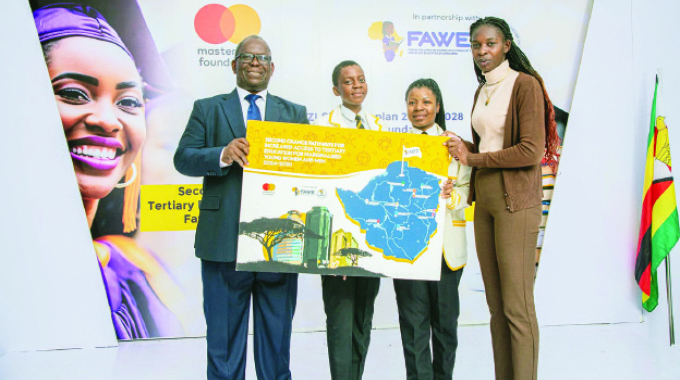
Fungai Lupande-Features Writer
AT Aparuquere, ominously translated to “spoiled home”, a primary school in northern Uganda, Gloria Achola began a journey that defied the obstacles often faced by girls.
Now a fourth-year medical student at Gulu University, Gloria’s story reflects the reality for many girls from disadvantaged backgrounds in Africa.
Speaking at the launch of the MasterCard Foundation programme in Harare recently, Gloria recounted her daily routine at Aparuquere Primary School, which included a three-kilometre trek to fetch water.
Her allocation of the water was “three to four cups” for showering and washing.
The school has 800 learners, many of whose families struggle to afford basic necessities.
Despite these hardships, Gloria excelled academically and was the top student.
In 2014, Gloria’s academic prowess led to her being fast-tracked to Primary Seven, where she achieved a coveted first grade, and received a blanket as a gift from her head teacher, a symbol of her hard work.
With support from her aunt, she moved to a central school for secondary education. After earning another first grade in 2018, her journey faced major hurdles.
The bursary that had supported her for four years ended after Senior Four, and by 2019, as she entered Senior Five, her family’s financial situation became dire.
Unable to pay for Senior Six, Gloria returned to her village in 2020, where she helped her mother with fishing and selling small fish.
Just when it seemed her aspirations for a better future were fading, she received a lifeline in 2021.
A friend informed her about a programme called the Higher Education Access Certificate.
Gloria, who had no cellphone, borrowed one, purchased data and researched on the programme.
Eager to join, she faced scepticism from her father and other family members, who claimed the course “doesn’t exist”.
However, her mother, the unwavering support in her life, stepped up, saying, “If you believe this course can help you and change your future, I’m ready to borrow money.”
With 50 000 Ugandan shillings, (approximately US$15), borrowed for the application, Gloria enrolled in the Higher Education Access Certificate programme.
She ranked among the top four in her class of 65 and was admitted to study medicine, fulfilling a childhood dream.
This pursuit took on greater significance after her mother passed on from liver cirrhosis.
Gloria said, “I want to be a doctor because my mother died of liver cirrhosis. I want to find out what the problem was and why her life wasn’t saved.”
Gloria’s story exemplifies the power of education and the resilience of a determined individual.
Access to higher education remains one of the most pressing challenges in sub-Saharan Africa today.
Speaking at the same event, Professor Pardon Kuipa, Vice Chancellor of Lupane State University, said higher education is a cornerstone of social transformation.
“Countries with higher rates of tertiary education completion tend to be more developed socially and economically,” he said.
Prof Kuipa explained that in developed regions, such as Europe and North America, over 80 percent of eligible populations are enrolled in higher education institutions — a benchmark many aspire to reach.
In stark contrast, sub-Saharan Africa has an average gross enrolment ratio of only 15 percent.
This means that out of every 100 eligible young people, only 15 are enrolled in higher education.
This glaring disparity reflects systemic barriers such as unequal access to quality primary and secondary education, pervasive poverty, and other socio-economic challenges that limit educational opportunities.
“The consequences of such low enrolment rates are profound, impacting not only individual prospects but also the overall development trajectory of nations,” said Prof Kuipa.
Recognising this, leaders and institutions across the region are beginning to respond.
Universities in Zimbabwe have undertaken commendable initiatives aimed at increasing representation in higher education.
“Transforming societies through education requires collective will and innovative solutions, and it is incumbent upon all stakeholders, governments, universities, communities, and individuals to work collaboratively toward this goal,” he added.
More than 10 550 young women aged 15 to 25 from 10 chapters of the Forum for African Women Educationalists (FAWE) in Zimbabwe, Malawi, Zambia, Tanzania, Uganda, Senegal, Liberia, Ethiopia, Ghana and Rwanda will benefit from the second phase of the MasterCard Foundation Programme.
The FAWE Zimbabwe Chapter (FAWEZI) has recently launched this second phase in Harare, marking an important step forward in expanding educational access for young women in the region.
Officially launching the MasterCard Foundation programme, Higher and Tertiary Education, Innovation, Science and Technology Development Permanent Secretary, Professor Fanuel Tagwira, said the initiative aligns with President Mnangagwa’s vision of creating “an inclusive society that leaves no one and no place behind.”
Additionally, the initiatives by FAWEZI support the Continental Education Strategy for Africa (CESA 2026–2035), which promotes transformative, inclusive, and lifelong learning systems across the continent.
Prof Tagwira added that the MasterCard Foundation programme was presented to Zimbabwe’s Ministry of Higher and Tertiary Education, Innovation, Science and Technology Development in 2024 and will run until 2030.
He praised FAWEZI for its efforts in promoting equitable access to education and championing science, technology, engineering, arts, and mathematics education for girls and young women.
“The programme closely aligns with Zimbabwe’s National Development Strategy 1, which prioritises human capital development and supports our ongoing efforts to close the gender gap in higher education, particularly in the sciences,” said Prof Tagwira.
“While women have made significant strides in the arts, achieving parity with or exceeding male participation, female representation in STEM fields remains disproportionately low, at approximately 37 percent.”
Prof Tagwira referred to a national skills audit conducted in 2019, which revealed a severe shortage of science and engineering professionals, highlighting the gender gap in these areas.
“This programme is timely and strategic, as it directly addresses our national priorities,” he stressed. “It improves access to tertiary and technical vocational education and training (TVET) through innovative, gender-inclusive pathways and stronger industry connections.”
Central to the MasterCard Foundation programme are eight strategic components designed to eliminate systemic barriers and support students from enrolment through to employment.
These components include a Higher Education Access Programme that facilitates entry into tertiary institutions for youth from marginalised and economically disadvantaged backgrounds.
A Higher Education Access Certificate (HEAC) is a bridging qualification that helps academically underprepared students to meet entry requirements for further study. It uses a responsive curricular model that promotes inclusive, flexible teaching approaches aligned with evolving labour market demands.
FAWEZI executive director, Mrs Lydia Madyirapanze, said the programme will also assist teen mothers in re-entering and completing their education.



 leeroy