Online Reporter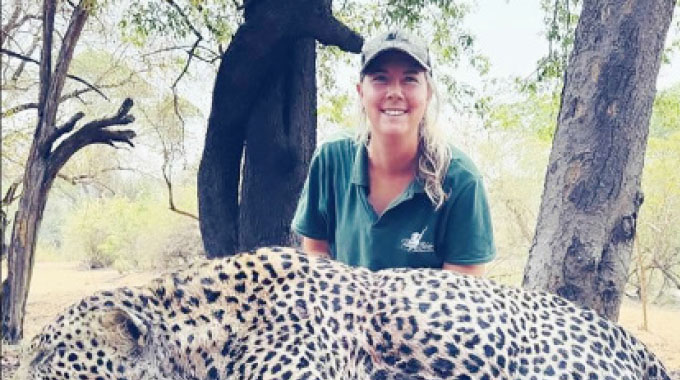
Mashudu Netsianda, Deputy National Editor
THE African bush is unforgiving, demanding courage, patience and bravery, qualities Ms Tanya Blake possesses in abundance.
With sun-kissed skin, windswept hair and an unshakable passion for the African wilderness, Ms Blake has carved a unique place for herself in Zimbabwe’s hunting fraternity, breaking barriers in a field long dominated by men.
At 36, the Bulawayo-based conservationist is Zimbabwe’s only female professional hunter (PH) and just the fourth woman in the country’s history to attain the prestigious qualification.
When she earned her licence in 2014, she became the first woman in three decades to join a profession long regarded as the preserve of men.
In a profession where women are few and far between, Ms Blake continues to blaze a trail, proving that courage and determination know no gender.
Growing up on a family farm surrounded by wildlife, she developed a fascination with animals and the outdoors at an early age.
“I grew up in a very strong hunting-oriented family and it was always my dream to leave school and go straight into the bush and study towards attaining a professional hunter’s licence,” Ms Blake said.
Her parents, however, wanted her to pursue a more conventional career.
“I enrolled for a secretarial course, but halfway through my first job I quit to pursue my dream,” Ms Blake said.
The decision would set her on a difficult but rewarding journey. Breaking into the hunting industry proved challenging.
“My dream was to go straight into a hunting camp, but being a woman, it was difficult to convince safari operators to give me a chance because it’s a male-dominated industry,” Ms Blake said.
She recalled how some safari companies offered her apprenticeship opportunities only to withdraw them when they discovered she was a woman.
“My dad would sometimes apply on my behalf and companies would offer me an apprenticeship, but the moment I showed up and they realised I was female, they would start coming up with excuses,” Ms Blake said.
Undeterred, in 2009, she embarked on the gruelling journey towards becoming a professional hunter, a process widely regarded as one of the toughest wildlife qualifications in Africa.
Candidates are required to undergo advanced first aid training, pass examinations on wildlife management, flora and fauna, ballistics and hunting regulations, before serving an apprenticeship under qualified professional hunters.
“It was physically and emotionally demanding, but the reward is worth it because at the end of it you earn the right to call yourself a professional hunter. Some of the biggest barriers I faced were that the men had no faith in my physical strength and also that I would be brave enough in the face of a charging dangerous game animal,” Ms Blake said.
In October 2014, after years of training, Ms Blake finally obtained her full professional hunter’s licence.
She remembers one milestone vividly.
“There were 40 candidates during the shooting test and I came second,” Ms Blake said.
She said the profession is about much more than hunting.
“As hunters, animals are our assets because it’s not just about money. It’s about creating habitats where wildlife can survive for generations. We have a sincere love and respect for wildlife, enough to look after it in ways many people may not understand,” Ms Blake said.
The hunting industry often comes under scrutiny, especially following high-profile incidents such as the killing of Cecil the Lion.
The hunting industry often comes under scrutiny, especially following high-profile incidents such as the killing of Cecil the Lion in July 2015.
The 13-year-old male lion, was illegally killed by American trophy hunter Walter Palmer just outside Hwange National Park.
Palmer, who allegedly paid a $55 000 fee, used an elephant carcass as bait to lure the lion out of the protected reserve before shooting it with a crossbow.
Since Cecil was wearing a GPS tracking collar as part of a research project by Oxford University, the animal’s death was highly documented.
But Ms Blake insists ethical hunting and conservation go hand in hand.
“Our common goal as hunters is to educate people about protecting wildlife because it generates huge revenue for Africa. Due to a constant increase in human numbers, wild habitats are shrinking and unlike poachers, professional hunters take minimal numbers under strictly regulated quotas,” she said.
Ms Blake said professional hunting also helps curb poaching while generating revenue that benefits local communities.
“It also benefits the communities around us through employment opportunities, meat from harvested animals and revenue raised through hunting. With this money, schools can be built, clinics improved and boreholes drilled to provide clean water,” she said.
Ms Blake said professional hunting in Zimbabwe is tightly regulated, with wildlife censuses conducted regularly to determine sustainable hunting quotas.
“If all the animals disappear, what will tourists come to see? Visitors don’t only come for Victoria Falls or the rocks at Matopos. They come to see our lions, elephants and giraffes too,” she said.
Ms Blake said hunters work closely with the Zimbabwe Parks and Wildlife Management Authority, which monitors their activities to ensure sustainable wildlife management.
Today, the professional hunter spends much of her time in the bush, leading safaris and introducing clients to Zimbabwe’s rich wildlife heritage.
Ms Blake carries with her a treasured family heirloom in the form of a .416 Rigby rifle passed down from her grandfather, then her father and eventually to her when she qualified as a professional hunter.
She said the gun has a lot of history attached to it. She said among her many achievements, one safari remains particularly memorable.
“One of my greatest achievements was helping a client harvest one of the oldest leopards in Zimbabwe. It was an incredible safari and we loved every bit of it, fully taking in all the flora and fauna around us,” she said.
Ms Blake said the bush remains her home, a place where passion, adventure and conservation come together.