Online Reporter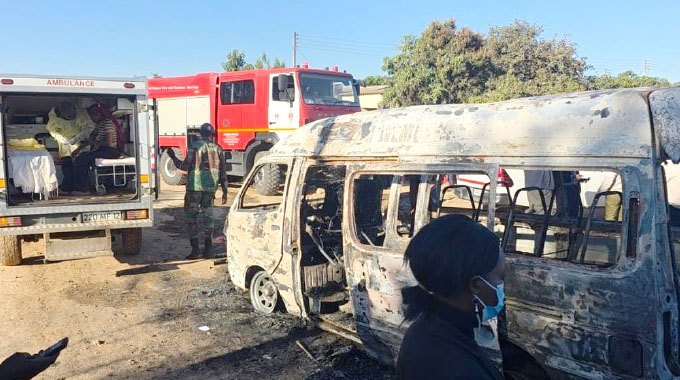
Patrick Chitumba, Midlands Bureau
THERE are days that never end. They do not remain in the past, they return quietly, without warning and sit beside you as if they had never left.
One of these days still lives for Mr Charles Matema, one of the residents at Senga Shopping Centre that attempted in vain to save pupils cramped in a commuter omnibus that caught fire near Matongo Primary School in Senga suburb recently.
“I was drinking beer at Senga Shopping Centre when someone shouted that a commuter omnibus was on fire,” Mr Matema(41), recalls, his voice dropping.
“Then came the cries. Loud, piercing cries for assistance from the pupils, especially those at the back who could see that getting out was becoming a struggle.”
On 10 June, just after 1PM near Senga Shopping Centre in Gweru, a commuter omnibus carrying 32 school children burst into flames.
Seven pupils were trapped and died in the inferno.
Twenty-five managed to escape.
“I saw the fire spreading very fast, covering the back,” Mr Matema recounted.
“We stopped trying to assist the children. Soon the commuter omnibus was a bolt of fire. The cries increased. They became so loud — these were young voices. In a split second, the cries just died down at the same time. The smell of human flesh filled the air.”
Those at the back, Mr Matema said, had no chance.
“They could see that getting out was becoming a struggle and all they could do was cry until there was no life left in them. Just charred bodies left,” he said.
More than a week later, Mr Matema said he still hears the children’s cries, smells burning flesh and can’t consume meat.
“It’s been over a week now and I still hear the children’s cries for help,” he said in an interview.
The tragedy has been described as one of the worst transport disasters involving school children in recent years.
President Mnangagwa declared the incident a state of disaster, with Government ensuring affected families receive support during this difficult period.
But beneath the immediate horror of the fire lies a deeper, systemic issue that transport officials, parents and community leaders are now confronting: the proliferation of unregistered school transport where profit is maximised at the expense of children’s safety.
The Senga vehicle was not a registered school bus. It was a commuter omnibus, one of the thousands of “kombis” that have filled the gap left by the decline of formal public transport, particularly the Zimbabwe United Passenger Company (ZUPCO).
While these informal operators provide a critical service, they often operate outside established safety frameworks.
“The systemic decline of formal public transport has led to a proliferation of informal operators, many of whom prioritise profit over passenger safety,” a teacher at one of the schools in Gweru said on condition of anonymity.
He said what makes matters worse is that parents do not involve schools when engaging vehicles for school runs.
Practices such as overloading, poor vehicle maintenance and the use of unsuitable vehicles for school transport have become common.
The Gweru United Transport Association (GUTA) has since called on operators to strictly adhere to the law and embrace self-regulation.
Speaking during a memorial service for the seven learners, GUTA representative Mr Richard Mudzingwa said transport associations have a critical role to play in supervising members and ensuring compliance with road traffic regulations.
Mr Mudzingwa addressed what he called “the elephant in the room,” — overloading.
“Some parents and guardians opt for cheaper transport services and knowingly allow their children to travel in overloaded vehicles, while some kombi crews overload passengers in an effort to maximise profits,” he said.
Mr Mudzingwa reiterated that the issue of overloading is a shared responsibility.
“On one end we have parents seeking affordable transport while on the other end operators try to maximise earnings, resulting in unsafe practices that put children’s lives at risk,” he pointed out.
The vehicle was carrying 32 learners when the fire broke out, rapidly engulfing the vehicle. Twenty-five learners survived the near death experience.
The deceased have been identified as Alisha Loyo, Peter Tambo, Thabo Maengamhuru, Keith Makarange, Anotida Mawere, Faith Jangara, and Junior Albert Muchenamakumbo.
The Senga tragedy has ignited a national conversation about the perilous state of school transport. Unregistered school runs are lucrative with operators charging parents less than formal school buses while packing more children into each trip. Without route permits, vehicle inspections, or trained marshals, oversight is minimal.
GUTA said it has implemented measures to restore public confidence: a strict no-overloading policy, prohibition of driving under the influence of alcohol or drugs, banning the mixing of passengers with goods, and ensuring vehicles meet safety standards. However, enforcement remains patchy.
Mr Mudzingwa called on the police to intensify efforts to curb the sale of illegal substances, particularly alcoholic beverages commonly known as “tumbwa,” which is reportedly sold at some commuter omnibus ranks.
For many, the loss is compounded by the knowledge that it was preventable.
Authorities now face the pressure to crack down on unregistered operators and strengthen school transport regulations.
The Ministry of Transport and Infrastructural Development has said it will work with police, city councils and transport associations to audit all vehicles transporting learners.
For Mr Matema, policy debates feel distant. His night has not ended.
“When it is quiet, I hear them again,” he said. “Seven voices. Then silence. All at once.”
He pauses, then adds, “No parent should bury a child because someone wanted to carry two extra passengers for a few more dollars.”
The Senga inferno has become a grim reminder of what happens when profit motives override safety. Until unregistered school transport is brought under proper regulation, until overloading is treated as a criminal offence rather than a cost of business and until enforcement matches the scale of the problem, parents will continue to gamble with their children’s lives every morning.
“Transport operators must unite through their associations to ensure compliance. We can’t wait for another Senga incident,” said Mr Mudzinga.
Meanwhile, the driver of the commuter omnibus, Malcolm Elvis Cook (22), and his conductor, Trinity Mudhenge (18) remain in custody and are expected to return to court on 23 June facing culpable homicide charges.
The two appeared before Gweru Magistrate Ms Deone Chiroyi following the tragic incident.
Preliminary police investigations revealed that on June 10, Cook picked up school children from various schools in Gweru before the conductor allegedly boarded the omnibus carrying a jerry can containing about nine litres of petrol.
Investigators believe the fuel container, which was reportedly placed behind the driver’s seat, may have contributed to the intensity of the fire.
But while investigations continue, Gweru mourns. And for Mr Matema, and many others who were there, the day the fire came to Senga Shopping Centre is far from over.