Online Reporter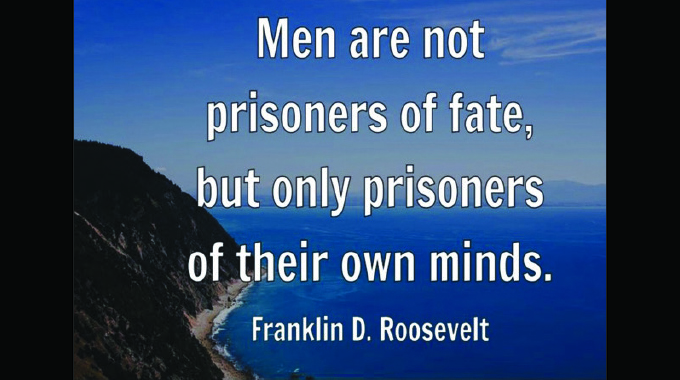
Arthur Marara-Point Blank
In the golden light of an Indian morning, a traveller paused at an elephant camp, captivated by a paradox.
Before him stood creatures of monumental strength — beings capable of uprooting trees and moving mountains — yet each stood placidly restrained by nothing more than a thin rope tied to a small wooden stake. No chains. No cages. The elephants made no attempt to break free.
When the bewildered traveller questioned their trainer, he received an answer that would haunt him long after: “When they were young, this same rope held them fast. Though they could now snap it effortlessly, they no longer try. They believe it can still hold them.”
This simple parable reveals one of humanity’s most profound truths: We are those elephants.
Our true captivity begins not with physical chains, but with the invisible ropes of the mind — those self-imposed limitations woven from threads of past failures, unquestioned assumptions, and inherited fears.
“I’m not leadership material,” we whisper. “People like me don’t succeed at that,” we concede.
“It’s too late to change,” we declare.
As Franklin D Roosevelt observed, “Men are not prisoners of fate, but prisoners of their own minds.” The tragedy lies not in our circumstances, but in our surrender to mental bonds we’ve long outgrown.
Why We Remain Bound
The persistence of these mental ropes stems from three deeply human vulnerabilities. First, we become hypnotised by past failures. Neuroscience confirms that repeated setbacks rewire our brains to expect defeat, transforming isolated incidents into personal identities.
A rejected manuscript becomes “I’m not a real writer”.
A missed promotion becomes “I’m not executive material”.
Like the elephant’s childhood struggle, these experiences calcify into self-fulfilling prophecies.
Second, we grow seduced by the false comfort of familiarity. There’s perverse security in known limitations. To test the rope invites terrifying questions: What if I break free and fail anyway?
What if freedom proves more demanding than captivity? We cling to our constraints because they absolve us from the terrifying responsibility of possibility.
Third, we inhabit echo chambers of limiting lore. Well-meaning voices — parents, peers, even society — reinforce our ropes with mantras like “Be realistic” or “Don’t rock the boat.”
We mistake their cautions for cosmic truths, never questioning that these ropes might be relics of their limitations, not ours.
The path to liberation
True peace arrives not through avoidance, but through conscious rope-testing. This is neither naive optimism nor abstract philosophy — it’s practical reality testing. Begin by interrogating your ropes with four liberating questions.
Ask yourself what core belief holds you hostage. Is it “I must be perfect to be loved”?
Examine what past failure still defines you. Does that career setback twenty years ago still whisper “fraud” when you speak in meetings?
Identify the recurring story keeping you small. Do you still introduce ideas with “This might be stupid, but . . .”? Finally, demand evidence: Is this rope truly unbreakable — or simply untested since your seasons of growth?
History’s greatest revolutions began when someone asked, “What if this rope is a lie?”
Consider the civil rights activist who challenged “the way things have always been,” the entrepreneur who saw opportunity where others saw impossibility, or the artist who reinvented their craft at eighty. Their power came not from ignoring constraints, but from testing them.
Rewriting these narratives requires deliberate mindset work — a kind of cognitive surgery. Since beliefs are neural pathways, we build new roads through evidence hunting.
If you believe “I’m unlucky,” document three daily wins. Employ micro-courage: If public speaking terrifies you, record a one-minute video today. Most crucially, master sacred language. Eliminate absolutes like “always” and “never.” Swap “I always fail” for “I haven’t succeeded yet.”
Language is the chisel that sculpts reality.
This work demands embracing the discomfort of strength. The elephant’s tragedy wasn’t the rope — it was forgetting its own power. Your liberation awaits in the stretch zone beyond comfort. Have that difficult conversation you’ve postponed. Start that abandoned dream at 1 percent capacity — write one paragraph, sketch one concept, make one call.
Speak the apology you owe your younger self aloud. As Ambrose Redmoon noted;
“Courage is not the absence of fear, but the judgment that something else is more important than fear.”
The unshakeable ground
When we release the uncontrollable, master our beliefs, and shatter these mental ropes, we discover true peace isn’t passive — it’s an unassailable inner fortress. Here, decisions flow from intuition rather than fear. Setbacks transform into data rather than destiny.
Your very presence becomes a sanctuary others seek in turbulent times. This is the cultivated serenity of warriors and wise leaders — the eye of the storm where vision clears and purpose solidifies.
So today, choose one rope. Just one.
Perhaps it’s the belief that you’re “not enough,” the shame of an old failure, or a dream sacrificed to others’ expectations. Test it. Pull gently.
Then harder. Feel its fraying edges.
Remember: You are both the elephant and the trainer. You bound yourself. Now, unbind yourself.
The journey continues in our next instalment, where we’ll explore how to protect this hard-won peace through boundaries and energy stewardship.
But before then, ask yourself: What single rope will you break before sunset today?
Your answer writes the first sentence of your next chapter.
To be continued . . .
Arthur Marara is a corporate law attorney, keynote speaker, peak performance and corporate strategy speaker. With his delightful humour, raw energy, and wealth of life experiences, he captivates audiences and inspires them to unlock their full potential. He is also a leadership expert with extensive experience in leadership development and coaching. He is passionate about developing effective leaders and empowering individuals and organizations to achieve their full potential. Through his engaging talks and workshops, he imparts invaluable insights and practical strategies that empower individuals to lead with confidence and make a lasting impact. Arthur is the author of “Toys for Adults” a thought-provoking book on entrepreneurship, and “No One is Coming” a book that seeks to equip leaders to take charge. Send your feedback to bookings@arthurmarara
attorneys.com visit his website www.arthurmarara.com or contact him at +263772467255.



 Bongani Ndlovu