admin
admin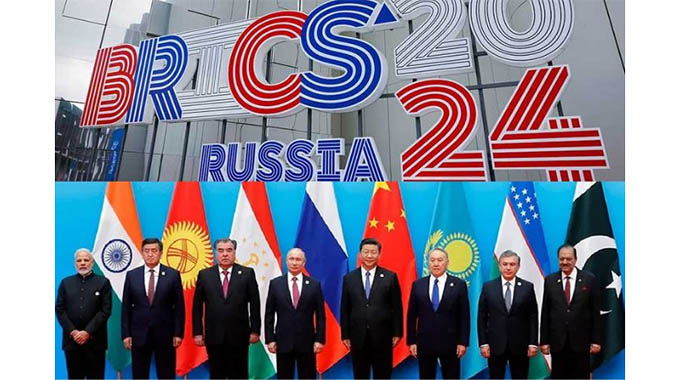
Richard Muponde-Zimpapers Politics Hub
THE just-ended 16th BRICS Summit held in Kazan, Russia marked a significant milestone in the global economic landscape as emerging economies assert their voice in a space dominated by the West.
Held from October 22 to 24, the summit holds significant relevance in the current global affairs as it serves as a crucial platform for emerging economies to assert and amplify the Global South and East’s voices in calling for a fair deal where the West, particularly, the United States has been in control.
The summit brought together leaders from various nations that included the host, Russian President Mr Vladimir Putin, China’s President Xi Jinping, and Indian Prime Minister Mr Narendra Modi, Venezuelan President Mr Nicolas Maduro, South Africa President Mr Cyril Ramaphosa, Iranian President Mr Masoud Pezeshkian and Brazilian President Mr Louiz da Silva Lula, among others.
For the first time, the expanded bloc welcomed new members: Egypt, Ethiopia, Iran and the United Arab Emirates which joined original members — Brazil, Russia, India, China and South Africa.
This strategic expansion bolsters the voice of emerging economies, countering Western dominance led by the United States.
Zimbabwe has also shown interest in joining the BRICS, which is bound by mutual respect in pursuit of political and economic independence, respecting each members’ sovereignty and territorial integrity.
The BRICS summit serves as a crucial platform for the Global South and East to assert influence, ensuring developing nations have a significant role in global governance. Discussions focused on amplifying their voice, recognising initiatives like the India-Africa Forum Summit. They also agreed that enhancing collaboration must take centre stage in their day to day interactions.
Key areas of cooperation include industry, energy, logistics, high technology and culture. The BRICS Plus – Outreach-format meeting which was initiated by Russia as the Group’s current chair, facilitated open dialogue between member states and global partners.
Russia invited Asian, African and Latin American leaders, fostering inclusive cooperation.
BRICS’ mutual understanding policy effectively counters the US and Western offensive, particularly in Africa.
China’s policies and subsidies, criticised for creating global oversupply, underscore BRICS’ strategic importance in asserting its influence on the global economic terrain.
The summit’s open invitation to Asian and Latin American countries signal a radical policy shift, challenging US global influence.
Unlike the West’s coercive approach, characterised by bullying and sanctions, BRICS fosters mutual respect where all members view each other as equals. Africa tends to benefit from BRICS member states investments with some flagship examples being the Dinson Manhize Steel Plant in Zimbabwe and Tanzania’s railway infrastructure respectively.
Addressing a press conference at the end of the Summit in Kazan, Russian President Mr Putin said BRICS offer opportunities of economic growth through collaboration.
“The new countries have witnessed and understood that it is feasible to work and achieve results within BRICS. They have come to appreciate that the cornerstone of our group is mutual respect and obligatory consideration of each other’s interests. I can state with satisfaction that all of them are actively participating in working forums and are putting forward useful and promising ideas and initiatives,” president Putin said.
“Regarding the Kazan Summit itself, delegations from 35 countries and six international organisations participated in it, as you are already aware. Such broad representation clearly underscores the authority and role of BRICS, as well as the growing interest in cooperation with us from states that are indeed pursuing truly independent and sovereign policies. Each of these countries has its own path of development, distinct models of economic growth, and a rich history and culture. It is obviously this civilisation diversity and unique combination of national traditions that underlie the strength and enormous potential for cooperation not only within BRICS, but also within the broader circle of like-minded countries that share the group’s goals and principles.”
The summit’s agenda was extensive, with member states discussing pressing issues mainly covering politics and security, trade and investment, and cultural and humanitarian exchanges.
The Kazan Declaration, which summed up the discussions, was approved at the summit.
It is a comprehensive conceptual document with a positive forward-looking agenda. Importantly, it reaffirms the commitment of all BRICS countries to building a more democratic, inclusive, and multipolar world order based on international law and the UN Charter.
The Russian president said delegates discussed at length possible joint efforts to further stimulate investment in order to promote economic growth in BRICS states and countries of the Global South and East.
According to analysts, the recent BRICS summit has shown that emerging economies were turning their back to the West’s exploitative relationship to that of mutual respect and interests.
Veteran journalist, Mr Methuseli Moyo said the growth and solidification of BRICS is a definite shake-up to the western dominated “world order”.
“The West itself has admitted as much, and is desperate to prevent the inevitable. They have been preaching about political democracy. BRICS is here to ensure economic democracy. People shall not live in political democracy only,” Mr Moyo said.
Political analyst and Global Economics2020 Consultancy Group executive director, Mr Naboth Paurosi Dzivaguru, said BRICS was the Global South’s fortress to cushion itself from the US and allies’ unfair economic practices shockwaves.
“The BRICS work as a safety net and economic shock absorber from the global North’s exports. This means, therefore, that the BRICS bloc have agreed to entertain fair and just trade amongst itself as equal economic partners,” Mr Dzivaguru
“The Global South was sidelined by the Global North in crafting rules to market access. As a result, the Global South had to be involved in economic trade which was in their disfavour. There are two main categories of economic barriers to market access namely, tariff barriers for example, custom duties or tariffs, and non-tariff barriers, that involve quantitative restrictions. All these barriers favour the North and disfavour the South.”
He said if the Global South continued with its foray in creating market access to itself or its member states, the US and its friends would lose out in global market places in the South.
BRICS’ evolving partnerships reshape the global landscape through strategic projects in energy and infrastructure with investments in renewable energy, transportation and telecommunications being the game changer.
China is the leading BRICS member in sectors and has fallen target to the West with its products placed under sanctions.
Collaboration on digital governance, cybersecurity and data protection as well as support for entrepreneurship, trade and regional economic integration are crucial.
BRICS should amplify the emerging economies voice through enhancing the New Development Bank and Contingency Reserve Arrangement effectiveness to help member states.
In the next decade analysts say BRICS’ African membership, including Zimbabwe, will play a pivotal role.
As the voice of the Global South and East, BRICS will influence international decision-making processes and deepen trade, investment and innovation ties.
It will also promote global peace and security through encouraging conflict resolution and regional stability.
Through solidifying its position as a champion of emerging economies, BRICS will reshape global dynamics, ensuring a multipolar world where diverse voices are represented.
-@muponderichard


 Online Reporter