admin
admin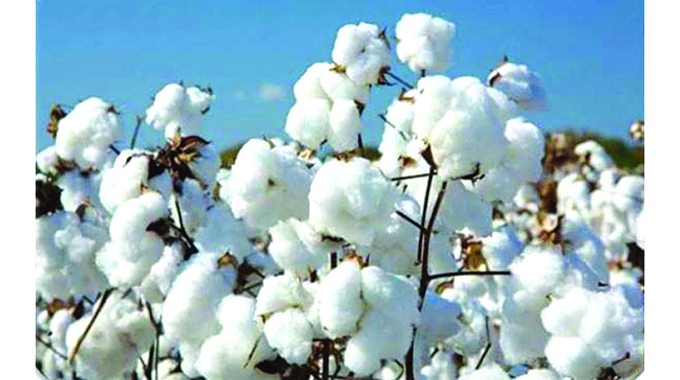
Precious Manomano Herald Reporter
Cotton deliveries have spiked this season despite side marketing concerns, with farmers describing the season as the best where they are paid with a high component in foreign currency, just like their fellows in tobacco.
Cotton farmers are paid 85 percent of their total sales in US dollars and the remainder will be paid in Zimbabwe dollars at prevailing interbank exchange rates upon delivery of the crop at any Cottco buying point.
Statistics from Agricultural Marketing Authority indicate that farmers have delivered 11 646 791kg of cotton as at 8 June valued at US$3,9 million and $3,5 billion.
In an interview, Cotton Producers and Markets Association of Zimbabwe president Mr Stewart Mubonderi said this year was the best season for cotton farmers as they were paid with a high component in foreign currency.
This season, farmers had a target of 100 000 tonnes.
He urged companies to speed up payments of farmers, adding that farmers should not travel long distances to access their payments.
“So far not all farmers are paid, so we appeal to companies to speed up payments,” said Mr Mubonderi. “We are, however, happy of the 85 percent foreign currency retention which is motivating more farmers to join farming next season.
“I urge farmers to remove stalks in the fields in preparation of the next season.”
It is a legal requirement to destroy cotton stalk debris to limit infection by pests.
Mr Mubonderi urged farmers to prepare for the next season since the Government is ready to distribute Pfumvudza inputs anytime soon.
He urged seed companies to increase supply of the seed of a new variety called myhco which helped most farmers to increase their productivity this season.
Farmers were excited this year and the majority showed that they will join cotton growing next year.
Mr Martin Bushe (39), a farmer and beneficiary of the Presidential Cotton Input Scheme from Alaska in Makonde, said getting a US dollar component was a good incentive for him to continue growing cotton.
“I intend to invest my money into an income generating project,” he said. “My four wives and I have agreed to buy a grinding mill while the excess will be used to purchase other things that we are lacking at the farm.”
Mr Bushe said because of the bright prospects that the cotton crop had for farmers, he was going to save some money for the rent on 15 hectares he wished to lease this coming season.
“I target to put 15 hectares under the crop as part-payment of it in forex gives us hope to continue cotton farming,” he said. “I am quite positive that the Second Republic will make sure that our local currency becomes stable so that more farmers plant the crop.”
Mrs Emilia Rwodzi (80) from Gudubu in Mhangura, who was elated by her recent payment of her cotton in local and foreign currency, said she was hoping to put a bigger portion of her farm under the crop this coming season.
“I have a big family and I need more land to grow cotton and improve our livelihoods,” she said. “I was elated by my recent payment of cotton in local and foreign currency. I am hoping to put more land under the crop this coming season.”
Another cotton farmer, Ms Doreen Chiedza from Mauya, in Hurungwe district, who is yet to try her luck this season, said she was being motivated by the handsome payouts.
“I will try to do cotton next year as most farmers in my area and surrounding places have managed to realise more from the crop,” she said. Cotton is a strategic crop that is interwoven into the rural economy and indeed, the national economy, as it is a cash crop for farmers, particularly those in drought-prone areas.
The crop provides lint for downstream textile industries and generates export earnings, while the cotton seed is used to extract edible oils for human consumption, with the seed residue used in animal feeds.
Production of cotton can transform rural communities through the major cash crop and having huge benefits to the economy at large as a major source of cooking oil for local consumption and cotton fibre for export markets.
The intervention by the Government on cotton production through the Presidential Inputs Support Scheme was meant to revive the sector, which was collapsing due to low prices offered by merchants and other problems related to inputs.
Some farmers in cotton growing areas had abandoned the crop after prices fell and merchants had reduced input packages citing side-marketing by farmers, further affecting production.


 Online Reporter