admin
admin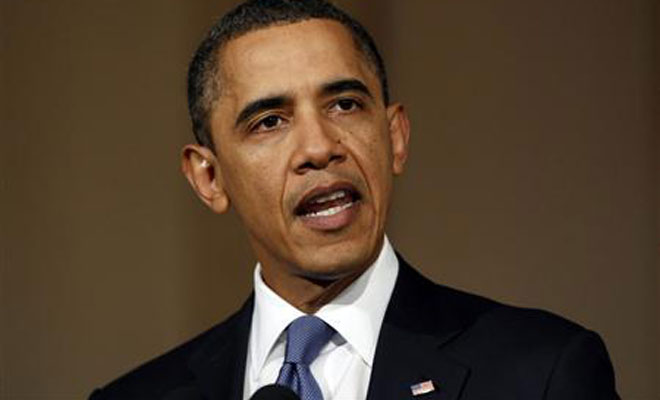
BRITAIN has been left out in the cold as the United States plots more extensive action in Syria to crush Assad’s military and topple him.
UK military chiefs are being excluded from meetings in Washington about plans for missile strikes because they cannot be trusted with highly sensitive information intelligence.
Foreign Secretary William Hague yesterday insisted that despite ruling out military action, Britain would step up diplomatic efforts to bring an end to the conflict during this week’s G20 summit.
US President Barack Obama had been thought to be planning limited and targeted strikes to deter use of chemical weapons, after the deadly attack in Damascus which killed more than 1 400 people.
But White House briefings for senior senators suggest the US military intervention will be much wider and more devastating.
General Jack Keane, a former Vice Chief of Staff of the United States Army, said Mr Obama wanted to ‘degrade’ Assad’s military forces while at the same time ‘upgrading’ those of opposition forces to trigger regime change.
Speaking after talks with senators including John McCain, who has been briefed by the President, General Keane said: ‘The President has decided to deter the use of chemical weapons but also to degrade military capacity of the Assad regime.
“At the same time he has upgraded the capacity of the opposing forces.
“And it’s the opposing forces that hopefully would be able eventually to topple the Assad regime,” he told BBC Radio 4’s Today programme.
But challenged about the reports in Parliament yesterday, Mr Hague seemed unclear about whether London was up to date with the latest planning in Washington.
Mr Hague told MPs: “I do not believe that to be the intention of the United States.
“President Obama is very clear that any action proposed by the United States would be to deter the further use of chemical weapons.
“I think we can take him at his word on that, and I am not going to criticise him for putting that forward.”
However, British military officials at US Central Command in Florida have reportedly been downgraded, after David Cameron ruled out UK involvement in any strikes.
A British defence official told The Times: “No British officers are now engaged in military planning for Syria at Central Command and none of them will be involved in the execution of the operation.”
Instead Mr Cameron will use the G20 summit in Russia this week to seek a non-military resolution to the crisis.
Mr Hague said the conflict in Syria would dominate the bi-lateral meetings between countries but it was up to the Russian government to set the agenda for multi-lateral talks, which will take place at the summit in St Petersburg tomorrow and Friday.
Speaking during Foreign Office questions in the House of Commons, Mr Hague also condemned the Syrian regime for preventing vital humanitarian aid from reaching Syrian refugees.
Mr Hague said: “It is in bilateral meetings that Syria will be a dominant issue in St Petersburg and should be. The Prime Minister will of course be pursuing it . . , through every channel in St Petersburg, as he has done and I have done in a whole series of bilateral and multilateral meetings over the last few months.
“Our problem is not being unable to discuss these things in the international community — it is being unable to agree how we bring about a transitional government in Syria, formed from government and opposition by mutual consent.
“There is no shortage of venues for discussing those things, platforms for discussing those things – we have had two-and-a-half years of discussion on this. It is agreement that is elusive, not a forum for discussion.” Meanwhile, Cameron mistakenly named India among countries which had concluded that Syrian regime forces were behind a chemical attack near Damascus, India’s foreign ministry said yesterday.
New Delhi took note of the lapse during Cameron’s 29 August speech to lawmakers in London, in which he called for Britain to join military action against Syria after the attack near Damascus.
More than 1 000 people died, according to US intelligence.
“We asked how this had come about and they admitted that this was a mistake,” a foreign ministry spokesman told AFP, saying the matter had been raised “informally”.
Cameron named India alongside other countries including Canada, Australia, Turkey and the United States which had concluded that forces loyal to Syrian President Bashar al-Assad had used chemical weapons.
India has expressed concern about the worsening violence in Syria, but has pressed for any action against the Assad regime to be authorised through the United Nations.
“The international legal norm against the use of chemical weapons anywhere and by anyone should not be breached. However, we would prefer to await the full results of the UN inspection,” its foreign ministry said in a statement.
India was in favour of bringing the Syrian government and the opposition to the negotiating table, the statement added, urging all sides to abjure violence.
Cameron suffered a stunning parliamentary defeat in his bid to authorise action against the Syrian regime, dealing him a personal political blow and undermining plans by President Obama to launch military strikes.
A spokesman for the British High Commission in New Delhi admitted the “innocent mistake” and attributed it to oversight during hurried preparations for the emergency debate.
“There’s a lot of work that has to be done in a very short period of time,” he told AFP. “It’s a little something that has fallen through the gaps.” — Dailymail/AFP.


 Online Reporter