Online Reporter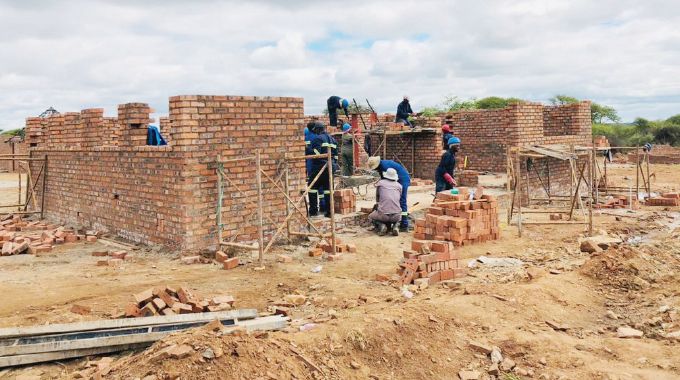
Bruce Ndlovu
IF one woke up in Maphisa with no prior knowledge of how they had arrived there, they would be forgiven for thinking they were now in one of Zimbabwe’s more affluent suburbs.
Old men and women, who watched the town grow from a tiny outpost nestled in the heart of Matabeleland South Province, Kezi to be precise, into a sought-after place of residence, often joke that in Maphisa, one must wait until lunchtime to bathe in the sun.
In Maphisa, they say, the sun does not merely rise, its rays have to bend around double-storey houses that are mushrooming around the centre.
A housing boom, attributed to mining activities and contributions from people in the diaspora, has transformed the face of Maphisa, which now hosts eye-catching mansions dotted in and around its centre.
Villas, 19-roomed mansions and houses equipped with what were previously thought to be urban features such as swimming pools, internal communication systems, closed-circuit television (CCTV), cameras, solar-powered geysers and security fences have sprung up, elbowing out the modest thatched huts of old.
Many of these houses would not look out of place in an episode of “Top Billing.” Yet amid this urban splendour, something different is taking shape.
A few kilometres from the gleaming mansions and modern villas that now dominate the landscape, a quiet effort is underway to take residents and visitors alike back to a time long before solar geysers, CCTV cameras and double-storey homes.
Here, planners are recreating a traditional Ndebele homestead, not as a relic frozen in time, but as a living cultural centre meant to remind a rapidly modernising community of where it came from.
The cultural village will give an illustration of the evolution of architecture in the region, illustrating various forms of shelter beginning with a beehive hut (iqhugwana), then showing the progression to the more common cone or cylinder thatched roof huts and finally, the modern form of housing that now dominates a modern Maphisa.
According to Matabeleland South Provincial deputy director in the Ministry of Sport, Recreation, Arts and Culture, Promise Dube, the village is being designed to mirror the structure and rhythm of a traditional Ndebele settlement.
Isizinda is part of the legacy projects that are being erected as part of this year’s Independence Day celebrations.
“The culture centre will have an administration block, four rondavels, among them ixhiba (hut) for girls, one for boys, a kitchen and a place where various crafts are meant to be displayed.
We will also have a caretaker’s house, where the person who will be taking care of this place will stay. We will also have a typical beehive, dome-shaped Ndebele hut, iqhugwana,” he said.
Far from being a random cluster of huts, the layout of the centre is deliberate, intended to tell a story about the journey of Ndebele architecture and society over the decades.
“The purpose of these structures is to show the progression that our society has undergone through the years. It starts from iqhugwana, to the thatched huts, right down to the administration that will, in this case, be roofed using the Inverted Box Rib (IBR) sheets.
“In this particular village, we will also have a granary, and this is because we want to show a model of a Ndebele homestead which accurately portrays how people used to live in the old days,” said Dube.
In a town that is increasingly looking to the future, the village aims to anchor the community to its past.
The centre will also double as a space where traditional crafts and artefacts produced by villagers from surrounding areas can be exhibited, ensuring that local knowledge and craftsmanship are not lost in the rush towards modernity.
“This village will be used to provide opportunities for young children and even older folk to come and appreciate the old Ndebele way of life. It will not only be about the structures, of course, because we will also display crafts and artefacts produced by villagers from around the culture centre. So, this centre will show the crafts produced by the people around here as well as the progression of architecture in Zimbabwe,” he said.
“We will show houses thatched of amathikili, then the thatched hut structures right down to the modern roofed homes.
We chose this path because we realised that the younger generation do not know how we built our homes. We have a lot of homesteads that do not illustrate our original way of life and the craftsmanship that went into the building of our homes.”
Beyond its cultural value, the village is also expected to become an educational resource for schools in the region.
Dube said the centre aligns with the country’s evolving education model, which places emphasis on practical learning and real-world experiences.
“We are hopeful that this village will also be an aid to children in schools because our current curriculum speaks of Education 5.0 and for those who come here, they will have a first-hand experience and a chance to talk about things that they have seen and not those that exist in theory only,” he said.
“We want children in the region to have an understanding beyond the illustrations or pictures that they see in books. In Zimbabwe, you will realise that the kind of structures that are built by people differ from region to region.
So the intention here is to show children in this region how our structures, some of which they do not see anymore, were built.”
Even the smallest architectural details in the village are being recreated with painstaking attention to authenticity.
“In the building of our structures, we made sure that what we call amafastela or windows were made from the material that we used to make them back in the day. If you see where the roof meets the walls, the same principles also apply.
The old structures were made so that there was never any need for any air conditioning, and this is the same principle that applies here,” said Dube.
“In the kitchen, one would never be forced to run away from smoke, even though a fire was always on. Our people were environmentally aware and knew that sustainability was something that was essential for their future.”
For a town now boasting homes fit for glossy lifestyle magazines, the Isizinda Cultural Village represents something quieter but perhaps more profound — a reminder that while Maphisa’s skyline rises higher with each passing year, its roots remain firmly planted in the traditions that first gave the community life.
Isizinda was the Ndebele regiment that was under the command of Maphisa Fuyane, from where the town derives its name.