Chronicle Editor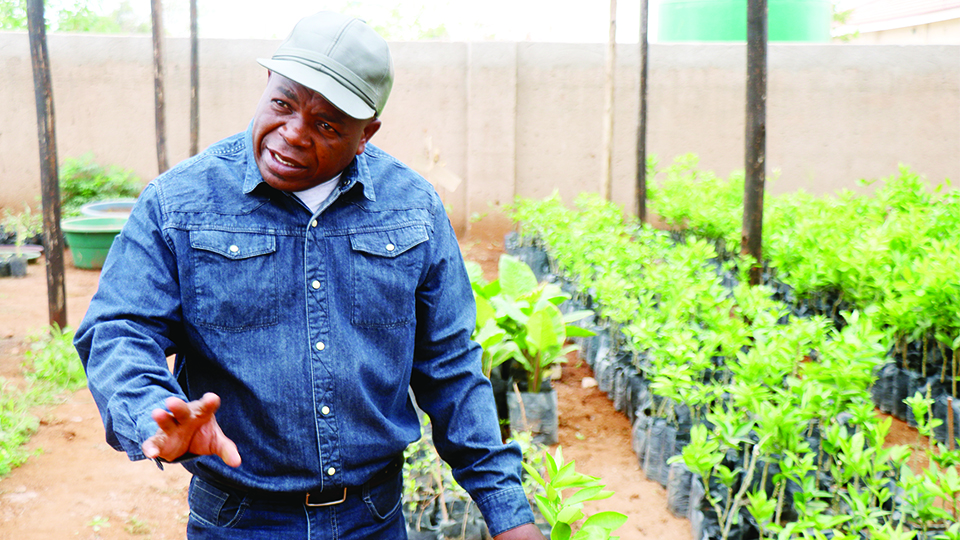
RAYMOND JARAVAZA, [email protected]
AFTER spending years in Israel as part of expert farmers driving that country’s ambitious plan to plant over a million citrus fruit trees, Dr Pritchard Donga is now committed to bringing the same agricultural success to Zimbabwe.
Armed with experience and knowledge, he returned home three years ago to start his ambitious venture, tapping into the lucrative commercial orange growing business for domestic and export markets.

He has set up a thriving tree nursery in Killarney suburb in Bulawayo and another one in Bubi District, Matabeleland North Province.
Dr Donga is also using the expertise gained overseas to teach local farmers the intricacies of citrus production, which remains hugely untapped, especially by smallholder farmers in the Matabeleland region.
Since returning home from Israel and Kenya, where he also worked with the Moi University in the field of peach and apple production, Dr Donga has planted 20 000 citrus fruit trees at his two nurseries.
In Killarney, he planted a variety of trees including oranges, naartjies, and mangoes from Israel and Kenya in an orchard that he uses as a research centre.
Through studying fruit tree varieties and their adaptation to the local conditions, the agriculture expert hopes to “breed” the right pedigree plants that will thrive in the Matabeleland region.
Dr Donga encourages local farmers to venture into the orange farming business as he believes it is best suited for local conditions and can position farmers to reap rich pickings offered by the commercial citrus industry.
“Some years ago, I ran a project to grow 200 000 citrus fruit trees in Israel, specifically the naartjies fruit. Israel generally does not have good soils for agriculture because the country is largely a desert and they have to import soils suitable for farming,” he said.
“Their government decided to increase citrus fruit production after realising that the industry is very lucrative and that’s how I got involved in the project to plant over a million citrus fruit trees,” Dr Donga told Chronicle at his nursery in Killarney yesterday.

It was during the time he worked in Israel that he realised that arid conditions in that country were almost similar to local conditions in parts of the southern region of Zimbabwe.
“I got me thinking how much our farmers, especially the small-scale farmers with a few hectares of land, are missing out on citrus production when they could be tapping into the industry and making money,” he said.
Dr Donga also worked in Kenya for Moi University, specialising in peach and apple production. After some time in that country, he was left convinced that citrus production in Zimbabwe was underperforming and needed intervention at the smallholder farming level.
To encourage other farmers to take up citrus farming, he decided to venture into fruit tree nurseries, predominantly orange trees.
“In order to merge the foreign citrus fruit trees with local varieties, I started collecting local lemon seeds, which I planted and later grafted with orange trees,” he said.
Grafting is a horticultural technique where parts from two different plants are joined together to grow as a single plant.
In Dr Donga’s case, he grafts lemon tree stems with orange tree shoots so that the single plant grows as an orange tree.
“The reason why we use a lemon stem is because it is resistant to diseases and has an improved nutrient retention rate so the tree will have a longer healthy lifespan of about 25 years,” he said.
“I started the nursery project two years ago on a smaller scale and as demand grew we scaled up production. Right now we have close to 20 000 orange, naartjies, and mango trees,” he said.
According to the Food and Agriculture Organisation (FAO), a specialised agency of the United Nations that leads international efforts to defeat hunger and improve nutrition and food security, oranges account for 40 percent of all citrus fruits exported all over the world.
In Dr Donga’s case, planting orange trees at his two nurseries is not a walk in the park as it requires attention to detail and hard work.
“From the nursery stages, we first plant lemon seeds and let the plants grow to about 60 to 70 centimetres. After that we start the grafting process of joining the lemon plant with an orange plant,” said Dr Donga.
“We keep the grafted plant for about three months before selling it to farmers. The whole process from planting seeds to the stage when the tree is sold to farmers or schools takes up to 18 months.”

A farmer with between one and two hectares can venture into orange farming, according to Dr Donga.
“One hectare of land can accommodate 550 orange trees. It takes an orange tree a year after planting to start bearing fruits.
“We, however, encourage farmers to destroy the first flowers from the trees because the oranges will break the tree as it will still be fragile and weak. In the second season, the farmer can start harvesting the oranges.
“At its peak, a healthy orange tree can give a farmer between 12 to 20 bags of oranges. Bearing in mind that a bag contains about 20 oranges, it’s safe to say that citrus farming is a lucrative business,”
At today’s asking price Dr Donga sells his cheapest orange trees for US$4 each.
“Foreign varieties are a bit expensive compared to local ones because they are imported. My advice to farmers is to start small, say with about 50 orange trees then grow from there,” he said.

“A farmer who invests in a two-hectare piece of land can plant about 1 100 trees, which is a lot considering the amount of oranges that they will harvest each season.”
He implored the Ministry of Primary and Secondary Education to invest in the school curriculum to include a robust approach to citrus farming as a way of encouraging school kids to develop an interest in the industry.



 Online Reporter