Chronicle Editor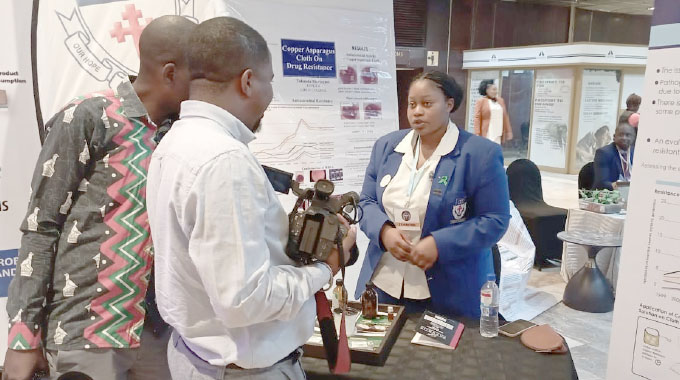
Robin Muchetu, Senior Reporter
TAKUNDA Muringani a Sixth Form pupil at Girls College in Bulawayo recently came third in the Presidential Innovation Fair 2024 under the Best Student Innovator-High Schools category.
The young innovator presented a unique bandage and asparagus solution that can be used to treat wounds.
Muringani’s innovation, a Copper Asparugus Cloth on Drug Resistance could be a new approach to treat Methicillin-resistant Staphylococcus aureus (MRSA), a bacteria that has become resistant to many antibiotics used to treat infections.
The solution does not promote Antibiotic Drug Resistance, which has become a challenge in Zimbabwe and the rest of the world.
“This idea of finding ways to treat people in hospitals came to me when we were told to create something innovative around science at school. I realised that in the medical field, certain drugs are expensive, so an alternative was needed, so I designed a cloth/bandage that is based on plant extracts from the asparagus plant and nanoparticles. This is used on patients that are suffering from MRSA,” she said.
Muringani said MRSA is affecting several people in the country and over time it causes wounds on the skin that eventually do not respond to treatment.

It remains on that patient for a long time even leading to the death of some of them.
“Others can fight it off by themselves but others fail and they cannot get cured. To counter this, I have come up with an alternative using asparagus extract and copper nanoparticle-based cloth. This cloth can be used in wound dressing as a bandage for a patient with an infected wound.
“The reason I refer to this as the best alternative is because some antibiotics are expensive and need to be imported but this innovation is cheap as all resources are locally available and also eco-friendly,” she said.
Muringani said the asparagus plant can be replanted and there is no chance of it being extinct in the event of scaling up of her innovation.
The solution also does not need to be refrigerated and can be used even in rural set-ups like clinics for patients in need.
“Plants contain certain Phyto-chemicals that have been researched on previously that work against certain bacteria. Phyto-chemicals such as flavonoids (natural substances found in fruits, vegetables, bark and stems that have beneficial effects on health), alkaloids and tryocine. These are found in asparagus and it has proven to work against these bacteria that is why I used it,” she added.
Asked about her experience at the Presidential Innovation Fair, Muringani said it was a great opportunity to exhibit before the President.
“The Presidential Innovation Fair 2024, provided me with a platform to exhibit my innovation. It was an amazing opportunity and an even much greater honour to be able to present my project to His Excellency, President Mnangagwa and Vice-President Chiwenga.
“It was also astonishing to see so many brand-new innovations in Zimbabwe. The ones that mainly caught my attention were the Pothole detector, originally designed by Rahil Bhavan from Christian Brothers College (CBC) and the Anthocyanin indicator by Nkanyiso Zibagwe from Dominican Convent Bulawayo. It’s just fascinating to see other young people like me come up with such great innovations that help the community,” she said.
She thanked her Biology teacher, Mrs Charity Chimbo who guided her when she was doing her project. — @NyembeziMu



 Online Reporter