

 Online Reporter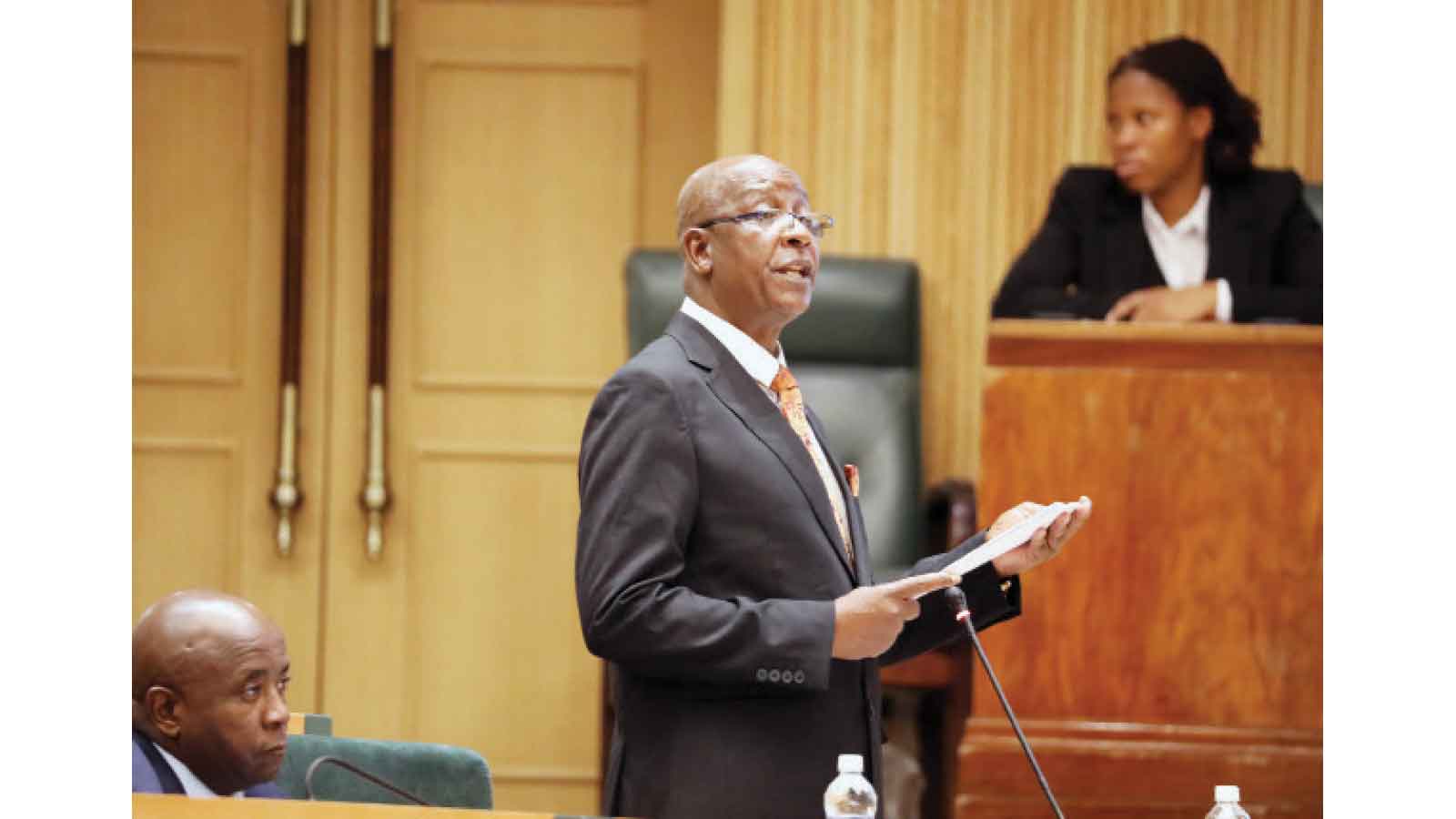
Nyore Madzianike-Senior Reporter
THE Constitutional Amendment No.3 Bill has received overwhelming support with more than 530 000 written submissions to Parliament in its favour, while 2 935 were against it, according to a report presented yesterday by the Parliamentary Portfolio Committee on Justice, Legal and Parliamentary Affairs.
The findings were tabled in the National Assembly after the Minister of Justice, Legal and Parliamentary Affairs, Ziyambi Ziyambi, presented the Bill for the second time before the Clerk of Parliament, Mr Kennedy Chokuda, made its Second Reading.
Parliamentary Portfolio Committee on Justice, Legal and Parliamentary Affairs chairperson Cde Eddison Zvobgo (Jr), then presented the committee’s findings before legislators began debating the proposed Bill.
According to the report, the majority of submissions strongly favoured changing the election of the President from a direct public vote to election by Parliament.
The committee said supporters argued that the proposed model would foster greater collaboration and confidence between the Executive and Parliament, ultimately enhancing governance and policy alignment.
The report said submissions also emphasised that electing the President through Parliament would substantially reduce the immense financial costs of organising nationwide presidential elections, which had previously been marred by political tension, violence and contestation over results.
The Committee further reported that submissions supported extending the electoral cycle of the President and Members of Parliament from five to seven years and applying the change to the incumbent.
“The majority of public submissions favoured the adoption of longer electoral cycles, primarily because reducing the frequency of elections mitigates both the immense fiscal burden on the state and the disruptive ‘perpetual campaign mode’ that frequently derails governance and development,” the report said.
It said the majority argued that extended electoral cycles defuse the political toxicity inherent in election seasons, providing Government with the necessary time horizon to fully implement long-term projects while ensuring policy stability and continuity.
“They noted that developmental activities routinely slow down or halt during election periods as national focus shifts entirely toward political processes,” the report said.
“Furthermore, submissions pointed out that extended mandates are not unprecedented globally, citing Egypt’s six-year presidential cycle and Azerbaijan’s seven-year electoral cycle as successful examples.”
The Committee also reported strong support for transferring voter registration and management of the voters’ roll from the Zimbabwe Electoral Commission to the Registrar-General.
However, it noted that the minority view opposed transferring the voters’ roll to the Registrar-General, arguing that management of the roll had previously been removed from that office because of concerns over credibility and manipulation.
Presenting the Bill for the second time in the House, Minister Ziyambi described the process as a defining moment in the country’s constitutional evolution.
He said it was a journey rooted in the liberation struggle, shaped by the aspirations of citizens and formally expressed through the 2013 Constitution.
“Constitutions, by their very nature, are not monuments cast permanently in stone.
“They are living instruments of good governance, designed to respond to changing realities, to emerging challenges, and to the ever-evolving needs and aspirations of society.
“The true strength of a constitutional democracy lies not in rigid permanence, but in its capacity for lawful, reasoned and progressive adaptation,” he said.
Minister Ziyambi said the proposed Bill was not an abandonment of the country’s constitutional order but a continuation of it.
He said the Bill was a product of practical experience, institutional reflection and recognition that after more than a decade of implementation, certain provisions of the 2013 Constitution required refinement to enhance their functionality, coherence and service to national progress.
“I ask this Honourable House to weigh the Bill in that spirit.
“A Republic confident enough to write its own founding law must be mature enough to improve it.
“What I bring before you is not a leap into the unknown, but a measured step, informed by the realities of constitutional governance, by lessons drawn from our history and comparable jurisdictions, and by our shared determination that the supreme law of our land should remain an instrument for development rather than an obstacle to it.”
Minister Ziyambi also dismissed claims circulating in the Press, public sphere and on social media regarding the Bill, saying they were untrue.
“Let me state, clearly and without qualification, five things this Bill simply does not do.
“First, it does not give the President a term extension or a Third Term.
“Second, it does not take away the right to vote, which is enshrined in the time-honoured principle of universal adult suffrage.
“Third, it does not at all concern itself with succession in any political party.
“Fourth, it does not postpone the nation’s elections to some distant or unknown year.
“Fifth, it does not concentrate power, or the running of our elections, in the hands of the President.
“None of these things is true of the Bill before this Honourable House,” he said.
Minister Ziyambi said the Bill sought to reform the manner in which the President is elected and extend the national electoral cycle, the term of office of the President and the lifespan of Parliament from five years to seven.
Minister Ziyambi said that since the introduction of direct presidential elections in 1990, public life has been gripped by five problems that have hampered the country’s development and progress.
He said the afflictions were inseparable, as they fed one another and each electoral cycle has made them worse.


 Peter Tanyanyiwa