Chronicle Editor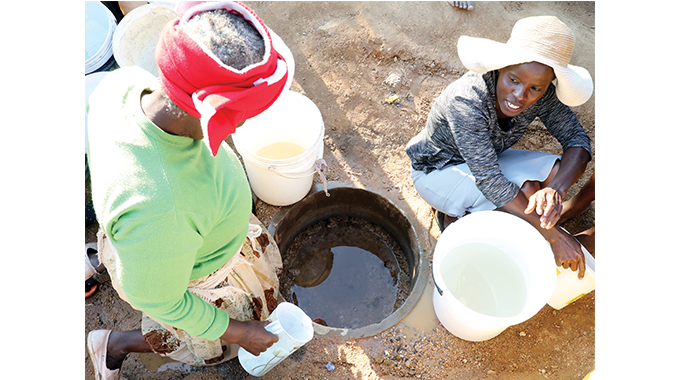
Nqobile Tshili, Chronicle Reporter
BULAWAYO’S water situation has become desperate with some residents going for weeks without tap water, forcing others to draw water from unprotected sources which may lead to serious health consequences.
Since the outbreak of Covid-19 in March, the availability of water should be guaranteed to fight the pandemic to ensure hygiene through people washing their hands and themselves.
However, water is increasingly becoming scarce for most residents.
The water situation has been worsened by the ever-bursting water pipes disrupting water supplies.
The water crisis has seen council steadily extending the weekly water shedding programme from an initial 48-hours to 72-hours then 96-hours.
Early last month the programme was increased from 108 hours weekly to the current 120 hour weekly-water shedding exercise.
According to the World Health Organisation, limited supply obliges people to store more water. If not handled properly, this will provide more opportunities for the outbreak of disease.
Moreover, WHO says low or negative water pressure in pipes due to short supply can attract contaminants that will put water quality at risk when the supply is restored.
A Chronicle news crew yesterday went around the city and observed residents queueing to fetch water from boreholes while others waited for hours for council water bowsers to make deliveries.
In suburbs such as New Magwegwe and Pumula East where the local authority said it would be sending water bowsers, by 11AM residents had deserted their lined-up containers at collection points as council had taken too long to deliver the water.

Residents said while council had come up with a timetable when it would make water deliveries, the local authority does not follow its own time-frames to deliver the commodity.
Some residents in suburbs such as Pumula East said they had even resorted to digging wells in a nearby bush and fetching water from streams filled with sewage to use in toilets.
While council imposed a five-day weekly water shedding programme, in some high lying areas such as New Magwegwe and Magwegwe North some residents have gone for more than a month without tap water.
Residents said when water is finally delivered by bowsers, it is never adequate as council has imposed a limit on quantities each family can draw per delivery.
Ms Mendy Ndlovu from Nkulumane suburb said while she requires 80 litres a day, council limits her to 60 litres which creates challenges for her.
“It’s been two weeks since we last received running water. We are supposed to get water from the council’s water bowsers but sometimes it runs out before we can fill up our containers. The nearby boreholes are broken down. We have to practise good personal hygiene but it’s difficult to do so with this water situation,” said Ms Ndlovu
“I have minor children that need to be bathed maybe twice a day but now I’m even forced to wipe them just to conserve water which is not good. With a baby you cannot spend a day without washing their clothes but we are forced to do that.”
She said she is forced to treat water drawn from a bowser using chlorine as water from the bowser is not safe as those who used it before her claimed that they ended up suffering from diarrhoea.
However, council insisted yesterday that the water is safe and those who have problems with it must report to the local authority.
Mr Simba Gwaindepi said in New Magwegwe, flats residents have gone for more than two months without running water.
“While other residents are crying about not having running water for five days a week, we would be grateful if we could access water just for those two days per week.
“Right now, we are having diarrhoea due to this dirty water that we are getting from water bowsers. The water is not safe but what options do we have,” said Mr Gwaindepi.
He said it seems BCC’s only solution to water challenges in the city is to impose rationing programmes.
Mrs Betty Ncube from Magwegwe North said they were forced to wake up as early as 4AM just to draw water from boreholes in the same suburb.
She said the situation is dire considering that people should maintain social distancing but at the boreholes residents would be crowded.
A Chronicle news crew observed that about four residents would be using the same hand pump simultaneously to fill up containers.
Most of the people were not wearing face masks which is now mandatory to fight Covid-19.
Mr Phillip Ndlovu, from Pumula East said he fears that there would be an outbreak of diseases due to lack of water.
He said residents risk contracting cholera and diarrhoea among other diseases caused by failure to practise good personal hygiene.
“We now even have Covid-19 which requires us to constantly wash our hands while staying indoors so that we are not infected. Is that possible when we are spending weeks without water?
“We are spending a better part of our day queuing just for water before joining another queue for something else”, said Mr Ndlovu.
Bulawayo City Council senior public relations officer Mrs Nesisa Mpofu said council needs help as it cannot address one of the city’s worst ever water crisis on its own.
She said water being provided in bowsers is safe because it is just the same as tap water.
Mrs Mpofu however said if residents are having problems with water provided in bowsers, they should contact council.
“We have a deficit of bowsers considering the number of people affected by water challenges versus the number of bowsers we have as a city.
“We need help. That is why we are partnering with the private sector and we are investigating how best we can improve the provision of water in areas that normally do not get water.
“We are talking to other partners on more solutions and those with bowsers can also come forward,” said Mrs Mpofu.
She said she did not have off hand figures how many water bowsers are needed for council to adequately provide water to desperate residents.
Council last week said it requires $910 million or US$22,75 million to implement three major projects that would ease the city’s water crisis.
In the meantime, council has said it will decommission Lower Ncema Dam this month, making it the third to be decommissioned after Umzingwane and Upper Ncema dams that were decommissioned last year.
This will leave the city with three supply dams namely Insiza, Inyakuni and Mtshabezi dams.
Decommissioning of Ncema Dam would result in council losing almost 60 megalitres (ML) while it is pumping about 130ML per day. — @nqotshili


 Online Reporter