

 Online Reporter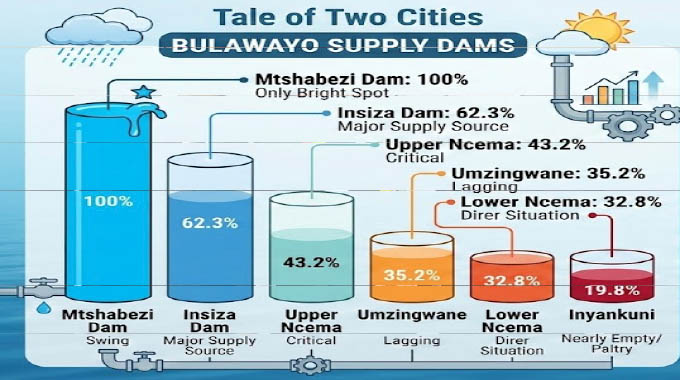
Rutendo Nyeve, [email protected]
DESPITE incessant rains that continue to pound most parts of the country, pushing the national average dam level to an impressive 91,7 percent, Bulawayo is staring at a prolonged water crisis as the city’s supply dams remain critically low.
Water experts have attributed the poor inflows into Bulawayo’s supply dams despite the heavy rains to rampant illegal gold panning activities upstream. The alluvial mining along the rivers that feed these reservoirs has resulted in damage to the natural water courses.
The river systems have been heavily degraded, meaning that instead of water flowing freely into the dams, it either gets trapped in pools created by panners or the flow is severely obstructed by excavated river banks.
According to a latest update from the Zimbabwe National Water Authority (Zinwa) dated March 4, 2026, most major dams like Tugwi-Mukosi are spilling at 100 percent full.
However, the seven dams that constitute Bulawayo’s primary water source are struggling to reach capacity, with some still below 50 percent. The Zinwa report, which sorts data by dam capacity from largest to smallest, provides a statistical breakdown of the situation.
Tugwi-Mukosi is 100 percent full and Manyuchi at 99,5 percent, reads the update.
However, the figures for the Bulawayo supply dams tell a different story.
According to Zinwa, Mtshabezi is the only bright spot for Bulawayo at 100 percent. However, the remaining critical dams are still low. Insiza Dam, one of the major supply sources, stands at only 62,3 percent.
Upper Ncema is at 43,2 percent, while Umzingwane is lagging at 35,2 percent.
The situation grows direr at Lower Ncema, which is at 32,8 percent, and Inyankuni is nearly empty at a paltry 19,8 percent. The national picture, however, remains good.
“Sebakwe is at 100 percent, Zhovhe in Beitbridge at 100 percent, Siya at 100 percent, and Arcadia, Bubi Lupane, Masembura, Silalabuhwa, Harava, Seke, and Upper Insiza are all recorded at 100 percent full,” reads the update.
Manjirenji sits at 92,8 percent, while Osborne is at 86,5 percent. Manyame is at 82,4 percent, and Chivero stands at 79,1 percent.
This publication established that while authorities have made significant strides in improving water infrastructure, notably the completion of pumping system upgrades at the Umzingwane and Inyankuni dams, these investments are rendered moot by the lack of raw water.
Unless the dams fill up, the city cannot pump what is not there. This leaves Bulawayo facing the same cyclical water challenges.
While the dams are the primary supply sources, the city has long relied on the Nyamandlovu Aquifer to augment supply.
The aquifer has an installed capacity of 20 megalitres per day. However, this figure remains largely theoretical due to persistent operational constraints.
Vandalism of equipment and continuous breakdowns of pumps at the Nyamandlovu wellfields have significantly reduced the actual yield over the past years, limiting its contribution to the city’s water budget.
In the long term, the Government’s flagship Gwayi-Shangani Dam project is earmarked as the permanent solution to Bulawayo’s water challenges.
Once completed, the pipeline from the dam is expected to pump 240 megalitres of water per day into the city, permanently altering the water equation for the region.


 Bongani Ndlovu