Chronicle Editor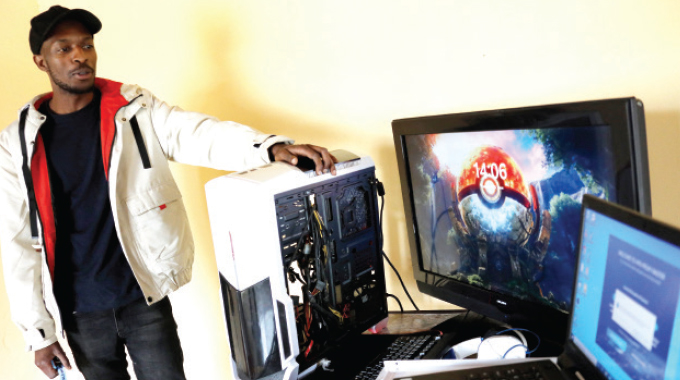
Raymond Jaravaza, [email protected]
Armed with the knowledge acquired through free online tutorials, two brothers in Bulawayo have mastered the art of harvesting computer parts to assemble electronic devices that they sell to clients from a makeshift workshop at their Emganwini home.
Without any formal education in computer repair and maintenance, Mr Marshal Ndiweni and his younger brother Sindiso have taught themselves to assemble harvested parts from discarded computers into usable devices for customers who cannot afford new computers. They are motivated by the zeal to learn anything about computers.
Frustrated by the high costs charged by local technicians to repair his laptop in 2014, Mr Ndiweni dismantled it without his grandmother’s knowledge and started taking free online lessons on how to repair computers. He was in Upper Six at Inyanda High School in Luveve.
His passion for computer repairs grew, and he soon roped in his brother, Sindiso, who also joined the online lessons. Today, they use their self-taught skills to harvest computer parts deemed excess baggage by residents to build low-cost computers for their clients.
A Chronicle news crew found Mr Ndiweni in the corner of his sitting room working on a computer ordered by a customer.
“I will not bore you with the technical jargon of how I’m building this PC (personal computer) for a client, but the long and short of what I’m doing here is that I harvested computer parts from computers that I got from some people and I will build a working computer for a client,” he said.
“When someone says their computer is no longer working and they don’t want it anymore, I ask to take it and harvest parts that are still usable.
“Of course, when building a computer for a client, I can’t rely on harvested parts alone. I also need to buy some parts to come up with a good computer that will not give my clients problems.”
But how did his journey from harvesting computer parts to building working devices start?
“My grandmother bought me my first laptop when I was doing my A-Levels at Inyanda High School and after a while it developed problems and I was charged US$120 to repair it, which was almost the same amount we had bought it for,” he said.
“I dismantled the computer without my granny’s knowledge and just started toying around with the idea of taking free online lessons on how to repair computers. In no time I was almost obsessed with learning about computer repairs and maintenance.”
Like a bug, his younger brother Sindiso also joined the lessons on computer repairs. The self-help tutorials soon paid off for Mr Ndiweni when a customer who was a lecturer at the United College of Education (UCE) brought his laptop for repairs. He said repairing the first computer for a client was a scary experience as he had no idea whether he would pull it off or not.
“Like everything in life, experience is the best teacher and from the first laptop that I repaired for the UCE lecturer, I have fixed countless more in addition to building computers from parts that I harvest from devices that no longer work,” he said.
The two brothers were orphaned at a young age and were raised by their grandmother, who passed away in 2020.
The world is facing a new phenomenon known as electronic waste or e-waste, described as the discarding of electronic devices in dumpsites, which poses serious health risks to humans and animals.
According to environmental experts, every year, millions of electrical and electronic devices are discarded as products break or become obsolete. These discarded devices are considered e-waste and can become a threat to the environment and human health if not treated, disposed of and recycled appropriately.
Common items in e-waste streams include computers, mobile phones, television sets and large household appliances, as well as medical equipment.
In their small contribution to curbing rising cases of e-waste in the city, the brothers are using their self-taught skills to harvest computer parts deemed excess baggage by residents to build low-cost computers for their clients.
“We might not be completely eradicating cases of e-waste but we are trying to play a part in ensuring that computers that are considered as waste are stripped of some usable parts that can be recycled and used to build or repair other devices,” said Mr Ndiweni.
His brother Sindiso currently works for Trendy Three Investments (TTI), a parking solutions company in Bulawayo, and works on building and repairing computers in his spare time.
The brothers’ immediate goal is to register a company and qualify for Government or private company tenders to repair their computers.
“We can’t apply for Government or private company tenders to fix their computers because we are not registered and no one will take us seriously.
“Even applying for a bank loan is a problem because financial institutions want proof of collateral if one fails to pay back the loan to recover their money,” he said.


 Online Reporter