Chronicle Editor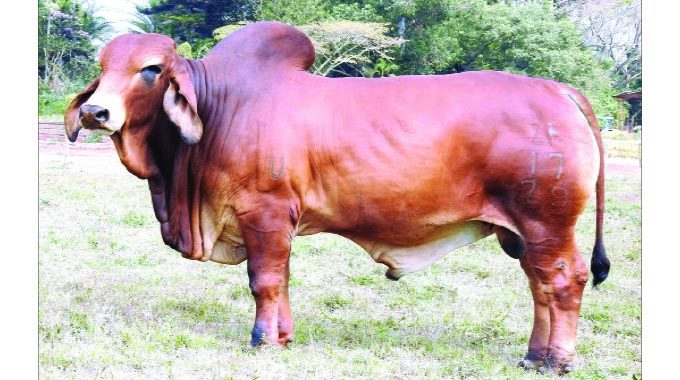
THE months of July and October have become what I will coin the “bull procurement” months in Zimbabwe. This is because the national bull sale which takes place in Harare annually, happens in July while the private Ruvale Brahmans bull sale has always happened during the last week of October every year.
However, this one will this year happen towards the end of September. Bull procurement is a very important occasion to a livestock farmer on two fronts.
First, this is a huge investment which means one has to prepare and budget for it because a good bull will subtract a good number of thousands of American dollars from your pocket. You need to be prepared financially for it.
Secondly, a bull is an important component of one’s herd hence the need to choose wisely. We have said it before that, in livestock production terms, the bull is said to be 50 percent of your herd, that’s how important it is. Put simply every offspring that is born in your herd, has half of its genetics coming from your bull.
This means when you buy a bull you need to take your time and be properly knowledgeable or advised such that you buy exactly what you are looking for in your herd. It cannot be a knee-jerk impulse driven purchase but a carefully thought out and well researched investment. It is thus important for livestock farmers to know what to look for in a good bull.
In that regard we herein share a few pointers for a good bull. The first and most important aspect to consider when buying a bull is masculinity. This means the bull has to look like a bull, forgive the redundance! It should have very clear and distinct features that define it as a bull. You don’t need to look at its genitalia to confirm that it’s a bull!
A good bull should be well muscled and have a strong top line. Good muscle expression means it will give you excellent steers and heifers with good weaning weights. Most bulls will have a hump directly above the shoulders and the extent of the development of the hump depends on the breed with the Brahman being one of those breeds with very well developed and distinct humps.
A lot of bulls will also show darkening of the coat around the shoulders which in itself is an indication of good hormonal balance and the masculinity of the bull.
You have probably noticed that red brahman bull will be darker around the hump, shoulders and lower part of the neck, same with grey/white brahmans. This aspect may not be very pronounced in other breeds but it is certainly noticeable in many.
A good bull should have a good length, width and broader midsection. The hind quarters should be well rounded and of a good width. This determines the meatiness of its offspring. It should also have strong and properly developed legs with no deformities of sort.
The bone structure of the front legs must be sound and there must be good width in the chest floor.
Hooves must be free of any genetic problems and should be even. Good conformation and structural soundness are important for the mounting ability of the bull. You do not want to get a bull which has some structural defects which compromises its mounting ability. Mounting is a precision game which means the bull has to be of a good stature to execute the task with the desired accuracy.
Also, the head of the bull must show a strong bone outline and have clear masculine features. Finally, the genitalia department has to be properly developed. The testicles should be big enough to have a scrotal circumference of around 30cm.
Scrotal circumference is correlated to the sperm production. Any testicular asymmetry should worry you as this could be an indication of a bigger problems such as orchitis, hernia and others.
The sheath should not be overly pendulous to the point where it is dandling. This kind of sheath is prone to injuries especially in thorny veldts and this leads to infection. A good sheath should follow the belly of the bull pointing front but tilting towards the gap between front legs. The other important aspect is the physiological development of the penis itself.
Unfortunately, you may not be able to check for this at the bulls’ auction or even at farm purchase as the penis condition will only be noticeable when the bull is in action. There are two important conditions of the penis which may make your prized purchase be useless.
This is phimosis and paraphimosis. Phimosis is when the bull cannot get the penis out of the sheath and paraphimosis is when the bull is unable to retract the penis completely back into the sheath. Both situations are not good for the bull.
With phimosis, it means the bull will not be able to get it into the cow hence there will be no fertilisation. Paraphimosis will result in the partially exposed penis getting injuries and infection. Lastly your bull should have good libido. This you may not be able to measure at auction but if there are females, you may see him attempting to mount one or two.
It’s no use to get a bull which has no desire for females, you want it to have a healthy appetite for females so that there is production on the farm. Uyabonga umntaka MaKhumalo.
ν Mhlupheki Dube is a livestock specialist and farmer. He writes in his own capacity. Feedback [email protected] or cell 0772851275


 Online Reporter