admin
admin
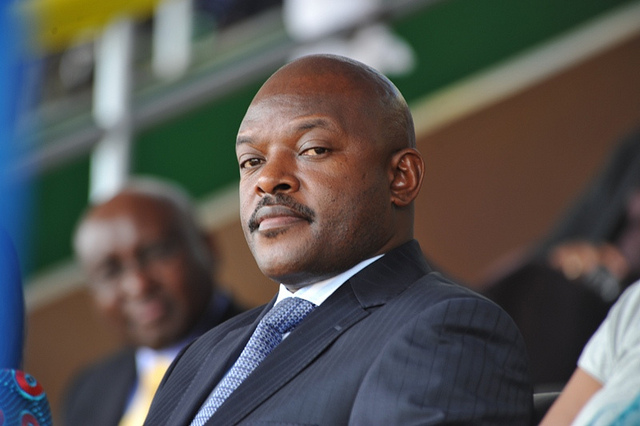
BUJUMBURA — Burundian President Pierre Nkurunziza appears set to win a controversial third consecutive term in elections today, a hollow victory that will leave him ruling over a violently divided nation. The opposition and civil society groups have denounced his candidacy as unconstitutional and a violation of a peace deal that brought an end to a dozen years of civil war and ethnic massacres in 2006.
With the elections denounced by opponents as a sham, the 51-year-old president — a former rebel, born-again Christian and football fanatic — has no competition.
“The government has opted to isolate itself and go ahead with pseudo-elections,” said Leonce Ngendakumana, a prominent opposition figure.
“It’s very irresponsible,” said another opposition figure, Jean Minani. “They have refused to save Burundi from sliding into an abyss.”
More than two months of anti-Nkurunziza protests have left at least 100 dead in a tough government crackdown, independent media has been shut down and many opponents have fled — joining an exodus of over 150,000 ordinary Burundians who fear their country may again be engulfed by widespread violence.
In mid-May, rebel generals also attempted to overthrow Nkurunziza in a coup, although this failed and they have since launched a rebellion in the north of the country.
Analysts say renewed conflict in the country could reignite Hutu-Tutsi violence and bring another unwelcome humanitarian disaster to the region, with the added risk of drawing in neighbouring states — much like in the war-torn east of the Democratic Republic of Congo.
The last civil war in Burundi left at least 300,000 dead.
The United Nations and the East African Community — a five-nation regional bloc — has been trying to mediate a solution but without success.
On Sunday an EAC source said the latest effort, led by Ugandan Defence Minister Crispus Kiyonga, now appeared to be “dead”.
“The security situation could degenerate at any moment,” the source warned.
The International Crisis Group, a conflict prevention think-tank, has also already warned that the crisis has all the ingredients to kick-start renewed civil war.
The CNDD-FDD scored a widely-expected landslide win in parliamentary polls held on May 29, but these were boycotted by the opposition and condemned internationally as neither free nor fair.
Nkurunziza views his presidency as divine destiny, and has campaigned on a promise of keeping the peace and lifting the country out of poverty.
“If you choose the CNDD-FDD you are sure of five more years of peace,” he said on Friday during one of his final rallies.
“Since the election of the CNDD-FDD in 2005, it is the first time since independence in 1962 that people haven’t been killing each other because of ethnicity,” the president said.
Burundi’s presidential camp over the weekend decided to suspend its participation in the political dialogue that began last Wednesday to find a compromise over points of disagreement on the forthcoming elections.
The presidential camp took the decision just three days to the presidential polls set for today.
Burundi’s Interior Minister Edouard Nduwimana who is the spokesman for the governmental group in the dialogue justified the withdrawal, alluding to the declaration by some opposition figures calling for the creation of a National Council for the Restoration of Arusha Agreement for Peace and Reconciliation in Burundi.
“There was no way of continuing with dialogue at a time when some people were preparing for other things. This is why we have asked for a temporary suspension of the talks to give the special envoy some time to ponder over that declaration and report back to the facilitator who sent him. But it is also upon us as government to examine whether we need to continue with this dialogue,” Nduwimana said.
Meanwhile, the African Union reiterated its readiness to immediately deploy human rights observers and military experts to Burundi.
The pan-African bloc said in a statement on Sunday that the deployment is part of the follow-up and implementation of the relevant decisions of the AU Peace and Security Council (PSC).
The statement recalled that the PSC meeting in Johannesburg on June 13 requested the immediate deployment of human rights observers and other civilian personnel to Burundi, as agreed in its communique of May 14, 2015, as well as that of military experts. — AFP/Xinhua.


 Online Reporter