admin
admin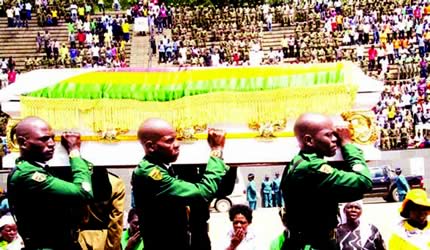
after acing four subjects at A-Level with As in Mathematics, Economics, Accounts and Management of Business.
His comment on being asked if he had at one point been anxious about the exam results was, ‘‘Not really, my greatest fear was just a string of Bs!’’
Ah ah!
How we, poor mortals, admired that “demi-god” as his story was read to us at assembly by our headmaster, Mr Samuriwo, May His Soul Rest In Peace, as he urged us Sixth Formers to burn the midnight oil so we could emulate the Mt Pleasant whizkid that year.
Mr Samuriwo was, however, not completely taken in by the dude’s comment as he, after putting the paper aside on the rostrum, quipped, ‘‘Aiwa kwava kutaura kwewabaya. Nyangwe akati ndaisvetuka makwenzi akakura kunge miti ndichitandanisa mhuka hamuzvirambe nekuti nyama munenge muchiiona!’’
There is an African proverb that aptly captures that proverbial situation of the return of the triumphant hunter. It goes: ‘‘until the lions learn to write down their own stories, the story of the hunt will always be told from the hunter’s perspective.’’
Hunters were a select group in the pre-colonial halcyon days.
They and the warriors who protected the kingdom, were a venerated lot that married the nicest women, held court with kings, ate the nicest meals, wore the trendiest kilts and often had great stories to relate about their exploits in the bush or on the battlefield. These mystical men were serenaded by praisesongs especially when they brought home big game animals.
Even though listeners hung on the hunter’s every word about how the beast had come to meet its maker, some knew that they were getting one side of what went on in the forest because the beast was not in a position to counter the hunter’s narration.
For instance, the lion a hunter would claim to have subdued after a fierce duel would probably have been sleeping when he sneaked upon and impaled it with his spear.
The deer he claimed to have outran would probably have been caught in a snare. But then the hunter had the bragging rights because he possessed the gift of speech which the lion or game didn’t.
So what’s my point?
My point is there are two sides to a story and we have not done much to tell our own even as Western presses roar night and day churning out literature that belittles our struggle for independence and democracy. In fact, the Rhodesians we vanquished and their kith and kin all over the world have been busy playing the hunter while we dutifully remained mum like lifeless prey.
Our nationalists, national heroes and former freedom fighters have not done much, if anything to record their wartime experiences for the post-independent generation and posterity
One by one the venerated nationalists have crossed to the other side of silence with their precious memories, and today another distinguished freedom fighter Cde John Landa Nkomo, will be laid to rest at the National Heroes’ Acre and with him a wealth of information on his wartime experiences.
We are burying more than just a body today, but a valuable part of our history that has been lost for good.
The bottom line is our national leaders are letting us down by not writing books detailing the history of the struggle.
Ironically, ex-Rhodies and their kith and kin like the late Heidi Holland of the Dinner with Mugabe fame have been churning out books by the year, painting Zanu-PF and President Mugabe in bad light while portraying themselves and those of their ilk as the wronged ones.
A visit to any bookseller at OR International Airport or any reputable Western bookseller will show row upon row of Rhodesian or European interpretation of Zimbabwean history and its leadership.
Add to this the attempt by the MDC-T leaders to re-invent themselves and their quisling agenda as a logical extension of the liberation struggle and what remains is a dangerous attempt at revisionism that needs robust countering.
The likes of Morgan Tsvangirai who lasted no more than 24 hours in a liberation war camp claim to be qualified to select national heroes.
Even Nelson Chamisa who was just an infant at independence in 1980 feels competent to select heroes of the struggle.
Eddie Cross and Roy Bennett — who never featured on the radar of progressive whites like Guy Clutton Brock — today claim to be long-suffering fighters of democracy in Zimbabwe and future generations may be taken in unless they have access to the stories of their heroes.
The best way to counter these reactionaries is to record our history so that future generations will know the source of the cloud that does not bear water.
Why don’t we have books on or by President Mugabe? The late Vice Presidents John Landa Nkomo, Joseph Msika and Simon Muzenda? Why don’t we have books by or on Mai Joice Mujuru, General Solomon Mujuru, Josiah Magama Tongogara, Herbert Wiltshire Chitepo, etc?
What’s stopping our writers from interviewing these luminaries and compiling their history? Can’t we see we are being willing accomplices to the West’s nascent revisionism within the regime change ranks?
Who will we blame when our children take Heidi Holland’s view of Zimbabwe and President Mugabe? For the life of me, I can’t understand why if a semi-literate like George W. Bush can have a book out in ‘a tongue similar to English’, our own leaders here seem averse to leaving documented history for posterity?
I REITERATE even Tsvangirai, for all his uhhhm eeh . . . has a book out, At The Deep End! Though of course credit goes to a fellow scribe, William Tagwirei Bango, for documenting the story according to Tsvangirai.
I challenge our heroes of the struggle to have, as part of their New Year resolutions, the documenting of our history. I am sure there is no shortage of writers, as long as resources are availed.
They owe it not only to this generation, but our children and their children’s children in perpetuity.


 Online Reporter