Chronicle Editor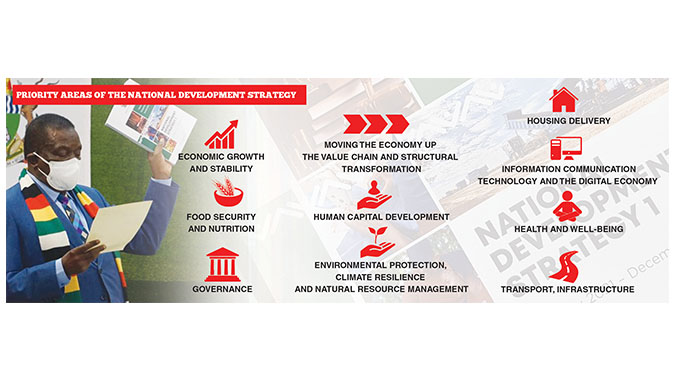
The ushering in of the New Dispensation in November 2017 saw the launch of Vision 2030 to chart Zimbabwe’s new development trajectory.
The Vision reflects the collective aspirations and determination of the people of Zimbabwe to achieve a Prosperous and Empowered Upper Middle Income Society by 2030. As spelt out in Vision 2030, achieving a Prosperous and Empowered Upper Middle Income Society will depend on the formulation and implementation of bold and robust policies as well as other interventions that Government will undertake through Short and Medium-Term National Development Plans.
The Transitional Stabilisation Programme (TSP, October 2018-December 2020) was implemented as a first step of a three-phase process to attain the country’s Vision 2030 outcomes. The TSP sought to strengthen key priorities that form the foundation for the implementation of Medium-Term Plans. The TSP was aimed at stabilising the macro-economy and the financial sector, introducing necessary policy and institutional reforms to transform the economy to a private sector led economy, as well as launching quick-wins to stimulate growth.
Further, the TSP was crafted to deal with distortions and challenges that would retard growth of the economy in the long run. These include persistent and unsustainable budget deficits, inflationary pressures, uncontrolled domestic borrowing and unsustainable debt levels.
These distortions and challenges hindered Government efforts to come up with a long-term development strategy, since sustained macro-economic stability is a prerequisite to long term National Development Planning and implementation. Significant progress was made in the implementation of the TSP across various pillars. These include fiscal consolidation, restoration of monetary policy, stabilisation of the exchange rate, the undertaking of governance and institutional reforms, entrenched engagement and re-engagement with the international community, facilitation of investment and infrastructure development.
Fiscal consolidation during the TSP was achieved through expenditure containment measures as well as limiting recourse to the Central Bank overdraft. During the TSP period, Treasury Bills (TBs) were only issued within the framework of the budget. In addition, Government managed to contain the Public Wage Bill to below 50% of Government revenues.
Additionally, the Zimbabwean dollar was re-introduced. Exchange rate stabilisation was also successfully achieved through the implementation of the foreign currency auction system. Several strides were made in transforming the governance eco system to ensure that the country’s institutions, systems and practices conform to the provisions of the new constitution. In or der to guarantee constitutional provisions, including fundamental rights, freedoms and responsibilities under the TSP, Government aligned more than 75% of the laws to the Constitution. This was also further complimented by implementation of various public sector reform measures to enhance institutional and individual performance towards provision of quality services to the citizenry.
Under the Infrastructure and Utilities pillar, a number of roads and other related infrastructure were constructed throughout the country. Besides the road networks, notable achievements were recorded in rail, water and sanitation, in formation communication technology, aerospace, energy and power, irrigation, housing and office accommodation infrastructure.
In Education, a total of 153 new educational institutions were registered during the TSP period. Government, through Private Public Partnerships (PPPs), completed the construction of new infrastructure at eight Universities, eight Polytechnics and four Teachers Colleges. These include: Gwanda State University, Manicaland State University of Applied Sciences, Marondera University of Agriculture, Lupane State University, Madziwa Teachers’ College, Mkoba Teachers’ College, Masvingo Technical College, Joshua Mqabuko Polytechnic College and Hwange Teachers’ College, among others. Notwithstanding these achievements, the TSP faced a number of challenges during its implementation. These include among others, high inflationary pressures, exchange rate volatility, continued illegal sanctions against the country, and exogenous shocks like droughts, Cyclone Idai and the Covid-19 pandemic. These shocks affected the entire economy with the greatest impact being on agricultural production and electricity generation, with extended effects also felt on other sectors of the economy. –National Development Strategy1.



 Online Reporter