Online Reporter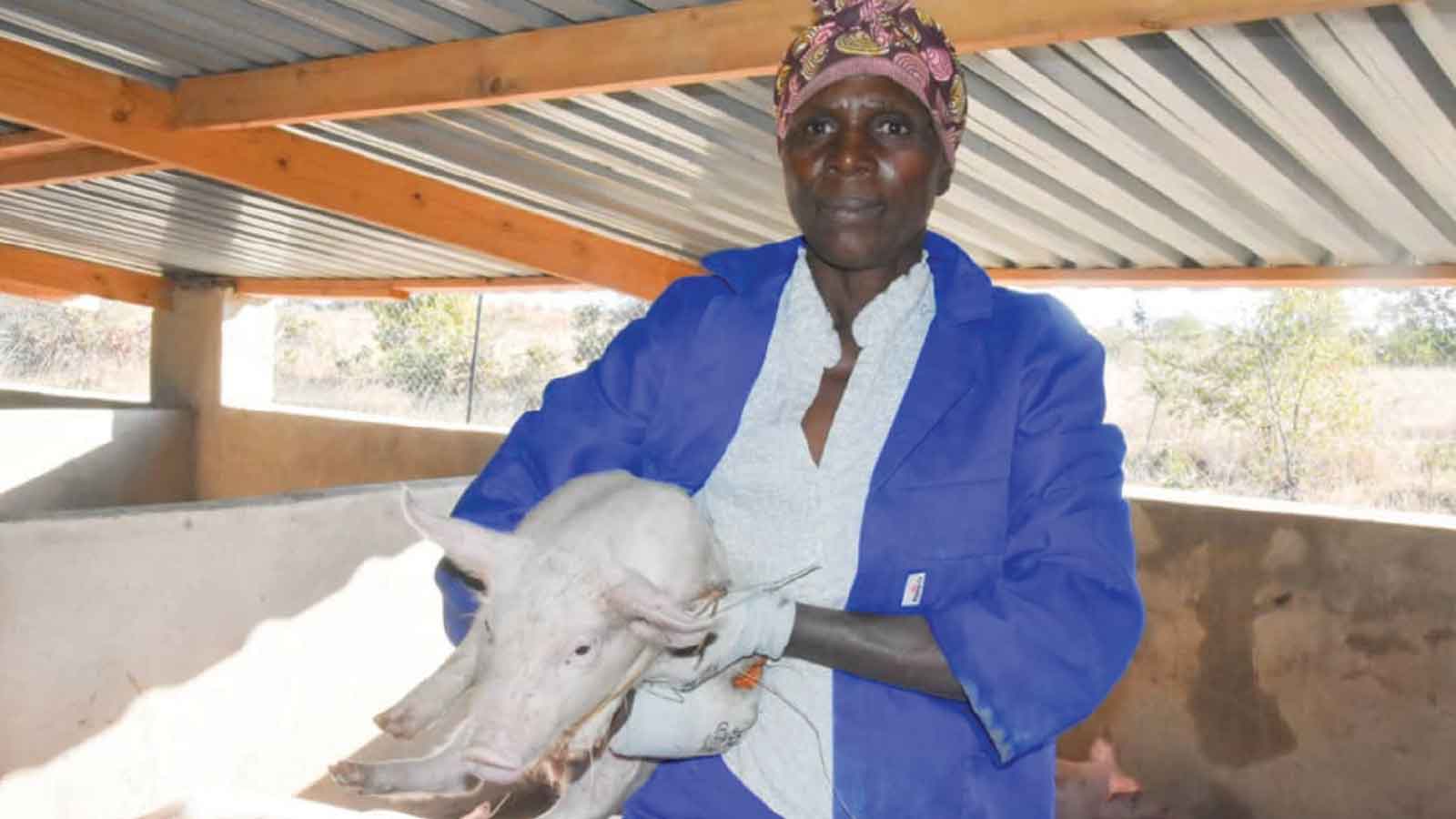
Theseus Mauruki Shambare
Features Writer
IN Fakanya Village under Ward 3 in Shamva, Mashonaland Central, the agreement is not taken lightly; it is worked on.
It is carried in buckets, mixed into cement, pressed into bricks and repeated each morning in the rhythm of feeding, cleaning, breeding and birthing pigs.
Over time, it has become both a livelihood and a discipline — an organised system of labour that the women say has reshaped their relationship with scarcity.
They call themselves Bvumazvipere — a Shona phrase they interpret to mean: “Commit and your suffering ends.”
In practical terms, it is a shared conviction that full participation in the project is the pathway out of chronic financial insecurity, including struggles with school fees and household poverty.
The group now brings together 45 women under a piggery project supported by SOS Children’s Villages.
What began as a small livestock initiative has evolved into a structured production unit where women manage the entire pig value chain — from breeding through farrowing to marketing.
For them, Bvumazvipere is not a slogan but daily production. At dawn, work starts without discussion.
Women move between pigsties, inspecting feed, cleaning pens, mixing rations and checking the condition of animals that now represent household income, school fees and future capital.
Nothing in the system is outsourced. Even breeding is handled internally.
The women monitor heat cycles, manage mating and track reproduction schedules — tasks typically associated with trained livestock technicians in commercial systems.
Then comes farrowing, the most demanding stage of pig production.
In livestock science, farrowing requires close monitoring due to risks such as piglet crushing, birth complications and early mortality.
Agricultural extension literature and FAO livestock manuals note that piglet mortality in unmanaged systems can range from 10 to 20 percent, but can be significantly reduced through supervision and proper husbandry practices.
In Fakanya Village, supervision is constant. The women rotate shifts, often staying through the night to monitor farrowing sows.
They assist when necessary, clearing space, repositioning piglets and ensuring newborns survive their first fragile hours. This is not auxiliary labour. It is full production responsibility.
“We agreed that whatever comes, we will do it as a group,” said Waringamoyo Pawakonorwa.
“We clean, we feed, we manage everything. Even when the pigs are giving birth, we must be there.”
Of the 45 members, only one is a man. The group constructed the pigsties themselves after receiving cement and roofing materials from partners, sourcing pit sand, moulding bricks and clearing the land.
The site — once densely vegetated near a wetland — has been transformed into a functioning livestock unit with structured housing and water access.
The project, supported by SOS Children’s Villages, has moved beyond a basic livestock intervention into a structured rural enterprise anchored on infrastructure, training and collective ownership.
SOS Children’s Villages injected US$50 000 into the initiative, funding the drilling and installation of a borehole with solar-powered pumping, construction of pigsties, perimeter fencing, a guardroom to secure the production site and a full feed package for the first three cycles.
The investment provided the physical backbone for a system that the women themselves now operate daily.
The initiative directly benefits 45 households, selected through a joint process involving the Project Management Committee, SOS Children’s Villages, AGRITEX and the Ministry of Primary and Secondary Education.
The selection model was designed to ensure community ownership and technical oversight from Government extension services and development partners.
Framed as an income-generating livestock enterprise, the project is intended to strengthen household resilience through sustained pig production, diversified income streams and improved food security.
In practice, it has become both a production unit and a social safety net for participating families. But the transformation is not only physical.
It is managerial. The women now control feeding regimes, breeding cycles, health monitoring and market readiness. In doing so, they occupy roles often reserved for commercial farmers or livestock technicians.
This shift reflects broader findings in livestock development literature, where institutions such as the Food and Agriculture Organisation (FAO) and the International Livestock Research Institute (ILRI) have consistently identified piggery as one of the most efficient small livestock enterprises due to its short reproduction cycle, high feed conversion efficiency and rapid turnover.
A sow can produce two litters per year, averaging eight to 12 piglets per litter under improved management systems, making pigs one of the fastest-growing income-generating livestock options for smallholder farmers.
The project began with just eight pigs, including a single boar.
Through collective management, the herd has grown to 56 animals.
A borehole drilled and solarised under the programme now supplies water for both livestock and a vegetable garden, integrating crop and animal production into a small mixed farming system.
In rural development practice, such integration is widely associated with improved household resilience through diversified income streams and reduced dependence on seasonal rainfall.
For the women, the change is already visible in practical terms: food security, school fee payments and incremental reinvestment into livestock expansion. For Florence Zuze, the meaning of the project goes beyond income.
“The piggery project has already shown us that it can transform our lives,” she said.
“We want to use the proceeds for school fees, better homes and other projects.”
Behind that statement is a deeper shift — women managing full production cycles that include reproduction, mortality risk, labour coordination and financial planning.
Programme officials say the initiative is part of SOS Children’s Villages’ family-strengthening approach, which links income generation directly to child welfare outcomes.
Coordinator Malven Manyeza said the model is anchored in household resilience.
“You cannot support a child unless you support the family,” he said. “That is why we combine income generation, infrastructure support and skills development.”
What distinguishes Bvumazvipere is not participation in agriculture, but presence across the entire production cycle.
They are there for feeding. They are there at the cleaning stage.
They are there for breeding. And they are there at birth.
In rural development systems, this is often the invisible labour that determines whether projects succeed or fail — consistent, co-ordinated human presence at every stage of production.
Here, it is structured, shared and visible. And it is female-led.
Bvumazvipere began as a promise and has become a production system where agreement has turned into labour; labour into ownership, and ownership into incremental economic change.
In Fakanya Village, the piggery is no longer just a project supported by a development partner. It is a functioning rural enterprise managed by women who have placed themselves at the centre of every stage of production.
They are not waiting for empowerment. They are working through it — one feeding cycle, one birth, one litter at a time. And they are not stopping until it is complete.