Chronicle Editor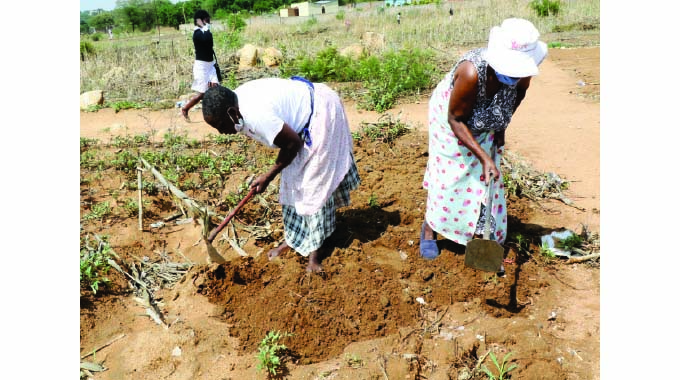
Mashudu Netsianda, Senior Reporter
THE onset of the rainy season has ignited excitement among urban farmers in Bulawayo and brightened their hopes of another bumper harvest with above average rains expected in most Sadc countries.
In the last season, Bulawayo farmers harvested 5 000 tonnes of maize. The country received normal to above normal rains in the 2020-21 season leading to a bumper harvest, improving food security and reducing imports.
Zimbabwe as a result saved at least US$300 million after it suspended maize imports.
The seasonal forecast issued by the 25th Southern African Regional Climate Outlook Forum (SARCOF 25) two months ago pointed to a likelihood of normal to above normal rainfall in the 2021/2022 cropping season.
Zimbabwe is in the area likely to receive normal to above normal rains in both the first and second halves of the season, which normally runs from October to March.
This is for the second consecutive season that the country and much of the region in general is likely to receive good rains.
According to the Meteorological Services Department (MSD), the country should expect improved rainfalls in line with projected normal to above normal rains.
MSD said the first quarter of the rainy season ended on November 15. The country is now in the second quarter and expecting a significant improvement in the amounts of rainfall.
Weather experts said farmers in parts of the country receiving at least 30mm or more of rainfall can start planting.
Some urban farmers in Bulawayo have already started planting following the onset of the rainy season.
Last week, Government started distributing agricultural inputs to 20 000 urban farmers in Bulawayo for the 2021/2022 farming season under the Climate-Proofed Presidential Inputs Scheme, popularly known as Intwasa/Pfumvudza.
The Inputs package include lime, basal fertiliser, top dressing, folia fertilisers, pesticides and 2kg seed maize. In low rainfall agro-ecological regions, three plots will be put under maize, sorghum and pearl millet.
Intwasa is a concept aimed at climate proofing agriculture by adopting conservation farming techniques and involves use of small plots and applying the correct agronomic practices for higher returns.
The Intwasa/Pfumvudza programme, designed for small-scale farmers will this season benefit 2,3 million households in the communal, A1, small-scale commercial farming and old resettlement sectors to produce cereals, oilseeds and legumes this summer cropping season.
Riding on the success of the Government funded scheme during the 2020/21 agriculture season, the programme has this year attracted interest from many farmers in Bulawayo, mostly youths who did not participate last season.
Under Intwasa/Pfumvudza scheme, Government has set a target of 2,8 million hectares of maize and traditional grains during the 2021/22 summer cropping season.
The Government is targeting 540 000 households to put 103 680 hectares under sorghum to produce 487 296 tonnes.
For soya beans, Government is targeting 560 000 households to plant 20 000 hectares and produce 30 000 tonnes while 500 000 households are expected to plant 32 000 hectares of groundnuts and produce 32 000 tonnes.
About 260 000 households are expected to put 49 920 hectares under pearl millet and produce 124 800 tonnes.
A Chronicle news crew yesterday visited selected suburbs in the city and observed some peri-urban farmers in places such as Robert Sinyoka and Rangemore on the outskirts of Bulawayo planting.
“The start of the rains has cheered us and as farmers we are happy that the heavens have opened up. I have already done the holes under the Pfumvudza/Intwasa programme and just last week I received inputs from Grain Marketing Board (GMB) under the Presidential Input Scheme,” said Mrs Thembinkosi Nkomo of Rangemore.
Mrs Dorcas Mlauzi of Rangemore said she was looking forward to another successful season after recording a bumper harvest last season.
“We are looking forward to another good harvest following the onset of the rainy season. This has put a smile on my face and I can’t wait to start planting,” she said.
Mrs Mlauzi said through farming she is able to look after her family and she is looking forward to taking the surplus to GMB as she did last season.
Mr Richard Thebe of Robert Sinyoka said from the previous season, he sold 15 bags of maize to GMB. He has also benefited from the Presidential Input Scheme.
“We have received enough rains to start planting and Iam one of the farmers who received inputs from Government under the Pfumvudza/Intwasa programme. This is a brilliant programme, which is proving to be a source of livelihood for us,” he said.
Mr Thebe said the programme has enabled families to boost food security.
“We are grateful to Government for providing us with inputs, which came right on time just when the rainy season has started,” he said.
Matabeleland North Provincial Agritex officer Mr Dumisani Nyoni said he can only comment after doing an assessment of the rainfall pattern.
“We can only be able to tell farmers to start planting after we have gathered enough information in terms of the amount of rainfall received. Let’s talk tomorrow,” he said.
Agriculture expert Mr Ivan Craig said farmers should plant after receiving effective rains.
He said farmers with irrigation facilities could plant and irrigate for proper germination.
“The rainly season is upon us and farmers can start planting as soon as they get effective rains, which is 22 mm and above for maize and 30mm for soya beans and other hard coat seeds,” said Mr Craig.
He said at the beginning of the season, farmers should plant long season varieties.
“As we move into the third week of November, they should plant medium to short season varieties.”
Mr Craig said farmers could use rain gauges to check on the amount of rainfall received.
“If a farmer does not have a rain gauge, he or she can test the moisture of the soil by digging with a hoe, take the soil and squeeze it in the palm. When the palm is opened, if the ball breaks, it shows the soil does not have enough water for germination and if it does not break then the farmer can plant,” he said.
Mr Craig said if the water comes out from the soil, it means the soil is too wet for planting and a farmer must wait for some few days before planting.
He said when the soil is too wet it forms a crust, which means the germination of crops will be compromised.
Agricultural extension officer for Bulawayo Ms Treggie Mpofu recently told Chronicle that they trained both new and old farmers, including 20 000 youths in the province.
Government supports nearly 15 000 commercial farmers through command agriculture and more than 2,8 million small holder farmers through the President Input Support Scheme.
The good rains in the 2020/21 season coupled with Government’s supportive programmes such as Pfumvudza/Intwasa, Presidential Input Scheme, National Enhanced Crop Productivity Scheme (Command Agriculture), Irrigation, the Livestock Growth Plan and Farm Mechanisation Programme contributed to the higher yields realised in the past season.
This resulted in the country producing 2,7 million tonnes of maize against 1,8 million tonnes cereal requirements per annum. – @mashnets


 Online Reporter