Darlington Musarurwa, Sunday Mail Editor
THE decision to overhaul the country’s governance architecture, through the Constitution of Zimbabwe Amendment Act Number 3, to align with the country’s developmental aspirations cannot be attributed “to a particular individual or group of persons”, but it was a collective decision that represents the “collective evolution of the political process”, President Mnangagwa has said.
The Constitution of Zimbabwe Amendment Act Number 3, which was gazetted on Tuesday, introduces sweeping changes to Zimbabwe’s governance framework.
Beyond extending electoral cycles, it establishes a parliamentary system for electing future presidents, transfers voter registration responsibilities to the Registrar-General Office, creates an independent Delimitation Commission and expands the Senate from 80 to 90 members with additional Presidential appointees. The Bill cleared the National Assembly on June 18 by 216 votes to 42, well beyond the required two-thirds constitutional threshold, before passing the Senate on June 24 by 75 votes to four.
Following Senate amendments, the National Assembly adopted the changes by 226 votes to 41 on June 30.
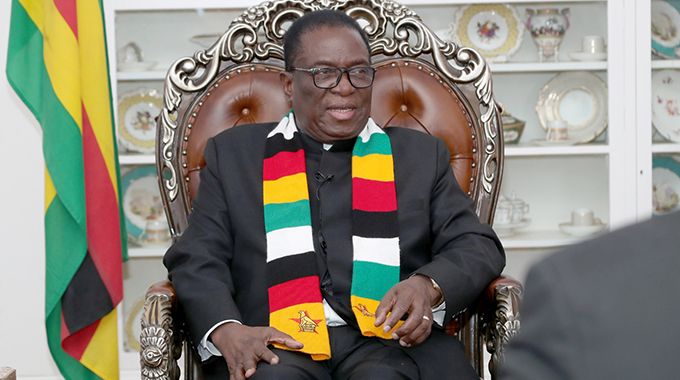
In a wide-ranging exclusive interview on Friday with a team of senior State media journalists at State House in Harare, President Mnangagwa said he was a firm believer in collective decision-making.
“At the end of the day, it wasn’t an idea of an individual. It’s the collective evolution of our political system. You cannot attribute this to a particular individual or group of persons, but a collective evolution of the political process,” said the President in an interview that will also be aired by the national broadcaster, ZBC TV, today.
“As things evolve, you decide what is good for your country at a particular time. And there is no time when individual views — individualistic views — take the centre stage and leave a country. Generally, I believe that whatever we do, it must be a collective decision. I carry my Cabinet and the country on whatever decision we make. I don’t believe in individual persuasion or individual systems where the needs of or the wishes of an individual take the day. No. I believe that whatever we do, it must be a collective decision so that whenever that decision is being challenged, it’s not only you who stands up to defend, but the entire system of Government defends what we decide.”
President Mnangagwa said the country’s political leadership continues to do its best, both individually and collectively, to consolidate unity and “embrace the systems which we have ourselves decided to have for our Government so that everybody is on board”.
“We continue to do our best, individually and collectively, to consolidate and embrace the systems which we have ourselves decided to have for our Government so that everybody is on board. There is not a single person or leader who says he is wiser than everybody else, but collective ideas produce collective wisdom of a country. So, I believe in a collective persuasion of the country.”
The latest constitutional reforms are designed to create a more stable political environment capable of sustaining long-term development programmes.
By extending the tenure of both the Executive and Legislature, the Government seeks to create longer planning horizons that enable uninterrupted execution of national programmes.
President Mnangagwa also attributed the success the country has realised over the past eight years to the resilience and focus of Zimbabweans, adding that he felt “very proud” of leading a country where people were well-organised, hard-working and self-motivated at every level of society.
“Because it would be a misnomer if we believe that the success we are achieving is a result of the wisdom of leadership. No. It’s a result of the resilience, focus of our own people. I think an atmosphere has been created for people, individually and collectively or as groups, to do their best for their country, individually and collectively. So, collectively, our country is moving forward,” he said.
“To be honest, I feel that I am privileged as President of this country, because wherever I go, you find that our people, at every level, are committed to developing the country. You can go in any part of this country, there is no part of the country — village, district or province — which has no programmes. They have programmes, they have targets, which they set by themselves. What else would you want as a leader? I feel very proud. I can sleep comfortably with the type of country I lead.”
Ban on unprocessed minerals and irrigation development
The President also expressed his views on mining and agriculture, sectors that have been key in driving local economic growth, describing the recent policy to ban the export of unprocessed minerals as an unavoidable intervention meant to ensure that Zimbabwe is the primary beneficiary of its mineral resources.
“We have not set up timelines for making sure everything is beneficiated, but that is the goal to achieve because it requires resources,” he added.
“What is important is that we are following a correct path for benefitting the country on the basis that these resources should benefit the country mostly than those to whom we will sell our resources to … We succeed as a country, fail as a country. We don’t need to emulate the failures of other countries or the successes of other countries. What we need to do is to do the best for our country on the basis of the resources and the skills that we have, and the vision as a country which we have and what we need to achieve. That is the platform from which we develop our country.”
President Mnangagwa also said he was optimistic the country will be able to achieve its target of putting 496 000 hectares under irrigation, as the country continues making strides to switch from rain-fed agriculture to insulate itself from the growing threat of climate change.
“In my perspective, I think they are achievable. I don’t know people like you. Do you think that they are achievable?”
Returning citizens from South Africa
On Zimbabweans who are returning home in the wake of growing anti-immigrant protests in South Africa, the President said Government was doing everything in its power to facilitate their transportation and welfare. He also said there hasn’t been any reports of challenges in reintegrating children of returnees in local schools.
“Government is not facing any problem at all. We do facilitate their transport, their welfare, we do that … We facilitate and they go to their homes. And whatever facilities we give to people already in the country, they will also enjoy those services we are giving. So, there is no problem at all. Every Zimbabwean who is in diaspora is welcome back home. We want them back home. They are our people,” he added.
“I have not received any complaint from the education system that they are overwhelmed by the children who are coming from across. Until I receive that, then I will see what to do. But for now, no complaint has come.”
Anti-immigrant sentiment, President Mnangagwa said, was being fanned by “small groups”.
“To be honest, I don’t think I am aware of any Government on the continent which supports that. These are small groups who do such things. But, generally, we are Pan-Africanists, we accept ourselves as Pan-Africanists wherever we are.”