Online Reporter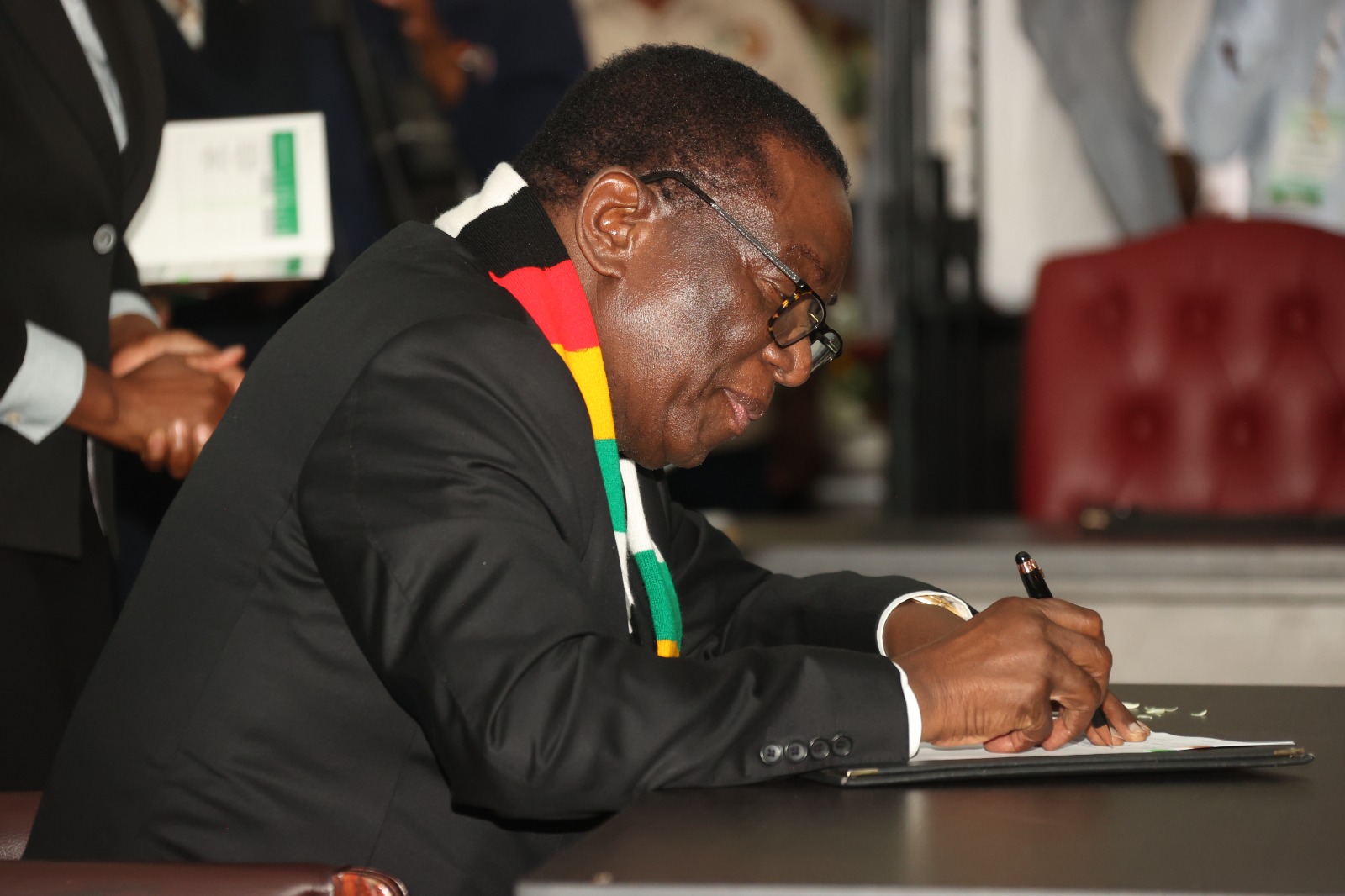
Gibson Mhaka [email protected]
PRESIDENT Mnangagwa’s assent to the Constitution of Zimbabwe Amendment (No. 3) Act marks more than the conclusion of a legislative process.
It represents the culmination of one of the country’s most exhaustive constitutional exercises since the adoption of the 2013 Constitution.
The signing of the Act this week closes a constitutional chapter that began in February when the Bill was gazetted and opens another that will undoubtedly shape Zimbabwe’s constitutional, political and governance architecture for generations.
For supporters, the enactment is not simply about changing constitutional provisions.
It is about affirming the supremacy of constitutional processes, parliamentary democracy and public participation as envisaged under the Constitution itself.
Perhaps more significantly, it has demonstrated that constitutional reform in Zimbabwe can proceed through established democratic institutions despite political contestation, legal scrutiny and relentless public debate.
Throughout the life of the Bill, there were predictions from some quarters that the proposed amendments would plunge the country into political turmoil.
Others forecast widespread unrest, instability and violent confrontation as Parliament considered the legislation.
Those predictions never materialised.
Instead, Zimbabwe witnessed perhaps the very opposite.
The constitutional amendment travelled through every stage prescribed by law — from gazetting, mandatory public consultations, committee hearings, parliamentary debate, Senate scrutiny, recommittal to the National Assembly and finally Presidential assent.
The process unfolded within the framework of the Constitution itself.
For those who had predicted constitutional chaos, the eventual signing of the Act has left them with a proverbial egg on their faces.
Rather than constitutional disorder, Zimbabwe produced constitutional order.
Rather than political violence, the country witnessed legislative engagement.
Rather than institutional collapse, constitutional institutions functioned exactly as they were designed to do.
That reality is perhaps one of the defining political messages emerging from the enactment of Amendment No. 3.
Equally significant is the manner in which Parliament approached the Bill.
Far from being a rubber-stamping exercise, legislators spent months interrogating every clause.
The constitutional amendment became one of the most debated pieces of legislation in recent years.
Members debated deep into the night.
Parliament repeatedly suspended its Standing Orders to extend sittings beyond normal hours.
Legislators sacrificed weekends and Friday adjournments.
Some sessions stretched until midnight to ensure every Member wishing to contribute was afforded the opportunity to do so.
More than 200 Members debated the Bill in the National Assembly before it eventually secured the constitutionally required two-thirds majority.
When first presented, the Bill attracted 216 affirmative votes—well above the constitutional threshold required to amend the supreme law.
Following Senate amendments, it returned to the National Assembly, where it received even stronger backing, securing 226 votes.
The Senate itself overwhelmingly endorsed the legislation by 75 votes to four.
Those margins tell an important political story.
They reflected not only parliamentary arithmetic but also the broad political consensus that ultimately emerged around the legislation after months of consultation and refinement.
Central to that process was public participation.
Zimbabwe’s Constitution places considerable emphasis on consultation before constitutional amendments.
In compliance with those provisions, Parliament embarked on nationwide public hearings that traversed every province, gathering citizens’ views from communities across the country.
For three months, Zimbabweans were allowed to scrutinise the proposed amendments before Parliament formally deliberated on them.
This mandatory 90-day consultation period became one of the defining features of the process.
It was during these hearings that citizens expressed support, reservations and recommendations on various clauses.
Importantly, Parliament did not merely collect those views as a procedural formality.
Several provisions were amended or abandoned altogether precisely because legislators listened to citizens and reflected their concerns.
One of the clearest examples involved the proposed political rights for traditional leaders.
During consultations and parliamentary debate, concerns emerged that granting such provisions could undermine the constitutional principle requiring chiefs and traditional leaders to remain politically neutral.
Government listened.
The clause was withdrawn.
Another notable example involved the proposed abolition of the Zimbabwe Gender Commission.
Concerns were raised regarding the important constitutional role played by the Commission in advancing gender equality and protecting rights.
Again, Parliament responded.
The provision was removed from the Bill.
These concessions illustrate perhaps the strongest evidence yet that public participation was neither cosmetic nor symbolic.
It influenced the final shape of the legislation.
In many respects, this gives practical meaning to President Mnangagwa’s often-repeated declaration that the people’s voice ultimately guides national decision-making.
For years, the President has consistently maintained that Government policies should derive legitimacy from the wishes of citizens.
The passage of Amendment No. 3 now stands as perhaps the most significant constitutional demonstration of that philosophy.
Citizens spoke during consultations. Parliament listened. Government adjusted.
The President assented.
That constitutional sequence reflects an important democratic principle.
The law that has now come into force is therefore not identical to the Bill first gazetted months ago.
It is a product refined by public engagement, parliamentary oversight and legislative compromise.
That reality significantly weakens assertions by critics who portrayed the amendment as a predetermined exercise immune to public influence.
If anything, the legislative history tells the opposite story.
The Bill changed because the people spoke.
Justice, Legal and Parliamentary Affairs Minister Ziyambi Ziyambi repeatedly defended the legislation in both
Houses while also accepting amendments where persuasive constitutional arguments were advanced.
Such flexibility is an often-overlooked feature of parliamentary democracy.
Good legislation evolves.
It is tested. It has improved. It responds to scrutiny.
That is precisely what happened during consideration of Amendment No. 3.
The Act introduces several significant constitutional reforms.
Among them are extending the presidential electoral cycle from five years to seven years, providing for Parliament to elect the President following general elections, establishing a Delimitation Commission, returning voter registration functions to the Registrar-General and refining institutional responsibilities involving the Judicial Service Commission and the appointment of the Prosecutor-General.
Whether one supports or opposes every individual amendment, there can be little dispute that the Act represents one of the most consequential constitutional reforms since 2013.
History will almost certainly record this week as one of Zimbabwe’s defining constitutional moments.
Few constitutional amendments fundamentally reshape governance architecture.
Amendment No. 3 unquestionably does.
Equally noteworthy is what this legislative process says about Zimbabwe’s constitutional maturity.
Constitutional democracies are ultimately judged not by the absence of disagreement but by how institutions manage disagreement.
Zimbabwe’s institutions were tested.
Parliament debated, the Senate scrutinised, Committees consulted and Government conceded where necessary.
Opposition legislators voiced objections, votes were taken and the Constitution prescribed the procedures.
Those procedures were followed, the President signed and the rule of law prevailed.
For supporters of the legislation, this sequence reinforces confidence in constitutional institutions.
For political observers, it illustrates that major constitutional questions can be resolved through Parliament rather than political confrontation.
That may well become one of the enduring legacies of Amendment No. 3.
There is also an unmistakable political message emerging from the process.
The overwhelming parliamentary support for the Bill contrasted sharply with the dire predictions made by some of its opponents.
Instead of instability, Zimbabwe experienced legislative certainty.
Instead of institutional paralysis, constitutional mechanisms functioned uninterrupted.
Instead of violence, parliamentary votes determined the outcome.
The predictions of impending disorder now stand contradicted by events themselves.
In politics, outcomes often speak louder than rhetoric.
The enactment of Amendment No. 3 therefore leaves its critics confronting a political reality that differs markedly from the scenarios they projected.
Ultimately, constitutions are living instruments. They evolve as societies evolve.
Zimbabwe’s constitutional journey did not end in 2013 nor does it end with Amendment No. 3.
Rather, the latest reforms become another chapter in the country’s continuing constitutional development.
For President Mnangagwa, the signing of the Act represents the fulfilment of a lengthy legislative process anchored, in Government’s view, on consultation, parliamentary deliberation and constitutional compliance.
For Parliament, it represents one of its most demanding legislative undertakings.
For Zimbabwe, it marks a historic constitutional milestone whose significance will be studied by lawyers, historians and political scientists for decades to come.
Above all, the passage of Constitution Amendment (No. 3) into law reinforces one enduring political message that has become synonymous with President Mnangagwa’s leadership philosophy: the voice of the people is the voice of God.
It is important to note that whatever one’s political persuasion, the journey from public hearings to parliamentary debate, Senate approval and Presidential assent demonstrates that citizens’ views shaped the outcome.
In that respect, Amendment No. 3 will be remembered not merely as another constitutional amendment, but as a landmark moment in Zimbabwe’s evolving constitutional democracy, where public participation found expression in the supreme law of the land.