Online Reporter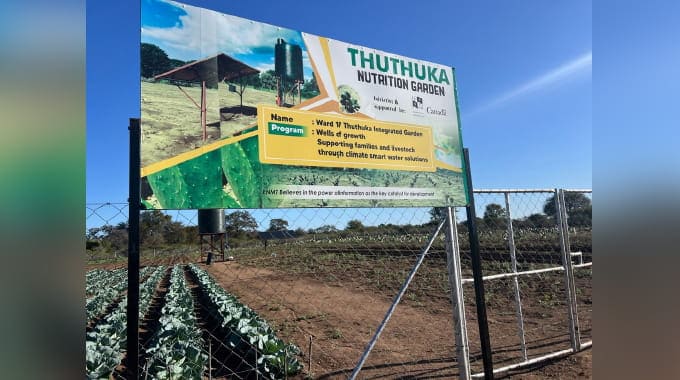
Sukulwenkosi Dube-Matutu [email protected]
FOR years, members of Thuthuka Nutrition Garden in Magaya Village, Ward 17, lived with a challenge familiar to many communities across Matabeleland South: water shortages.
Keeping vegetables alive was difficult enough. Protecting livestock during drought years was even harder.
Today, however, a different picture is emerging at the garden. Rows of cabbage and chomolia still fill parts of the plot, but alongside them is a crop that many local farmers would never have imagined growing a few years ago: spineless cactus.
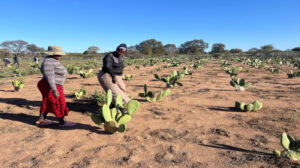
The hardy plant is now at the centre of an initiative aimed at helping farmers keep their livestock alive during droughts while adapting to the growing impact of climate change.
For the 37 members who make up Thuthuka Nutrition Garden, the project represents more than agricultural experimentation. It is an attempt to find practical answers to problems that have become increasingly common in recent years.
In a district where dry spells are frequent and grazing areas often deteriorate before the rainy season arrives, livestock can quickly lose condition. Farmers regularly watch their animals travel long distances in search of water and pasture, only to return weaker.
It was against this backdrop that the Edward Ndlovu Memorial Trust (ENMT), with support from the Canadian Fund for Local Initiatives (CFLI), introduced the cactus project to the community.
The intervention started by addressing one of the garden’s most pressing challenges: water.
A borehole at the site was solarised and connected to a piped water system, ending years of reliance on manual water pumping. The improvement has made it easier for members to irrigate their crops and has opened the door to new farming activities.
Thuthuka Garden treasurer Ms Thambulo Ndou said the introduction of cactus came as a surprise to many members.
“We were used to the production of horticultural crops and other fodder crops, and then we were introduced to cactus. We were equipped with knowledge and skills to produce cactus, its importance and benefits. We are hopeful that this plant will play a crucial role in preserving our livestock, especially this year when the country is expected to experience a Super El Niño,” she said.
Like many farmers in Matabeleland South, members of the garden have witnessed how changing weather patterns can devastate livestock production. Poor grazing conditions, shrinking water sources and prolonged dry periods have become recurring concerns.
As a result, a plant that can survive with little water and remain productive throughout the year is attracting growing interest.
Unlike conventional fodder crops, spineless cactus thrives in harsh conditions. It remains green long after other vegetation has dried up and requires far less water to establish and maintain.
That makes it particularly suitable for semi-arid areas such as Gwanda.
For garden member Ms Prisca Ncube, the project has highlighted just how much things have changed at the nutrition garden. Before the infrastructure upgrade, members relied on a hand-operated borehole and carried buckets of water to irrigate their crops. The work was physically demanding and often limited production.
Watering large portions of the garden was difficult, and crops frequently suffered.
The solar-powered water system has dramatically reduced that burden, allowing members to focus on production rather than spending hours fetching water.
ENMT director Mr Michael Moyo said the cactus project forms part of a wider climate-smart agriculture programme designed to help communities cope with climate-related challenges.
Livestock production, he said, was one area that required urgent attention.
“One of the challenges that we realised under livestock production is that animals lose a lot of weight in search of water,” he said.
“We are saying farmers can feed livestock on cactus as it has an abundance of water. Research has shown that animals eat more water than they drink, and from cactus they can get the needed water.”
The thinking behind the project is straightforward.
Because spineless cactus contains large amounts of moisture, animals can obtain both feed and water from the same source. This reduces pressure on already strained water supplies while helping livestock maintain their condition during periods when natural grazing is scarce.
In practical terms, that means cattle and goats do not have to travel far in search of water, conserving energy and reducing stress.
Mr Moyo said one of the major advantages of cactus is its adaptability.
It can grow in different soil types, survives under dry conditions and requires minimal maintenance once established. Farmers can continue producing their traditional crops while setting aside a small area for cactus cultivation.
The crop also has year-round value. Unlike seasonal fodder, cactus remains available throughout the year. Its flattened stems, known as cladodes, can be harvested and fed directly to livestock when grazing conditions deteriorate.
According to Mr Moyo, the plant can replace up to half of an animal’s water requirements, making it particularly valuable during drought periods.
The project follows training conducted with the assistance of goat specialists from Matopo Research Station, who have been working with communities affected by recurring droughts.
“It acts as a feed and water supplement for livestock, based on research that was conducted at Matopo Research Station. It is a pilot project that we are conducting,” he said.
While livestock feeding is the immediate focus, the project’s supporters believe the cactus has the potential to deliver wider economic benefits.
The plant can be processed into beverages, used in medicinal products and incorporated into food preparations. These possibilities could create opportunities for value addition and small-scale business ventures within rural communities.
Farmers are also being encouraged to sell cactus planting material to others.
As interest grows, the sale of cladodes could become an additional source of income while helping spread the technology to neighbouring areas.
Behind the success of the project is a strong element of community ownership.
After conducting a needs assessment, ENMT identified water as the greatest obstacle facing the garden. That assessment ultimately led to Thuthuka Garden being selected for CFLI funding in 2025.
The support package included a 10 000-litre storage tank, solar panels, a tank stand, submersible pump, electric cables, poly pipes and other equipment needed to improve the garden’s water supply system.
Community members also made their own contributions to ensure the project succeeded.
“Members contributed some additional equipment, which included 100 metres of poly pipe, 32 metres of electric cable, cement, bricks and labour. Garden members and the entire community contributed additional material and labour for project completion,” he said.
Standing at the garden today, it is easy to see rows of vegetables and newly planted cactus. What is less obvious is the sense of optimism taking root alongside them.
For the people of Magaya Village, the spineless cactus is not being viewed as a miracle crop. Rather, it is another tool in the fight against an increasingly unpredictable climate.
In a part of the country where drought has become an ever-present reality, that may prove to be its greatest value. The plant offers farmers something they desperately need: a chance to stay one step ahead of the next dry season, instead of simply reacting when it arrives.