Chronicle Editor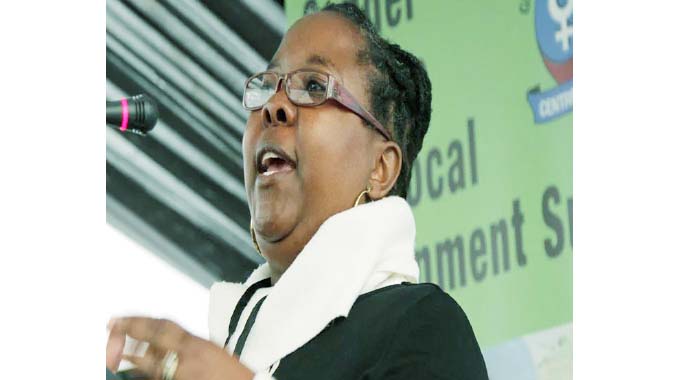
Leonard Ncube, Victoria Falls Reporter
THE Zimbabwe Gender Commission (ZGC) has implored the country’s electoral body to be sensitive to needs of women and youth when carrying out delimitation of voting areas.
The Zimbabwe Electoral Commission (Zec) recently closed registration of voters for the purposes of delimitation although citizens who have not registered for next year’s national elections are encouraged to do so at the 63 Zec offices countrywide.
The electoral commission is carrying out pre-delimitation activities and the process will be completed once a report of the recent population and housing census is released.
Delimitation of constituencies, wards and other electoral boundaries is done in terms of provisions the Constitution and Electoral Act to come up with a threshold of registered voters in each of the country’s 210 National Assembly constituencies and 1 958 wards.
The exercise could see constituencies with low number of registered voters being merged with others while some could be split into more than one, subject to the number of registered voters.
ZGC is concerned that while women constitute the majority of voters, the delimitation exercise may not consider gender issues.
The delimitation exercise affects services like water, sewer provision, health, housing and transport which constitute much of gender issues affecting women.
Speaking after a recent meeting hosted by Zec to consult stakeholders and apprise them of the impending delimitation, ZGC chief executive Mrs Virginia Muwanigwa said electoral processes should be sensitive to gender issues.
“As Zimbabwe Gender Commission our interest around delimitation is actually informed by Section 161 (6)(c) which talks about communities of interest where we are talking about gender as we look at men, women and youth.
“We want to understand to what extent the delimitation exercise will result in an outcome where the constitutional benchmark of 50 percent parity will be realised,” said Mrs Muwanigwa.
She said since 2013 elections have consistently not retained the 50 percent representation for women as one group.
“We want all electoral processes to prioritise gender dimension as a very important factor considering particularly that when you look at the statistics in terms of the people who are registering, the majority voters are women,” she said.
More than 200 000 citizens registered as new voters since the start of the mobile voter registration a few months ago and of these, 53.82 percent are female and 46.18 percent are male.
There are more than five million registered voters in the country.
The Gender Commission a few months ago partnered United Nations Entity for Gender Equality and Empowerment of Women (UN- Women) and Women Rise in Politics (WRIP) to come up with a mentorship programme to encourage more women to participate in politics and address the country’s political domain.
According to ZGC, the political domain is infested with gender intolerance manifested through violence, name calling, body shaming, sexual exploitation, and harassment, stereotyping and systematic exclusion-predominantly against women.
The programme targets the 2023 elections and beyond and was necessitated by the decrease in the participation and representation of women in past national elections.
Women hold only 23 percent of elective parliamentary seats, 13,3 percent of local Government seats and 48 percent of Senate.
Amendment No. 2 of the Constitution effected last year extended the women quota in Parliament while reserving a 30 percent quota for them in local authorities as a way of boosting participation in the 2023 national elections.
Zec deputy chairman Ambassador Rodney Simukai Kiwa said there is a need for a shared vision on the delimitation exercise to inform how issues of gender mainstreaming can be addressed.
– @ncubeleon



 Online Reporter