Online Reporter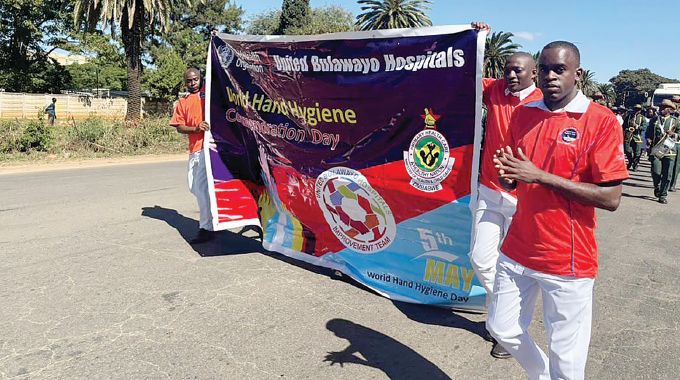
Tanaka Nkala, [email protected]
THE United Bulawayo Hospitals (UBH) yesterday joined the global community in commemorating World Hand Hygiene Day, observed annually on May 5, with a strong call for consistent hygiene practices to prevent infections and save lives.
This year’s commemorations, held under the theme “18 Years of Save Lives: Action Saves Lives,” began with a march from Ascot to the hospital, drawing healthcare workers, students and stakeholders in a show of commitment to infection prevention and control.
Speaking during the event, Infection Prevention and Control chairperson Dr Michael Drau emphasised that hand hygiene remains one of the simplest yet most effective measures in healthcare.
“Hand hygiene must become part of everyday practice. Before touching a patient, before any procedure, after exposure to body fluids, after touching a patient and after touching patient surroundings, these are critical moments where handwashing or sanitising is essential.”
Dr Drau highlighted that healthcare-associated infections can largely be prevented through proper hygiene, noting that even developed countries continue to prioritise strict hand hygiene protocols to reduce infection rates.
He encouraged healthcare workers to adopt a culture in which sanitising or washing hands becomes automatic, stressing that prevention is more effective and less costly than treatment.
Representing the Infection Control Association of Zimbabwe (Icaz), Bulawayo branch chairperson Sister Beatrice Gara from Mater Dei commended UBH for consistently hosting the annual commemoration in line with global standards set by the World Health Organisation (WHO).
“Zimbabwe has consistently joined the international community in marking this day and this year represents the 18th anniversary of the ‘Save Lives: Clean Your Hands’ campaign,” she said.
Sister Gara described hand hygiene as the cornerstone of infection prevention, tracing its significance back to 1847 when Hungarian physician Ignaz Semmelweis demonstrated that mandatory handwashing among medical staff drastically reduced maternal mortality rates at Vienna General Hospital.
She also referenced the Covid-19 pandemic, noting that it reinforced the importance of hand hygiene across communities and healthcare institutions alike.
“The pandemic highlighted the critical need for rigorous hand hygiene compliance. It showed us that simple actions like washing hands can significantly reduce the spread of infections,” she said.
Sister Gara further revealed that the WHO is advocating for hand hygiene to be adopted as a national key performance indicator across all referral hospitals by 2026.
“This would allow for better monitoring and improved quality of care across healthcare facilities,” she said.
Sister Gara also raised concern over rising antimicrobial resistance, linking it to poor infection prevention practices.
She noted that Zimbabwe has since revised its National Antimicrobial Resistance Action Plan (2025–2030) to incorporate a One Health approach, which recognises the connection between human, animal and environmental health.
“A core objective of this strategy is to optimise hand hygiene and reduce the transmission of multi-drug resistant organisms in healthcare settings,” she said.
The commemoration concluded with an awards ceremony recognising various hospital departments for excellence in cleanliness and hygiene, reinforcing the importance of maintaining high standards in infection control practices.