

 admin
admin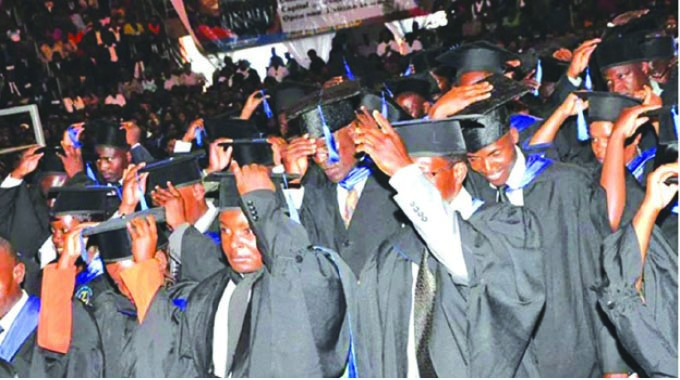
Latwell Nyangu
Youth Interactive Writer
The journey of graduates can be understood through various pathways they may take after completing their education.
Undoubtedly, these pathways are influenced by an individual’s aspirations, societal needs and the evolving landscape of the job market.
Many graduates choose to continue their education by pursuing advanced degrees such as masters’ or doctoral programmes.
This decision is often motivated by a desire to deepen their knowledge in a specific field, engage in research, or enhance their career prospects.
Different fields, including academia, frequently attract students seeking further specialisation.
Imagine that more than 10000 students in Zimbabwe graduate each year with a variety of degrees with the intention of entering the workforce.
If we consider the average graduate’s brain as a fountain of knowledge, skills and experience, combining these would theoretically create a vast pool of cognitive resources.
The human brain is capable of processing complex information and generating innovative solutions and when multiple brains are combined, the collective cognitive capacity could be significantly greater than that of any individual.
This could lead to enhanced creativity and problem-solving abilities due to the diversity of thought processes and perspectives.
Combining the brains of all graduates would necessitate a new framework for collaboration.
A critical aspect of combining graduates’ brains would involve integrating diverse fields of knowledge. Graduates come from various disciplines, science, arts, humanities and engineering and each brings unique insights that can contribute to holistic understanding and innovation.
I am a little analytical this week since I want to find out where the best graduates are heading and what would happen if we could bring together all of the brightest minds graduating.
I have been talking to myself a lot over the past weeks about where other students will work, who will provide them opportunities, and who will offer them jobs.
As I considered all of life’s possibilities, I calculated a unique amount by multiplying 10000 graduates by five brains.
At least 10000 graduates gave me a total of 50000 brains.
With 50 000 brains, can we not change our communities for the better? To be honest, I asked myself again, that of over 50 000 brains every year, where are they all going?
The University of Zimbabwe has an enrolment range of 20000-24999 students and over 2500 students graduate each year with degrees, masters and doctorates.
In 2024, the university’s 43rd graduation ceremony capped a record 6778 graduates and fortunately, these students were the first to graduate under the Second Republic’s Heritage-Based Education 5.0 programme, which was launched in 2020.
It is my hope to see a generation who will combine forces for the sake of improving their lives through collaborative minds.
Surprisingly, some students go to college for the sake of going with no hope of a big picture.
At some point, I even asked some students why they were attending university.
The percentage varied with some saying they wanted to change homes while others were at college due to pressure.
A few claimed they were at college by default.
Some other students are forced to go to college while we have another crop of students who are in serious chase of better days.
But it is my wish that, every student gets a job after graduating but at times all those dreams will not ago according to our expectations.
Of course, there is need for the creation of opportunities for all graduates and it has to be like that but sometimes, waiting can be a disadvantage.
When students come together for a noble cause, they harness the strength of collective action.
In contemporary education, the concept of students collaborating is increasingly recognised as a powerful approach to enhancing learning outcomes.
This collaborative learning model emphasises the importance of teamwork, peer interaction and shared responsibility in the educational process.
When students unite for development, they benefit from diverse perspectives and ideas.
Each group member brings unique strengths and experiences that can enrich the learning experience.
For instance, a student who excels in mathematics, chemistry, medicines, development, arts, among other faculties, can contribute strong different skills to enhance development and solving a problem.
This diversity fosters an environment where all graduates feel valued and empowered to contribute.
Fellow students, collaborative among graduates encourage critical thinking as students must articulate their thoughts clearly and consider alternative viewpoints.
When students work together towards common goals, they create a supportive community that fosters trust and respect among peers.
This environment reduces anxiety associated with life after college since students feel they have allies who share similar challenges.
A supportive atmosphere encourages risk-taking in real life.
Education traditionally focused on rote memorisation and standardised testing has often neglected the broader aspects of student development.
A holistic approach recognises that students are not just vessels for knowledge but individuals with diverse needs and capabilities. This perspective emphasises the importance of nurturing social and emotional skills alongside academic achievements.
The need to think beyond academics is particularly pressing in discussions about educational equity.
Many students come from backgrounds where access to resources is limited and by focusing solely on academic performance, universities may overlook the unique challenges faced by these graduates.
A more inclusive educational model considers various pathways to success, recognising that different students may excel through different means be it artistic expression, technical skills, or leadership abilities.
We need to encourage each other to think beyond academics so that we instil a mindset of lifelong learning. When education encompasses various forms of knowledge—academic, practical, emotional—it fosters curiosity and a desire for continuous growth.
This approach helps students understand that learning does not end with formal education but rather, it is an ongoing process that extends into all areas of life.
May God bless us as graduates so that we change the world through our collaborative means.
Until we meet for a toast.
Feedback: [email protected]



 Online Reporter